Loading...

This is default featured post 1 title

Go to Blogger edit html and find these sentences.Now replace these sentences with your own descriptions.This theme is Bloggerized by Lasantha Bandara - Premiumbloggertemplates.com.

This is default featured post 2 title

Go to Blogger edit html and find these sentences.Now replace these sentences with your own descriptions.This theme is Bloggerized by Lasantha Bandara - Premiumbloggertemplates.com.

This is default featured post 3 title

Go to Blogger edit html and find these sentences.Now replace these sentences with your own descriptions.This theme is Bloggerized by Lasantha Bandara - Premiumbloggertemplates.com.

This is default featured post 4 title

Go to Blogger edit html and find these sentences.Now replace these sentences with your own descriptions.This theme is Bloggerized by Lasantha Bandara - Premiumbloggertemplates.com.

This is default featured post 5 title

Go to Blogger edit html and find these sentences.Now replace these sentences with your own descriptions.This theme is Bloggerized by Lasantha Bandara - Premiumbloggertemplates.com.

Showing posts with label buddhists in space. Show all posts

Monday, January 14, 2013

Discovery of 42 alien planets

Elizabeth Howell (Space.com, Jan. 12, 2013); Wisdom Quarterly on Buddhist Cosmology

A team of amateurs has discovered evidence for 42 alien planets, including a Jupiter-size world that could potentially be habitable, by sifting through data from a NASA spacecraft.
 
Forty volunteers with the crowd-sourcing Planet Hunters project discovered the new planet candidates, which include 15 potentially habitable worlds and PH2 b, a Jupiter-size planet that the team confirmed to be in the habitable zone of its parent star.
 
This is the second time Planet Hunters project, which is overseen by Zooniverse, has confirmed a new exoplanet discovery. What's more, several candidate planets found by the project may be in the habitable zones of their parent stars. These candidates are awaiting confirmation by professional astronomers.
 
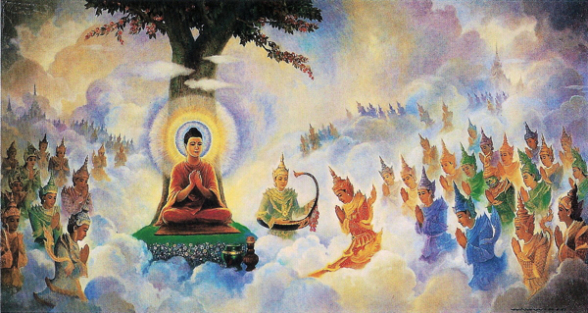
The Buddha teaching in Tavatimsa, "Space World of the Thirty-Three" (mettarefuge)
  
Researchers suggested this bonanza of planets in the so-called Goldilocks zone around a star, a habitable zone in which conditions are liquid water to exist on a planet’s surface and potentially supportlife, could mean there is a "traffic jam" of worlds where life could exist, project officials said.
  
"These are planet candidates that slipped through the net, being missed by professional astronomers and rescued by volunteers in front of their web browsers,” said the University of Oxford's Chris Lintott, who helms the Zooniverse, in a statement. “It's remarkable to think that absolutely anyone can discover a planet.”
  
Life on an "Avatar"-like moon
The planet PH2 b was found using data from NASA's prolific Kepler Space Telescope and confirmed with 99.9 percent confidence by observations at the W. M. Keck Observatory in Hawaii. More

The Buddha taught in Space?
Dhr. Seven, Amber Dorrian, monks of the Los Angeles Buddhist Vihara
  
Yes. The Buddha and many of his monastic disciples frequently visited space. There are many such worlds described. Two spheres of planes are material, one dense and sensual the other fine and ethereal, and those worlds can be reached from here.

Not only were their various forms of conveyance (vimanas) in space (akasha, limitless sky) at the time of the Buddha, but there had been overt extraterrestrial contact many times in the ancient prehistoric past of the planet. (There are long-lived beings who visit and reside on this planet as well as on nearby sectors in space who told the Buddha of the past; however, he was capable of discerning the past independent of their reports).

Mother Maya dreams of conceiving a baby
One spectacular case of the Buddha visiting space is when he went to go visit his biological mother, Maya Devi. She died seven days after his birth and was reborn in space. As Buddhism is divided into three sections (sutras, disciplinary code, and "higher teachings") a question arises as to who formulated the ultimate-teachings known as the Abhidharma.

In the commentaries of the oldest existing Buddhist school, the Theravada ("Teaching of the first generation Elder Disciples of the Buddha"), it is held that the Abhidharma was first taught by the Buddha himself.

Other traditions argue that it was a later addition by monastic commentators systematizing the Teachings. According to legend, shortly after his great enlightenment the Buddha spent a long time in meditation. 
  
During this time he formulated the Abhidharma, a very systematic way of presenting the highest truths or ultimate realities that lead to liberation from ignorance and suffering in this very life.

He later traveled into space -- by his own means (roughly speaking by, for lack of a better term, astral projection that produces a physical counterpart body appropriate to the realm being visited) -- to teach the "heavenly" space beings dwelling there the Abhidharma. This included his deceased mother Māyā, who had been reborn as a male by the name of Maya-deva-putta (which is more description than name, "Maya born among the devas") in a higher "celestial" or akashic (space) world known as Tusita

Buddhist depiction of space worlds
Tradition holds that the Buddha gave daily summaries of the teachings delivered in space to his chief male disciple "foremost in wisdom," Shariputra, who then passed them on to the other monastics (Red Pine, The Heart Sutra: The Womb of the Buddhas, 2004).

The Abhidharma is presented as a pure and undiluted form of the Dharma that was usually too difficult for most (earthling) practitioners of the Buddha's time to grasp. Instead, the Buddha taught by the method related in the various sutras, giving appropriate, immediately-applicable teachings as each situation arose, rather than attempting to set forth the complete Abhidharma in all its complexity.
 
There is a similarity between the Theravada tradition of the Adhidharma and that of the later and larger Mahayana school, which also claimed to be too difficult for the people living in the Buddha's time.

Thursday, January 10, 2013

The Story of Setaketu (Bodhisat)

"The Great Chronicle of The Buddhas" (Maha Buddhavamsa), Tipitakadhara Mingun Sayadaw, edited and translated by U Ko Lay and U Tin Lwi; further intensive editing Wisdom Quarterly

Setaketu (Santusita) in Tusita world
The deva Setaketu, the future Buddha, enjoyed the supreme deva bliss in the [space] abode of Tusita for 4,000 years according to deva-time reckoning (which is equivalent to 576,000,000 years in the human world).
 
Then 1,000 human years before the end of his life-span in the Tusita world, divinities (brahmas) of the Pure Abodes (suddhavasa) proclaimed:

"Friends, 1,000 years from today there will appear in the human world an omniscient buddha!"
 
Because of this proclamation from the vault of the deva world, the uproar (buddha kolahala) announcing the appearance of a buddha, "An omniscient buddha will be appearing! An omniscient buddha will be appearing!" reverberated across the entire human world 1,000 years ahead of the event [Note 1].

The Devas' Request
On hearing the uproar announcing the advent of a buddha, the deva kings of the 10,000 world-systems -- such as the Four Great Sky Kings (near earth orbit rulers), Sakka, Suyama, Santusita (6th Heaven, Para-nimmita-vasavatti), Sunimmita, Vasavatti, and all Great-Brahmas congregated in a certain [galaxy or world-system] to hold a discussion on the Bodhisat (Bodhisattva) whose deva life-span had only seven days remaining, by human reckoning, and whose approaching end of life had become manifest through five predictive signs. 
 
Then they all approached the deva Setaketu with their hands joined in adoration and made this request:
 
"O deva Bodhisat [Buddha-to-be], you have completely fulfilled the Ten Perfections, not with the desire to gain the bliss of Sakka [Michael or Thor, Lord of Lords (of Tavatimsa) and King of Kings (in the Realm of the Four Great Kings], of Mara (in Brahma's Retinue or 7th Heaven), of Brahma (in the Maha Brahma deva loka), or of a Universal Monarch (on Earth). You have fulfilled these perfections aspiring for all-knowing buddhahood in order to acquire for yourself freedom from the three worlds (spheres) as well as to liberate the multitudes of humans, devas ["shining ones"], and brahmas ["creative divinities," supremos].
 
"O deva Bodhisat, this is the most propitious time for you to become an omniscient awakened teacher! This is truly the right moment to become an omniscient awakened teacher! Therefore, take conception in the womb of the human world. And after attaining the supreme enlightenment of a teacher, liberate humans, devas, and brahmas from the round of suffering/rebirth (samsara) by teaching the Dharma of deathlessness: nirvana."

The Five Great Investigations
The deva Bodhisat Setaketu did not hastily consent to the supplication of the devas and brahmas who had come together from the 10,000 world-systems. Instead, in line with the tradition of previous bodhisattas, he made five great investigations:

(1) Is it the appropriate time for the appearance of a buddha?

(2) Is there an appropriate world (dipa, island, continent, planet, light) for the appearance of a buddha?

(3) Is there an appropriate land for the appearance of a buddha?

(4) Is there an appropriate family into which to be reborn (in a final existence)?

(5) Is it the appropriate span of life of a bodhisatta's mother. More

NOTE: With reference to the name of the Buddha-to-be as a deva, it was Santusita according to the chapter on Ratanasankama, Buddhavamsa which in Pali reads: Yada'ham tusite kaye santusito nama'ham tada. Also in the commentary to the Buddhavamsa and Jinalankara Tika the same name is mentioned. But in the exposition of the Pubbenivasa-katha, Veranja-kanda of the Parajika commentary, and in the exposition of the Bhayabherava Sutra of the Mulapanasa commentary, his name is given as Setaketu ["White Banner"]. Moreover, successive authors of Burmese chronicles or Buddhavamsas such as the Tathagata-Udana Dipani, Malalankara Vatthu, Jinatthapakasani, etc., give Setaketu as the name of the deva. Therefore, it has been explained by various teachers that Santusita was a common name derived from Tusita -- the name of the celestial abode (space world) -- whereas Setaketu was the proper name that specifically refers to the deva who would become Prince Siddhartha the Buddha Gautama.

Monday, October 1, 2012

Nazi Buddha from Space (archeology)

Wisdom Quarterly; "Family Guy" (hulu.com); Space.com

Nazi-acquired Buddha statue came from space
Hooded or helmeted space Buddhist (akasha deva)
It sounds like a mash-up of Indiana Jones' plots, but German researchers say a heavy Buddha statue brought to Europe by the Nazis was carved from a meteorite that likely fell [to Earth] 10,000 years ago along the Siberia-Mongolia border.
  
This space Buddha, also known as "iron man" to the researchers, is of unknown age, though the best estimates date the statue to sometime between the eighth and 10th centuries.
   
The carving depicts a man, probably a Buddhist deva, perched with his legs tucked in, holding something in his left hand.
  
On his chest is a Buddhist swastika, a[n ancient worldwide spiritual] symbol of luck that was later co-opted by the Nazi party of Germany.
   
"One can speculate whether the swastika symbol on the statue was a potential motivation to displace the 'iron man' meteorite artifact to Germany," the researchers wrote online Sept. 14 in the journal Meteoritics & Planetary Science.
 
The iron man first came to Germany after a 1938-1939 Tibet expedition by zoologist and ethnology Ernst Schäfer, who was sent to the region by the Nazi party to find the roots of Aryan origin. More

Space is the place; it is where part of our roots are among the many humanoid species.
 
Why were Nazis interested in Buddhist paraphernalia?
Dhr. Seven, Pat MacPherson,  Wisdom Quarterly
"Hitler bad, Vandals good" (msnbc.com).
Inner-circle German "National Socialist" party leaders (referred to by the shorthand Nazis) like Goebbels, Himmler, and the Austrian Vril Society ladies headed by their oracle Maria Orsitch were fascinated by all things occult -- particularly as they related to "Aryans" and beings from space who contacted the party through Vril and other means. Whether these were well meaning entities from Aldebaran, the Nordic goddess (devi) Freyja, the northern quadrant sky/space King Vaisravana, (Vessavana), or sinister titans (asuras), it is hard to say. But Nazis tried to deify their mouthpiece Adolf Hitler (much as Rove was the architect for Bush), a skillful orator kept on drugs that produced delusions of grandeur, in the public eye. They did this by associating him with the myth of Aryan forbears, psychic Madame Blavatsky Buddhist/Theosophical lore, religious symbols (like the iron cross and swastika), vegetarianism, German pagan and Spiritism movement trappings. Modern people, weighed down by their counter-propaganda biases and assumptions, can't be bothered to assimilate the complicated-truth when a compelling-narrative is so much easier to swallow. Why did the Nazis go to Tibet? Why did they send delegations all over the world to inspect extraterrestrial artifacts and bases, particularly in Antarctica? Why did they build saucer-shaped craft and time-traveling bells (Die Glocke)? Why did they try to unite the world under one tyrant?

Thursday, September 13, 2012

Protection from "Bad Spirits" (sutra)

Dhr. Seven, Wisdom Quarterly translation based on Ven. Piyadasi (Atanatiya Sutra, DN 32)
(Mitjoruohoniemi/flickr.com)
 
Space beings, akasha devas (Jasspierxia/flickr.com)
VULTURES PEAK, India - Once upon a time the Buddha was living on Vulture's Peak near Rajgir. The Four Space Kings -- having guarded the four quarters with a large army of ogres (yakkhas), fairies (gandhabbas), gnomes (kumbhandas), and dragons (nagas) and having placed troops and a barricade of soldiers set up on all four sides -- came to the presence of the Buddha when the night was far advanced.
  
Illuminating the entire peak with their surpassing radiance, they saluted him and respectfully sat to one side. From among the (attendant) ogres, some saluted and sat to one side; some exchanged greetings with the Buddha, conversing in a friendly and courteous manner, then sat to one side; some saluted him with clasped hands then sat to one side; some announced their name and lineage then sat to one side; some simply sat to one side in silence.
 
Then the great sky King Vessavana (Sanskrit, Vaisravana), while seated to one side, said to the Buddha:
  
The text's most famous yakkha, Alavaka
"Venerable sir, there are eminent ogres who are not pleased with the Blessed One; there are also eminent ogres pleased with the Blessed One. There are ogres of middle rank who are not pleased with the Blessed One, and there are those who are pleased with the Blessed One. There are ogres of inferior rank who are not pleased with the Blessed One, and there are those who are pleased with the Blessed One. Venerable sir, the ogres as a rule are not pleased with the Blessed One. What is the reason for this?"
  
"Well, the Blessed One teaches the Dharma to establish beings in abstaining from 
  1. killing
  2. stealing
  3. sexual misconduct
  4. false speech
  5. intoxicants that occasion negligence. 
"To them such a teaching is unpleasant and unpalatable."
  
"Surely, venerable sir, there are disciples of the Blessed One. They frequent the remote recesses of forests. There in woodland wildernesses there is no sound, no tumult, where breezes are void of human contact suitable for physical and mental seclusion and quiet contemplation. But there are eminent ogres (yakkhas) who haunt these forests, who have no confidence in the word of the Blessed One.
  
"Venerable sir, may the Blessed One learn the Atanata protection [the name of a town, according to the commentary (Dighanikaya-attakatha-tika, vol iii, p. 194), where King Vessavana and the other sky rulers assembled and recited this protection, which speaks of the virtues of seven Buddhas: Vipassi, Sikhi, Vessabhu, Kakusanda, Konagama, Kassapa, and Gotama] so that the displeased ogres may be pleased, so that the monks and nuns, laymen and laywomen, may be at ease, guarded, protected, and unharmed."
  
Buddha, Thiksey, Ladakh (Hitlersmiles/flickr.com)
The Blessed One gave consent by his silence. Then the great sky King Vessavana, knowing that the Blessed One had consented, recited the Atanatiya protection:
  
Reverence to Seven Buddhas
1. "Homage to Vipassi Buddha possessed of the eye [of wisdom] and splendor. Homage to Sikhi Buddha compassionate towards all beings.
2. "Homage to Vessabhu Buddha free from all defilements and possessed of ascetic energy. Homage to Kakusanda Buddha, the conqueror of [the fivefold] army of Mara.
3. "Homage to Konagamana (the Buddha) who has shed all defilements and had lived the holy life. Homage to Kassapa Buddha who is fully freed from all defilements.
4. "Homage to Angirasa Buddha, the son of the Shakyas, who is full of radiance and who proclaimed the Dharma that dispels all suffering.
5. "Those in the world, who have extinguished (the flames of passion) and have perceived through meditative insight things as they really are, they never slander anyone; they are mighty ones who are free from fear.
6. "Gotama (Gautama) Buddha, dear to devas and men, endowed with knowledge and virtue, mighty and fearless, all do homage to him.
  
7-8. "When the resplendent sun -- offspring of Aditi with its full orb -- arises, then night ceases, and it is called day. From the direction the sun rises (east) there exists the ocean deep and vast.
9. "This spreading sheet of water they know as the ocean [possibly space]. Where there is east (east of Mount Sumeru) they say that quarter is east. [The great sky kings each guard a quarter of the sky/space.]
10. "Guardian of this quarter is the great sky king named Dhatarattha who has a retinue of attendants, and is sovereign lord of the fairies (gandhabbas).
11. "Attended by these angelic beings he enjoys their song and dance. Many are his (Datharatta's) offspring, all of one name, so have I heard.
12-13. "Eighty and ten and one are they, Inda their name, and mighty are they. They too, beholding the Buddha -- Kinsman of the Sun, mighty and fearless -- salute him from afar: "Homage and glory to that one unique and noblest among humans."
14-15. "With sublime wisdom, you have looked on humankind with a knowing eye so that even non-humans pay reverence. This we have often heard. Therefore, we request the ogres (yakkhas) to pay homage to Gotama Buddha, the Conqueror. They too say: 'We pay reverence to Gotama, the Conqueror; we pay reverence to Gotama who is endowed with knowledge and virtue.'"
  
16-18. "The direction from where the ghosts (petas, subtle-body spirits of the dead), backbiters, murderers, fierce brigands, and the deceitful are removed is the direction (to the right of Mount Sumeru) called the south. The custodian of this quarter is the great sky king named Virulha, who has a retinue of attendants. He is the sovereign lord of gnomes (kumbhandas). Attended by the them he enjoys their song and dance.
19. "Many are his offspring, all of one name, so have I heard. Eighty and ten and one are they, Inda their names, and mighty are they.
20. "They too, beholding the Buddha -- Kinsman of the Sun, mighty and fearless -- salute him from afar: 'Homage and glory to you who are unique and highest among humans.'
  
21-22. "By your sublime wisdom you have looked on humankind with a knowing eye so that even non-humans pay you reverence. This we have often heard. Therefore, we request the ogres to pay homage to Gotama Buddha, the Conqueror. They too say: 'We pay reverence to Gotama, the Conqueror; we pay reverence to Gotama who is endowed with knowledge and virtue.'
  
23-24. "When the resplendent sun -- offspring of Aditi with its full orb -- sets, the day ceases, and it is called night. In the direction where the sun sets (the west) there exists the ocean deep and vast.
25. "This spreading sheet of water they know as the ocean (and space). West (of Mount Sumeru) they call the western quarter.
26. "Guardian of this quarter is a great sky king named Virupakkha, who has a retinue of attendants, and is sovereign lord of the dragons (nagas).
27. "Attended by dragons he enjoys their song and dance. Many are his offspring, all of one name, so have I heard.
28-29. "Eighty and ten and one are they, Inda their name, and mighty are they. They too, beholding the Buddha -- Kinsman of the Sun, mighty and fearless -- salute him from afar: 'Homage and glory to you, unique and noblest among humankind.'
30-31. "By your sublime wisdom you have looked on humankind with a knowing eye so that even non-humans pay you reverence. This we have often heard. Therefore we request the ogres to pay homage to Gotama, Buddha the Conqueror. They too say: 'We pay reverence to Gotama, the Conqueror; we pay reverence to Gotama who is endowed with knowledge and virtue.'
32. "In delightful Uttarakuru (north), where towers beautiful Mount Sumeru, there are born humans who are selfless and unattached.
33. "They neither sow seed nor use the plow. Spontaneously grown grain is there for them to enjoy.
34. "The rice, purged of the red powder and of husk, clean and sweet-scented, is boiled in golden vessels; it is this that they partake of.
35. "They make of cows a single-seated mount and ride about from place to place.
36-37. "They make use of women and men, girls and boys as vehicles, and travel from place to place in them.
38. "Mounting vehicles (craft or elephants and horses) they (the ogres under King Vessavana) travel in every direction.
39. "This king who has a retinue of attendants is possessed of elephants and horses on which he rides. He also has celestial chariots [flying craft, vimanas], palaces [larger ships], and palanquins [platforms]. He has cities well built in celestial regions.
  
"These cities are named Atanata, Kusinata, Parakusinata, Natapuriya, and Parakusitanata. To the north, the city of Kapilavata, to the South Janogha, and cities named Navanavati, Ambara-ambaravati, and the kingdom of Alakamanda.

(Addressing the Buddha:) "Happy one, this Kuvera [another name for Vessavana] has a kingdom named Visna. Therefore, the great sky king Kuvera is called Vessavana. There are ogres under this king who hold investigations and make them known. They are Tatola, Tattala, Tatotala, Ojasi, Tejasi, Tatojasi, Suro, Raja (Sura-raja) Arittho, and Nemi (Arittha-nemi). There (in Visana kingdom) lies the lake Dharani where rain-clouds (drawing water) pour them forth. There is also a hall named Bhagalavati where the ogres assemble.
40. "There (around the hall) are trees bearing perpetual fruit. (On these trees) there are multitudes of birds. There also is heard the cry of peacocks and herons and the melodious song of kokilas (the Indian cuckoo).
41. "There (near the lake) the cry of the birds that call out 'Live! Live!' (jivamjivaka) is heard. The bird Otthavacittaka ('O lift your hearts!'), the jungle fowl, the crabs, and the Pokkharasataka birds roam the woods.
42. "There the cry of the parrot, the myna-birds, and the Dandamanavaka birds is heard. And Kuvera's lotus-lake is beautiful through all seasons.
43-44. "That direction (north of Mount Sumeru) is called by people the northern quarter. The guardian of this quarter is a great sky king named Kuvera who has a retinue of attendants. He is the sovereign lord of the ogres. Attended by them he enjoys their songs and dance.
45. "Many are his offspring, all of one name, so have I heard. Eighty and ten and one are they, Inda their names, and mighty are they.
46. "They too -- beholding the Buddha, Kinsman of the Sun, mighty and fearless -- salute him from afar: 'Homage to you unique and noblest among humankind!'
   
47-48. "By your sublime wisdom you have looked on humankind) so that even non-humans pay you reverence. Thus have we heard. Therefore, we request the ogres to pay homage to Gotama Buddha, the Conqueror. They, too, say, 'We pay reverence to Gotama, the Conqueror; we pay reverence to Gotama who is endowed with knowledge and virtue.'
"Happy One, this is the Atanata protection whereby both monks and nuns, laymen and laywomen may live at ease, guarded, protected, and unharmed.
  
"If any monk or nun, layman or laywoman learns by heart this Atanata protection and is word-perfect in repeating it, and if any non-human
  • male or female ogre, youth or maiden ogre, ogre minister, or any ogre, or ogre attendant; 
  • male or female fairy...
  • male or female gnome...
  • male or female dragon... 
"were to walk with him or her, or stand or sit or lie down with him or her with malevolent intent, such a non-human, Happy One, will not obtain hospitality from any town or township, will not obtain a place to dwell, nor live in the Kingdom of Alakamanda. 
  
"Such a one will not be able to attend the meetings of the ogres and furthermore would not be accepted or given in marriage, but instead would be reproached (by casting remarks on his deformed teeth or eyes or any part of the body), and the non-humans would put an empty bowl over such a one's head and split it in seven pieces. [The "splitting of a head into seven pieces" was a common saying in ancient India. It seems to mean that it would be "an unbearable situation."]
 
"Happy One, there are non-humans who are fierce, violent, given to retaliation; those non-humans heed neither the (four) great sky kings nor their ministers nor their attendants. They are called rebels against the (four) great sky kings.
  
"Even as in the kingdom of Magadha [where the Buddha resided], the thieves heed neither the king of Magadha, nor the ministers, nor their attendants, but are called rebels against the king of Magadha, so there are non-humans who are fierce... They are called rebels against the (four) great sky kings.
  
"Happy One, if any non-human -- male or female ogre... fairy... gnome... dragon... were to walk with a monk or nun, or a layman or laywoman, or stand, or sit, or lie down with him or her with malevolent intent, then should (the molested individual) inform, cry aloud, and shout to those ogres, to the mighty ogres, their commanders and chief commanders saying: 'This ogre is seizing me, is taking possession of me, is harassing me, is assailing me, is harming me, harming me intensely and will not let me go!' [then something will be done but] who are the ogres, mighty ogres and commanders, and chief commanders (to whom such appeal should be made)?
49. "Inda, Soma, and Varuna, Bharadvaja, Pajapati, Candana, Kamasettha too, Kinnughandu, Nigahandu,
50. Panada, Opamanna too, Devasata and Matali, Cittasena and Gandhabba, Nala, Raja, Janesabha,
51. Satagira, Hemavata, Punnaka, Karatiya, Gula, Sivaka, Mucalinda too, Vessamitta, Yugandhara,
52. Gopala, Suppagedha too, Hiri, Netti, and Mandiya, Pañcalacanda, Alavaka, Pajjunna, Sumana, Sumukha, Dadamukkha, and along with these Serisakka.
  
"These are the ogres, mighty ogres, the commanders, the chief commanders to whom (the molested person should inform, cry aloud, and shout saying: 'This ogre is seizing me, is taking possession of me, is harassing me, is assailing me, is harming me, and harming me intensely, and this ogre will not let me go!'
  
"This, Happy One, is the Atanata protection whereby monks and nuns, laymen and laywomen may live at ease, guarded, protected, and unharmed.

"Happy One, we now take our leave of you; for we have many duties to attend to" (so said the four great sky kings)."
  
"Great sky kings, it is time for your departure" (replied the Buddha).
  
The four great sky kings arose from their seats and saluting the Buddha respectfully circled around (circumambulated) him staying to his right side, and there and then they vanished. From among the (attendant) ogres some arose from their seats and saluted the Buddha, circled around him on his right side, and there and then they vanished; some exchanged greetings with the Buddha conversing in a friendly and courteous manner, and there and then they vanished; some saluted the Buddha with clasped hands, and there and then they vanished; some announced their name and lineage and there and then vanished; some in silence there and then vanished.
  
The Buddha (bezen.wordpress.com)
When the night had passed the Buddha addressed the monks residing with him: (The Buddha related word for word what King Vessavana said).
  
"Monastics, learn by heart the Atanata protection, and constantly make use of it, bearing it in mind. This Atanata protection pertains to your welfare, and by virtue of it monks and nuns, laymen and laywomen may live at ease, guarded, protected, and unharmed."
  
This is what the Buddha said. Those monks glad at heart rejoiced at the words of the Buddha.

Thursday, August 16, 2012

Who are the "Buddhists from space"?

Dharmacharis Seven and Amber Dorrian, Wisdom Quarterly
The Buddha under, on, above Mt. Sumeru, Axis Mundi, with humans at base (michielkauwatjoecom).
  
 Cave art: sky devas (Jasspierxia)
Who are the "space aliens" (akasha-loka devas) and how could they be Buddhist? As funny as it may sound, there are Buddhists in space. 
  
"Space" (Sanskrit, akasha) refers to the infinite sky. Beings coming from, patrolling, or living in the sky are referred to as akasha devas -- literally, "space shining ones."
  
Not all are devas proper, but it is a general term for superior and longer lived beings. (These are the gods, godlings, and demigods described in religious lore East and West, from pre-Hindu to pre-Christian, in ancient India, Rome, Greece, Egypt, Sumer, and throughout the Near East).
There are also asuras (titans), yakkhas (ogres of a furry bipedal nature), nagas (reptilians), and brahmas (powerful creative beings that have transcended sex). One class of beings who reside two levels up in the space worlds (lokas) above Earth are the subjects of Sakka, Ruler of the Devas. Which devas? Only the limited number in Tavatimsa, the world of the 33 "lords" or rulers of that space plane.
 
His "star command" is good and wishes to benefit humans and the perpetuation of the Buddha's Dharma (path to liberation).
   
He frequently visited the Buddha in his vimana (UFO, space chariot) with his driver and is said to have become a stream enterer, having entered upon the first stage of enlightenment by hearing the Buddha's teaching. There are inimical forces however. And Sakka is said to have asked lesser "angelic" (subordinate space rulers from the four quarters of the sky) messenger beings (devas and gandharvas) to keep an eye on human progress particularly in the arena of virtue.
   
It is said that these "Four Great Kings" (catu-maha-rajikas), who regard Sakka as their king making him "King of Kings," patrol our skies and monitor humanity in that respect apparently with devices that read the heart/mind of humans.
   
These devas or "space aliens," it should be noted, are not hideous reptoids, little green men, or monsters. They are Nordic aliens who mated with humans and thereby enhanced our physical symmetry, beauty, and intelligence as is recorded by countless cultures and spiritual traditions.
   
While all this may seem like utterly ridiculous "mythology," East and West, Wisdom Quarterly tries to keep abreast of actual UFO research, leaks, and discoveries to show how far from the mark we have strayed from what is real and what the modern mainstream media would have us believe.
  
It is only natural that one would doubt and dismiss any talk of angels, aliens, giants, and virtue. And that would be fine if we did not then fail to investigate. After all, the truth is much stranger than our fiction.

Buddhist depiction of deva/"angel (Swanksalot)

Saturday, June 16, 2012

The Buddha's return from Space

Tipitaka.net, Dhammapada 181, edited by Wisdom Quarterly
Higher Buddhist heavens (akasha deva lokas) 20th anniversary Hubble (NASA)
  
SANKASSANAGARA, ancient India - On returning from space, the Realm of the Thirty-Three, the Buddha uttered this verse (181) in reply to Sariputra's welcome. 
  
On one occasion, while at Savatthi, the Buddha performed the "miracle of the pairs" in answer to the challenge of the ascetics of various sects. After this, he went to Tavatimsa. His mother -- who had been reborn in another space realm, Tusita, as the deva Santusita -- also went to Tavatimsa. 
  
There the Buddha met her and expounded the Higher Teachings (Abhidharma) to the devas and the brahmas throughout the three-month Rains Retreat. As a result, Santusita attained the fruition of stream entry along with numerous devas and brahmas
  
Sariputra -- the Buddha's chief male disciple foremost in wisdom -- spent the Rains Retreat at Sankassanagara, 30 yojanas [estimated 210 miles] from Savatthi. While there, regularly instructed by the Buddha, he taught the Abhidharma to the large number of ascetics staying with him. He covered the entire course by the end of the retreat.
   
Towards the end Great Moggallana -- the Buddha's other chief male disciple foremost in psychic powers -- went to Tavatimsa to see the Buddha. He was told the Buddha would return to the human world at Sankassanagara on the full moon day at the end of the retreat. As promised, the Buddha came with his aura's six colored rays shining forth from his body to the city gate during the month of Assayuja as the Moon shone brightly.
   
Butterfly Nebula (NASA/Hubble)
He was accompanied by a large following of devas on one side and a large following of brahmas on the other. A large gathering led by Sariputra welcomed the Buddha as the whole town was lit up.
  
Sariputra was awed by the grandeur and glory of the scene. He reverently approached the Buddha and said, "Venerable sir! We have never seen or even heard of such magnificent and resplendent glory. Indeed, venerable sir, you are loved, respected, and revered by devas, brahmas, and humans alike!"
  
The Buddha replied, "Sariputra, buddhas endowed as they are with unique qualities are truly loved by humans and devas alike." Then the Buddha uttered this verse:

The wise who practice absorbed concentration
and insight meditation [jhana and vipassana]
take delight in the peace of liberation from
sensual pleasures and mental defilements. 
Such wise and mindful ones truly comprehend 
the Four Noble Truths
and are also held dear by the devas.
  
At the end of the discourse the large number of ascetics who were Sariputra's pupils attained full enlightenment (arhatship) and a great many from the congregation attained steam entry (the first stage of enlightenment).

Buddhists in Space: China's female astronaut

Reuters; MSNBC.com
View of Buddhism's First Heaven (catumajhrajika akasha deva loka) near Earth space ESA Christer Fuglesang at ISS STS 128 spacewalk (NASA handout 9-5-09/Reuters)

  
Female astronaut Liu Yang (Jason Lee/Reuters)
China is sending its first woman into outer space this weekend, prompting a surge of national pride as the rising power takes another step toward putting a space station in orbit within the decade. 
   
Liu Yang, a 33-year-old fighter pilot, will join two other astronauts aboard the Shenzhou 9 spacecraft when it lifts off from a remote Gobi Desert launch site on Saturday evening (6:37 pm Beijing time, 6:37 am ET).
   
They will attempt a crew-controlled docking for the first time with the uncrewed Tiangong 1 module, which was launched last September as part of China's exploratory preparations for a space lab. The module is now orbiting 213 miles (343 km) above Earth.
   
Rendezvous and docking exercises between the two vessels will be an important hurdle in China's efforts to acquire the technological and logistical skills needed to run a full space lab that can house astronauts for long stretches.
  
China's aspirations
Last October, China launched a robotic Shenzhou 8 module that successfully performed a remote-controlled docking with Tiangong 1 ("Heavenly Palace") in preparation for this month's crewed mission. Space program spokeswoman Wu Ping told reporters that Shenzhou 9 would make two dockings with Tiangong 1 -- the first by remote control, and the second under manual control. More
A Great Buddhist in Space
Daw Mya Tin, M.A., Dhammapada 219-220 (What-Buddha-Said.net)
While residing at Isipatana, the Buddha uttered these verses with reference to Nandiya, a rich man from Varanasi. After listening to the Buddha's discourse on the benefits of building monastic residences, he built the great monastery at Isipatana. The building was pinnacled and fully furnished. As soon as the monastery was offered to the Buddha, a corresponding "mansion" came up for him in Tavatimsa, deva space world.
   
One day, Great Moggallana visited that space world and saw the mansion. On his return from Tavatimsa, the Heaven of the Thirty-Three, Great Moggallana asked the Buddha:

"Venerable sir, for those who perform meritorious deeds, do they have mansions and other riches prepared in the deva realm even as they live in this world?" 
   
The Buddha replied: "Why do you ask? Have you yourself not seen the mansion and riches awaiting Nandiya in Tavatimsa? The devas await the coming of good and generous beings the way relatives await the return of one long absent. When good ones die, they are welcomed joyously in the abodes of the devas." Then he uttered these verses:

One who has long been absent then
returns home safely from a distance
is welcomed with joy by relatives,
friends, and well-wishers on returning. 

In the same way, one's good karma
will receive one who has done good
when going from this world to another,
as relatives receive a dear one returning.