|
| The Buddha addressing female monastics |
Some believe Buddhism is so lofty and sublime a system that it cannot be practiced by ordinary men and women in our workaday world. Does someone have to retire to a forest monastery or some quiet place if one wishes to be an authentic Buddhist?
This misconception comes from a lack of understanding the Buddha. We jump to such conclusions after casually reading or hearing something about Buddhism. We form impressions of Buddhism after reading magazine articles or books that only give a partial or lopsided view of Buddhism.
Authors of such articles and books only possess a limited understanding of the Dharma, the Buddha's Teaching. It is not meant only for monastics in hermitages or those on retreat. It is for ordinary women and men living at home with families.
 |
| "Little monks," novices (annecam.blogspot.com) |
The Noble Eightfold Path is the Buddhist way of life, and it is intended for all people [regardless of their "religion"]. It was an offering to all humankind without distinction.
The vast majority of people cannot become monks or nuns who retire into caves and peaceful wooded glades. However noble and pure Buddhism may be or seem, it would be useless to the earthlings if we could not follow its guidance and advice in our daily lives in this modern world with all its complexity.
If we understand the spirit of Buddhism, we can surely follow and practice it while living the life of an ordinary "householder."
There may be some who find it easier or more convenient to accept Buddhism by living in a remote place, by cutting themselves off from others. Yet others may find that this kind of retiring into seclusion -- instead of being a means to uninterrupted practice -- actually dulls and depresses their entire being, physically and mentally. It wold therefore not be conducive to the development of any kind of spiritual or even intellectual life.
 Our lives seem so special and different from one another but boil down to an animated short.
Real renunciation does not mean physically running away from the world. We can let go right here. (We often fool ourselves, of course, and never get around to actually letting go).
Sariputta, the Buddha's chief male disciple (whose female counterpart was the nun Khema who was also declared "foremost in wisdom" by the Buddha), said that one might live in a forest devoting oneself to ascetic practices and yet might be full of impure thoughts and "defilements" of the heart/mind. Another might live in a village, town, or city practicing no ascetic discipline yet be purifying the mind/heart freeing it of defilements.
"Of the two," Sariputta explained, "one who lives a pure life in the village, town, or city is definitely far superior to and greater than the one who lives in the forest" (
Middle Length Discourses).
The common belief that to follow the Buddha's guidance one has to retreat from normal family life is a definite misconception. It is actually, when examined carefully, an
unconscious defense mechanism against practicing! And it works.
Nirvana now  |
| Ten Precept nuns (Ragg Burns Imaging/Flickr) |
There are numerous references in Buddhist literature to men and women living ordinary family lives while successfully practicing what the Buddha taught and realizing nirvana.
Vacchagotta the Wanderer once asked the Buddha in a very straightforward way: "Venerable sir, are there laymen and laywomen leading the family life who follow the Dharma successfully and attain high spiritual states?"
The Buddha categorically answered that there are many laypeople leading the household family life who follow this Dharma successfully and attain high spiritual states.
It may be agreeable for certain people to retreat and live a retired life in a quiet place away from noise and disturbances. But it is certainly more praiseworthy and courageous to practice Buddhism wherever one is. Making the excuse that we will begin to practice when conditions are better than they are is a sure way delay and even permanently put off doing good for ourselves, others, and everyone we impact.
It is better to undertake our self-training while living among our fellow beings (often with us because of karma working itself out in mysterious ways), helping them and offering service to the planet. It may perhaps be useful in some cases for a person to live in a hermitage or alone for a time in order to improve mind and character, as a preliminary to training in virtue, spirituality, and intellectual pursuits. (We often do not get a vision quest or any kind of official rite of passage nowadays to graduate from total dependence to full participation in society).
Such preparation makes us strong enough to come out later and help others and recognize how to best help ourselves. But if a person lives all her life in solitude, thinking only of one's own happiness and liberation, without caring for one's fellow travelers through life, it is surely not in keeping with the Buddha's Teaching, which is based as much on loving compassion and serving the interests of ourselves and others as it is on insightful wisdom and having advanced ourselves spiritually to aid us in the many lives to come.
(We are not likely to be conscious of the Dharma, karma, or how life really works for a long, long time. If we have that awareness now, it will be very profitable to advance now to ensure the future we would wish for ourselves in the future. How can I make
that person happy, that person I will be far in the future? If I only worry about this person, I indulge and doubt and shortchange myself terribly!)
What are monastics for?  |
| American nuns (Sylvia Boorstein/Huff Post) |
One might now ask, "If a person can follow Buddhism while living the life of an ordinary householder, why was the Monastic Order, the
Sangha, established by the Buddha?"
The Order provides opportunity for those who are willing to devote their lives not only to their own spiritual and intellectual development, but also to serve others. An ordinary person with a family cannot be expected to give oneself over to an entire life of service to others, whereas a monastic freed of family responsibilities and other worldly ties is in a position to devote oneself "for the good of the many" (Ven. Walpola Rahula, Ph.D. author of
What the Buddha Taught).
What is the "good" that many can benefit from?
 |
| Where in the world can I find reliable guides? |
Monastics can provide spiritual guidance to those troubled by worldly, family, and emotional problems even if they cannot give laypeople material comfort. Monastics devote their lives to the pursuit of knowledge-and-vision of the Dharma taught by the Buddha.
They then explain and inspire untutored laypersons to benefit from what the Buddha taught. And if the layperson is well educated, the monastic is there to discuss the deeper aspects of the Dharma so both can gain insight from the discussion.
In Buddhist countries, monastics are largely responsible for the education of the young. As a result of their contribution, Buddhist countries have very literate populations well-versed in spiritual values without the expense many other nations expend. Monastics also comfort the bereaved, soothing their emotional upset by explaining how all humankind is subject to similar disturbances now as in the time of the Buddha, who also soothed a great deal of grief.
In turn, the laypeople are expected to look after the material well-being of monastics who do not gain income (even if they work from morning to night). Monastics are provided with the basics of life -- food, robes, shelter, and medicine.
In common Buddhist practice, it is considered meritorious to contribute to the health of a virtuous person, such as a monastic, because by so doing one makes it possible for the monastic cultivate virtue, serene concentration, liberating-insight, and to continue to minister to the spiritual needs of the community.
More: Previous - Contents - Next 


 Seeing him, the Buddha requested monastics to accept additional robes for their hardship. One robe in particular, the special kathina robe, was to go to a monastic who had successfully completed the rigors of the Rains Retreat. (At this time those in robes are not allowed to travel or venture from the nunnery/monastery for overnight trips; instead they stay in one place and meditate in a loosely cloistered setting).
 Thereafter Buddhist devotees have provided hermitages with a specially made robe, which is awarded to the one who has most successfully completed the Rains Retreat.
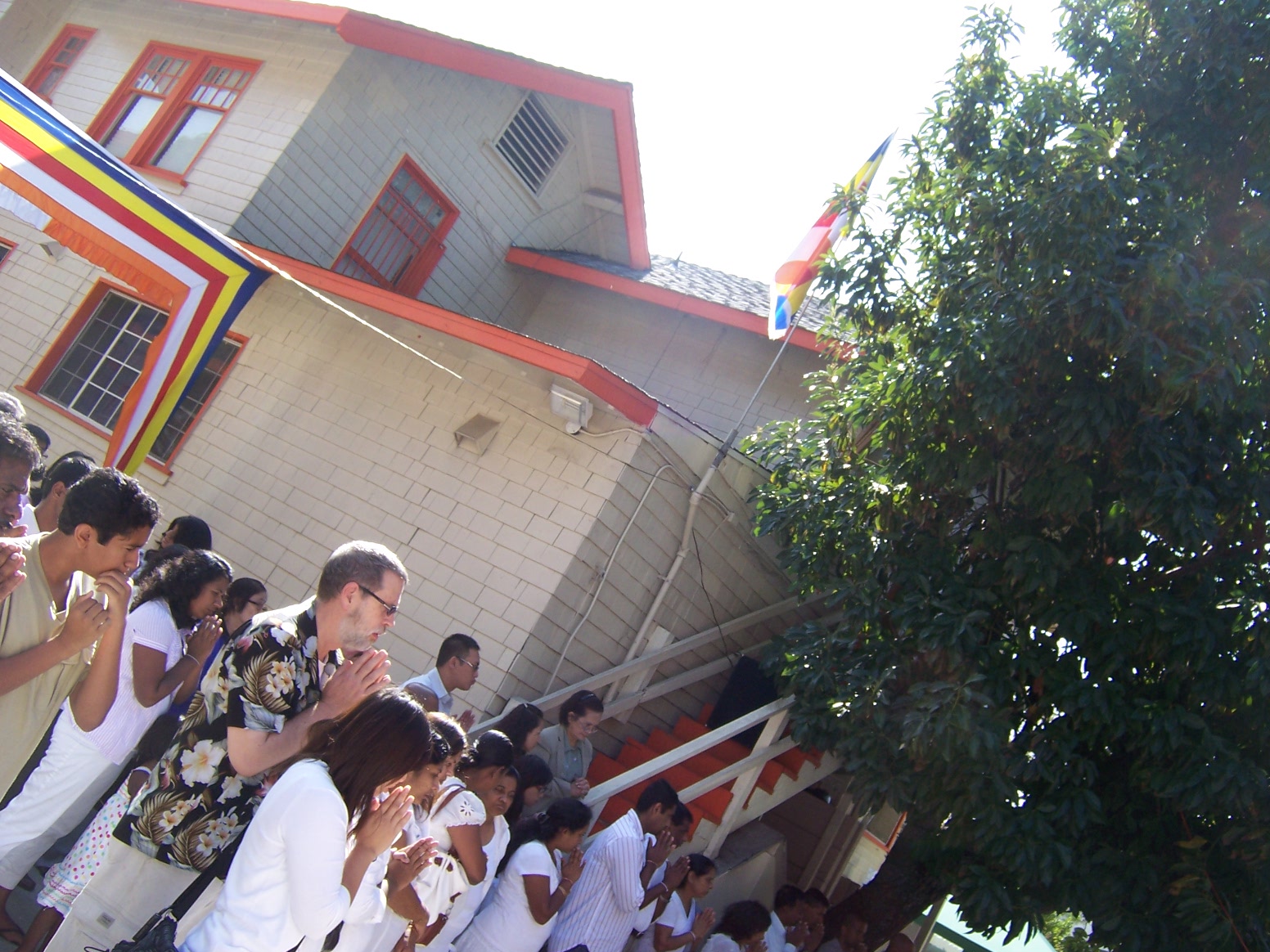 Whereas the monastic who receives the robe gains five mundane benefits, the donor of the robe accrues a tremendous amount of merit (anisangsa, punya). The Pali word for the robe is kathina, Bengali kathin.
 Traditionally, devoted Buddhists undertake to strictly observe moral and ethical precepts during the period of the retreat culminating in the sacred ceremony. However, even the simple act of participating (attending in approval of this gift) they are able to share in the remarkable merit of this special gift-giving.