Loading...

This is default featured post 1 title

Go to Blogger edit html and find these sentences.Now replace these sentences with your own descriptions.This theme is Bloggerized by Lasantha Bandara - Premiumbloggertemplates.com.

This is default featured post 2 title

Go to Blogger edit html and find these sentences.Now replace these sentences with your own descriptions.This theme is Bloggerized by Lasantha Bandara - Premiumbloggertemplates.com.

This is default featured post 3 title

Go to Blogger edit html and find these sentences.Now replace these sentences with your own descriptions.This theme is Bloggerized by Lasantha Bandara - Premiumbloggertemplates.com.

This is default featured post 4 title

Go to Blogger edit html and find these sentences.Now replace these sentences with your own descriptions.This theme is Bloggerized by Lasantha Bandara - Premiumbloggertemplates.com.

This is default featured post 5 title

Go to Blogger edit html and find these sentences.Now replace these sentences with your own descriptions.This theme is Bloggerized by Lasantha Bandara - Premiumbloggertemplates.com.

Showing posts with label forbidden archeology. Show all posts

Tuesday, November 20, 2012

Forbidden Archeology: UFOs of India (video)

Pat Macpherson, Pfc. Sandoval, Seven, Wisdom Quarterly
Michael Cremo addresses the monthly MUFON LA meeting, Universalist Unitarian Church, Studio City, on the extreme antiquity of humans on Earth and written documentation of UFOs in ancient Sanskrit texts (WQ).

Part I: Spacecraft in Ancient Sanskrit Texts

Accounts of Spacecraft in Texts of Ancient India
THE VALLEY, California - Last night the Mutual UFO Network of Los Angeles hosted scientist Michael Cremo who read and translated ancient Sanskrit texts, such as the Puranas or "Histories," explaining the nature of the universe.
  
Just as the Buddha asserted, there are three distinct spheres (lokas): kama, rupa, and arupa or sensual, fine-material, and immaterial. MUFON's interest is in UFOs and extraterrestrials rather than cosmology as such.

But Cremo made the link: There are three distinct kinds of UFOs (vimanas) depending on which sphere it is from. There are gross/dense machines, subtle-light vehicles, and "spiritual" craft. We can think of it in modern terms as ordinary Grey/MIC/Nazi saucers, vehicles used for dimensional travel, and mind-only (non-material) craft.

 
PART II: Spacecraft in Ancient Sanskrit Texts
 PART III: Spacecraft in Ancient Sanskrit Texts

Cremo distinguishes authentic Sanskrit texts of great antiquity from later "channelled" materials like the Vimanika Shastra, which may shed light on the matter but are not writings from yogis in the Himalayas. One amazing aspect is that when Dhurva meditated in the Himalaya, beings came down in a craft to take him to their world in another sphere. Earth is a world in the Sensual Sphere, and those beings were from a fine-material world or higher). 
 
And this is the amazing thing: As he entered the craft, his body became like theirs. He had already understood by meditation that consciousness was separate, or at least separable, from his earthly body. He was transformed upon entering the craft and recounts in the texts that the craft became transparent and he saw the planets in our solar system passing, and they passed through other higher-dimensional planets on their way to their destination.
Live in Los Angeles
(forbiddenarcheologist.com)
MUFON LA proudly presents Michael Cremo this month. In this rare (perhaps twice a decade) event, one of our favorite scientists reveals stunning findings. His research forms much of the basis of our view about Earth. His science is in line with a firm grasp of Vedantic and Puranic Hindu and Buddhist cosmologies, which he uses to tie together the story behind forbidden artifacts. What do they reveal? Past life and technology on our planet is much older and far more advanced than we can easily conceive. There is no denying that the forbidden truth is much stranger than the mandatory fiction in our college textbooks due to the knowledge-filterers and science suppressors. We "evolve," of course, but we were "created" (genetically manipulated) as well.

Tuesday, November 6, 2012

World's Oldest Buddhist Temple: Mes Aynak

Dhr. Seven, Wisdom Quarterly; Salman Hameed, Irtiqa-blog.com, Aug. 15, 2010)
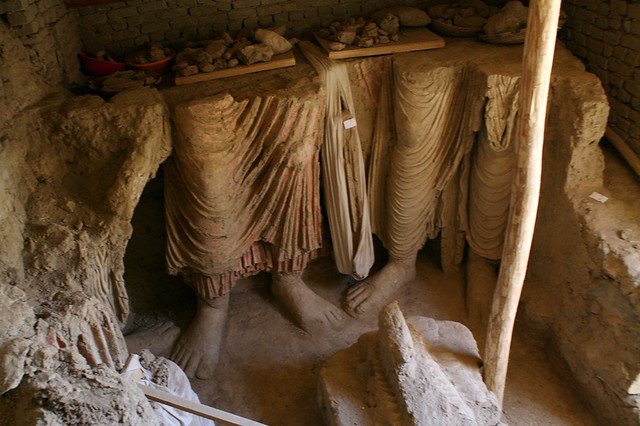
Excavations at Mes Aynak ("Copper Well"), Afghanistan, a massive Buddhist temple complex in danger of demolition due to US war, Afghan desperation, and Chinese greed (Science, Vol. 329, 7-30-10/Irtiqa).
  
To outrage the world and create a pretext for war, the CIA-created Taliban demolished some of the world's largest Buddha statues at Bamiyan, 125 miles to the northwest. The age of those statues is hard to pinpoint because long before they were converted to Buddhist images, monastic caves, and a rich cultural crossroads along the Silk Route, they were monolithic giants depicting humankind devolving slowly through the epochs, according to Russian psychic and Theosophist Madame Blavatsky.


Map of Mes Aynak, Afghanistan (SV)
A precious metal and rare earth mine 25 miles southeast of Kabul, the current Afghan capital, was an enormous Buddhist temple complex 2,600 years ago. Why? The Buddha was born in the ancient region (now called Logar Province), which was once India's northwest frontier.  Temples were often built near mines to draw raw materials for the ornate temple structures.
   
Buddhist archaeological discoveries: Mes Aynak, Tepe Naranj, Buddhist art of the Kabul River Valley -- the first new collections to enter the Nat'l Museum (Kabul) in 30 years come from the newly excavated Buddhist sites of ancient Kabulistan. The spectacular finds from two sites, Mes Aynak and Tepe Narenj, greatly expand our understanding of the artistic culture of the region during the expansion of Islam and the displacement of Buddhism and Zoroastrianism More

Mes Aynak jewelry treasure (SV)
That fabulous 1,000 hectare complex -- with various monasteries, nunneries, and other buildings -- is very ancient and is apparently set atop two older layers of a town. But Chinese government corporate interests are doing their best to make sure the world never sees most of what constitutes this archeological site. They seek to demolish it and extract its mineral wealth.
  
Millennia ago, this region served as a critical conduit in the spread of Buddhism to Central Asia [up to Europe and the only indigenously Buddhist portion of Europe, Kalmykia] and China [Buddhism flourished in ancient Greece before it got to China], says T. Richard Blurton, an archaeologist and curator at London's British Museum who has excavated in Afghanistan. 
  
The barren site hiding cultural wonders
Blurton says Mes Aynak could provide new data on both the origin and demise of the religion here. Researchers now believe that as late as the 7th century C.E., when Islam arrived in the area, Buddhism was still making inroads as far west as Iran and as far north as Turkmenistan. "It's quite tantalizing to consider how Buddhism coexisted with the new religion."

photo
Mes Aynak, Afghanistan (Michal Przedlacki, Dziadek/Flickr.com/GALLERY)
There are also Hindu deities from that late period at Tepe Sardar, a large monastery located in the eastern Afghan city of Ghazni. Further evidence from Mes Aynak could help provide a new picture of religious blending at an important historical juncture, explains Blurton. There is some hope for compromise and coexistence -- by creating a protected zone for archeology. But it looks like the decision is now directly in the hands of US-installed Afghan leader Karzai. Read full article (subscription may be necessary).

Friday, October 12, 2012

Where was the Buddha really born?

Ranajit Pal, Ph.D. (ranajitpal.com)
Bamiyan, Afghanistan, was near Kapilavastu, birthplace of the Buddha (Afghan Treasures)


The fantastic recent find of about 10,000 ancient Buddhist fragments at Bamiyan [Afghanistan], part of which is now in the Schoyen Collection, shows that Buddhism was born here. 
  
The names Tiŝŝa, Siddhartha, and Suddho-dana, of the Persepolis Tablets prove conclusively that Gotama [Gautama Buddha] was from Seistan-Baluchistan. 
  
About the iconography of a beautiful schist stele from Mes Aynak, G. Fussman of the College de France writes that the prince shown sitting under foliage of [a] Pipal [tree] is Siddhartha before his enlightenment. 
  
Sistan-Baluchistan, ancient Indian frontier
Gregory Schopen also writes about a "cult tied to a cycle of festivals celebrating four moments, not in the biography of the Buddha but in the pre-enlightenment period of the life of Siddhartha."
  
Yet neither he nor G. Fussman recognizes the need to integrate the Mes Aynak findings with the priceless inscriptions from the Persepolis Tablets, which mention Tissa, Sedda Saramana (Siddhartha), Sudda Yauda Saramana (Suddodana), and Saman.
  
Schopen's video, entitled "Buddha as a Businessman," is largely based on false Nepalese data. More

Tuesday, October 9, 2012

World's Greatest Buddhist Site (photos)

UPDATE: Seven, Wisdom Quarterly; photostream by Michal Przedlacki (dziadek/flickr.com)
Afghan archaeologist examines the remains of Buddha statues discovered inside an ancient monastic complex in MES AYNAK, Logar province, Afghanistan, on Nov. 23, 2010 (AP).

Tuesday, August 14, 2012

New human species discovered (video)

Pallab Ghosh, BBC News, Aug. 8, 2012
"March of Progress" had many dead ends, as well as the implicit racism of researchers.
  
Researchers studying fossils from northern Kenya, Africa, have identified a new species of human that lived two million years ago.
   
The discoveries suggest that at least three distinct species of humans co-existed in Africa.
   
The research adds to a growing body of evidence that runs counter to the popular perception that there was a linear evolution from early primates to modern humans.
   
The research has been published in the journal Nature. Anthropologists have discovered three human fossils that are between 1.78 and 1.95 million years old. The specimens are of a face and two jawbones with teeth. More
DEVO (de-evolution, devolving): "They tell us that we lost our tails, evolving up from little snails. I say it's all just wind in sails. Are we not men? We are DEVO! We're pinheads now. We are not whole. We're pinheads all, Jocko homo. Are we not men? D-E-V-O. Monkey men all in business suits. Teachers and critics all dance the poop. Are we not men? We are DEVO! We must repeat. Okay, let's go! (Oh, give it up! God made man, but he used a monkey to do it. Apes in the plan, and we're all here to prove it. I can walk like an ape, talk like an ape. I can do what monkeys do. God made man, but a monkey supplied the glue)."

 
"God made Man, but he used a Monkey to do it." Nevertheless, McKayla's not impressed.