Douglas Smith, Caltech Media Relations, Watson lecture preview (caltech.edu); Ashley Wells, Pat Macpherson, Dhr. Seven, Wisdom Quarterly  |
| The physics of the Large Hadron Collider explained at Caltech's Beckman Auditorium, Wednesday, Jan. 9, 2013 (Wisdom Quarterly/Wells) |
 |
| Prof. Harvey Newman, Watson Lecture (WQ) |
What is the origin(s) of the universe? What are its dimensions? What are its primary causes and supportive conditions?
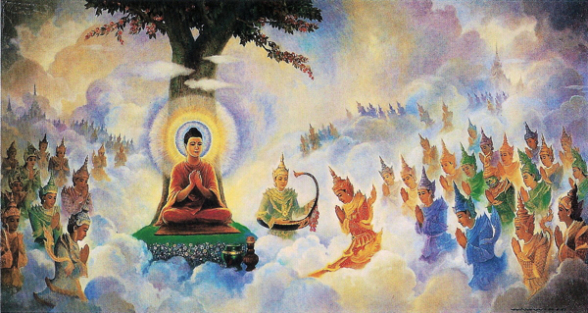
We know (or at least can know with certainty). But here, Science, have a crack at it. And remember to show your work when you produce the final equation you call an answer! The growing field of particle physics is homing in on kalapas, the subatomic "particles of perception" the Buddha pointed out when he discussed ultimate-materiality.Buddhist physics speaks of qualities of materiality (rupa) rather than tangible material realities as such. These subatomic building-blocks are more like aspects of blocks rather than amorphous blocks. These "elements," qualities, or features of material are spoken of as indirectly perceptible in profoundly elevated states of consciousness during meditation on the Four Elements (which, it cannot be emphasized enough, are not elementary particles but fundamental qualities of kalapas) and other Abhidharma practices.
 |
| Desktop Buddha (Koba53/flickr.com) |
Those who have seen such minute and almost unimaginable particles -- and we know more than one English speaker who has -- universally state that they look nothing like idealized "atom" posters in science classrooms. Unfortunately, they do not say much about how they do look because seeing is replaced by knowing-and-seeing. It goes deeper than observation to intimately/intuitive certainty and understanding of what is being seen. But how could something that moves so fast ever be tracked by conscious-awareness? This is a great question! The Buddha could not come up with a simile for the speed of ultimate realities and settled for the time it takes a speeding arrow to traverse the shadow of a tree as a poor approximation. (This is a very inferior example that merely suggests something far too fast to even take note of; we would never see it coming).Conscious awareness cannot take note of the arising-turning-passing of such realities. Fortunately, however, there is something faster than the fastest particle, faster than the fastest transformation, faster than the fastest material process. And that some-"thing" is consciousness (cittas, mind-moments). This psychological or conscious-process can track the material-process because there are more impulsions (javanas) transpiring within a mind-moment than the phases of a kalapa, which lasts a moment. Having recorded it, one can play the track of a kalapa-process back, slowed down, for review in the mind-door. This when done correctly can lead to liberating insight in that it reveals the Three Marks of all phenomena. They are radically impermanent, hopelessly unsatisfactory, and utterly impersonal.Performing this "reviewing" allows the successful meditator, having emerged from mind/heart intensifying and purifying absorptions (jhanas), to perceive the impossible -- to directly know-and-see physical reality. One does not take it on faith and is not liberated by faith, but rather by wisdom. The truth itself sets one free, for how could the heart/mind continue to cling to phenomena marked by such characteristics as one has just seen and can see again if one begins to doubt. Seeing replaces believing with complete certainty.
Alas, who will listen to such reports? Such knowledge-and-vision benefits only the perceivers. So if we would benefit, we must see for ourselves. Seeing will be believing -- when we see it for ourselves.
What does physics offer (besides lots of math homework)? Dr. Newman quoted Einstein, the post-lecture Q&A period, that it is far more amazing that things are comprehensible. That is the unlikely thing, and how amazing that math describes anything. Science is trying to make the subjective experience of the perceiver a universal, replicable experience. I don't know about you, but I've never replicated anyone's physics experiment, anyone's data, anyone's logical deductions. I take it on faith, I take it on authority, I take it as "handed down" by jargon-uttering elders in black robes and mortarboards.

And that's good enough; it doesn't change my inner-life, try as I might to have it change my attitude and outlook. But Buddhism makes particle physics a firsthand experience no one will believe, whereas "science" makes personal experience an academic report about an artificial experiment someone else concocted and carried out then reported on with some peer review of the alleged results and their meaning.
(If you ever want to doubt the "God particle," the Higgs boson, listen to firsthand reports by researchers at the LHC; their cautious pleas for not jumping to conclusions and adamant assertions that "more research is needed" do more to convince onlookers that little good is coming out of these grand endeavors beyond the financial support of the priestly duties of our current Brahmin Caste and their mantra-like mathematically-based mysterious-machinations).
But we were eager to hear it firsthand. And the one thing Dr. Newman said with certainty was that the Standard Model was wrong (deficient, incomplete, incompatible with observable results so far, but there is not yet a better theory to align itself with the data and make that data believable -- almost as if reality had to adjust to our limited descriptions and depictions of it before science would be happy). The best part came at the end when fewer than 1% of the audience stayed behind to ask questions. Everyone else just clapped and ran out.
LHC kingpin at Caltech
Douglas Smith (Caltech.edu) Q&A with Dr. Newman |
| The secret is the micro looks like the macro, but that's as far as it goes. Look here, look there, read Plato. And still until you SEE-AND-KNOW, it's all for naught anyhow. |

Professor of physics Harvey Newman has been searching for signs of dark matter, extra dimensions, and the elusive Higgs particle at the Large Hadron Collider in Geneva, Switzerland.
He reported from the high-energy frontier of particle physics on Wednesday night (Jan. 9, 2013) during the Watson Lecture Series at Caltech. His talk was open to the public and packed.
Q: What do you do?
A: I'm a high-energy physicist. Together with my colleague, Professor of physics Maria Spiropulu, we explore the forces and matter that make up our universe, using the highest energies one can [at this time] achieve at particle accelerators. [But we already have the means of going higher, and we will when we swap out decaying equipment with more powerful replacement parts.] These energies are now found in Switzerland, where CERN, the European Organization for Nuclear Research, sends protons traveling at 99.999997 percent of the speed of light crashing head-on into one another inside the Large Hadron Collider, better known as the LHC.
The LHC has two general-purpose detectors -- our experiment, the Compact Muon Solenoid, or CMS, and ATLAS. "Compact" means "dense" not "small," and our experiment is relatively compact. It's only as tall as a four-story building, as opposed to ATLAS, which is like a six-story building.
Our lab had a primary role in designing the CMS's electromagnetic calorimeter, which detects high-energy photons and electrons using 76,000 crystals of lead tungstate. These crystals, which Caltech helped develop, together weigh 90 tons, and if they weren't so dense we would need even more of them in order to collect all those particles. And we need to see every particle, as we are looking for pairs of photons -- a key signature of the Higgs particle that we've been focusing on for decades. We had first hints by the end of 2011, and by July 2012, CMS and ATLAS had accumulated sufficient evidence to announce the discovery of a Higgs-like particle.
 |
| Close up of one slide in a dense and extensive PowerPoint presentation (WQ) |
Q: What is the Higgs, and why are you looking for it?
A: In 1964, Peter Higgs and others [but not Dr. Stephen Hawking] proposed the existence of a field that permeates all of space and would allow the generation of particle masses. The photon, which carries the electromagnetic force, has no mass, but the W and Z particles, which carry the weak force, do. But if you take the unified theory of the electromagnetic and weak interactions and try to put in a mass term for the W and one for the Z, the mathematics don't work. When you rewrite the theory to include the Higgs field, the Z and the W now have mass, the photon stays massless, and you get this other thing called the Higgs particle.
It is really quite amazing that relatively simple mathematical expressions describe how nature works. There's no reason for it, necessarily, but it is a characteristic of the world we live in. Fundamental expressions like F = ma [force equals mass times acceleration] have great predictive power in their own domains, and when you go outside those domains you have to look for something even more fundamental.

So it is for the so-called Standard Model of particle physics. It has been very successful until now, and yet we know that something lies beyond it. It does not have a candidate particle for dark matter, for example. It only describes normal matter, which is just four percent of the matter in the universe. And then there's dark energy, which we're not even sure has a "particles and fields" description. That's a frontier where we don't even know yet how to write things down. The Standard Model also does not work in the early universe. If you calculate the mass of the Higgs particle, the calculation blows up when we get to an energy scale that lies between where the universe is today and the moment of the Big Bang.
Caltech has a central role in the search for dark matter and whatever else lies beyond the Standard Model. It's a never-ending journey, and one that has inspired students at Caltech for decades.
Q: How did you get into this line of work?
A: I was in the fourth grade in PS 225 in Brooklyn, and one day Mrs. DeSimone put out a cart of books that went way beyond what was in our class. I read them all from end to end, and then I started to read everything in sight....
More- NOTE: The entire slide presentation is available at his website or through personal email (faculty at caltech.edu); however, photos and recording were not allowed during the presentation. Ours were taken before and after. Maybe the next Watson lecture on social science will be better:
 |
| Will you marry me? You, me, and Wolfman? |
(Watson Lecture Series with Prof. Tracy K. Dennison on Marriage and Economic Development in the Past) Before industrialization, people married young and lived in extended families with several generations under the same roof -- or so the story goes. In parts of Europe, however, our "modern" pattern -- late age at first marriage combined with nuclear family households -- goes back many centuries, leading some researchers to wonder if this very pattern actually brought about the Industrial Revolution and early economic growth in the West.