Go to Blogger edit html and find these sentences.Now replace these sentences with your own descriptions.This theme is Bloggerized by Lasantha Bandara - Premiumbloggertemplates.com.
The fifth and fourth centuries B.C. were a time of worldwide intellectual ferment. It was an age of great thinkers, such as Socrates and Plato, Confucius and Laozi.
In India, it was the Age of the Buddha, after whose passing a religion developed that eventually spread far beyond its homeland.
The Gupta period, from the fourth to the sixth century A.D., in northern India, sometimes referred to as a golden age, witnessed the creation of an "ideal image" of the historical Buddha.
Siddhartha, the prince who was to become the Buddha, was born into the royal family of Kapilavastu, a small kingdom in the Himalayan foothills [likely in what is now Afghanistan, traditionally believed to be in modern Nepal].
His was a [beginning associated with a dream by his mother, Maya, and spoken of as a [divine conception and miraculous birth], at which sages predicted that he would become a universal monarch, either in the physical [or the spiritual realm].
It was the latter conquest that came to pass. Giving up the pleasures of the palace to seek the true purpose of life, Siddhartha first tried [meditation and samadhi under two yogis then] the path of severe asceticism, only to abandon [these efforts] after six years as a futile exercise [not getting him to enlightenment and the final end of all suffering].
Buddhism along the Silk Roadat the Met, New York City, Jan. 9, 2013 (Asterix611/flickr)
He then sat down in yogic meditation beneath a banyan tree [pipal or "sacred fig," the Ficus religiosa, the forebear of world's oldest historically documented tree] until he achieved enlightenment. He was known henceforth as the Buddha, or the "Enlightened One."
He found the Middle Path, rejecting both hedonism and asceticism. Buddhism proposes a life of good thoughts, good intentions, and straight living, all with the ultimate aim of achieving nirvana, release from [all conditioned] existence.
(Asterix611/flickr.com)
For most beings, nirvana lies in the distant future, because Buddhism, like other dharmas [doctrines] of India, believes in a cycle of rebirth.
Beings are reborn many times, each time with the opportunity to further perfect themselves or devolve. And it is their own karma -- the sum total of deeds, beneficial and harmful -- that determines the circumstances of future births.
The Buddha spent the remaining 45 years of his life teaching a doctrine and discipline and making vast numbers of converts. When he entered final nirvana, released from all rebirth, his body was cremated as was customary in India.
The cremated relics of the Buddha were divided into several portions and placed in relic caskets that were interred in large hemispherical mounds known as stupas. Such monuments are centrally placed in Buddhist monastic complexes. They attract pilgrims from far and wide who come to experience the teaching, the monastic order, and even some small portion of the remains of the Buddha.
Stupas are enclosed by a railing that provides a path for respectful circumambulation. The sacred area is entered through gateways at the four cardinal points.More
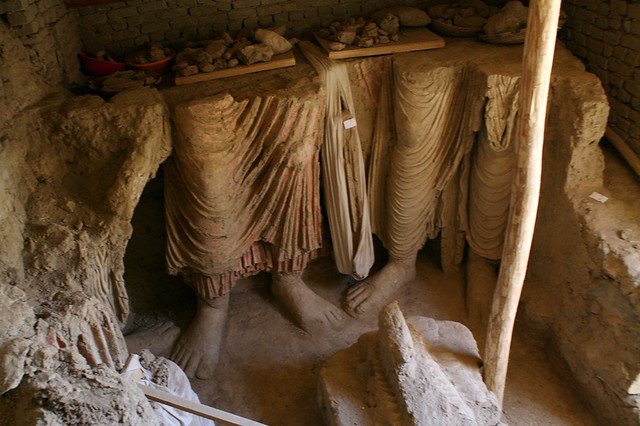
Excavations at Mes Aynak ("Copper Well"), Afghanistan, a massive Buddhist temple complex in danger of demolition due to US war, Afghan desperation, and Chinese greed (Science, Vol. 329, 7-30-10/Irtiqa).
To outrage the world and create a pretext for war, the CIA-created Taliban demolished some of the world's largest Buddha statues at Bamiyan, 125 miles to the northwest. The age of those statues is hard to pinpoint because long before they were converted to Buddhist images, monastic caves, and a rich cultural crossroads along the Silk Route, they were monolithic giants depicting humankind devolving slowly through the epochs, according to Russian psychic and Theosophist Madame Blavatsky.
A precious metal and rare earth mine 25 miles southeast of Kabul, the current Afghan capital, was an enormous Buddhist temple complex 2,600 years ago. Why? The Buddha was born in the ancient region (now called Logar Province), which was once India's northwest frontier. Temples were often built near mines to draw raw materials for the ornate temple structures.
Buddhist archaeological discoveries: Mes Aynak, Tepe Naranj, Buddhist art of the Kabul River Valley -- the first new collections to enter the Nat'l Museum (Kabul) in 30 years come from the newly excavated Buddhist sites of ancient Kabulistan. The spectacular finds from two sites, Mes Aynak and Tepe Narenj, greatly expand our understanding of the artistic culture of the region during the expansion of Islam and the displacement of Buddhism and Zoroastrianism More
That fabulous 1,000 hectare complex -- with various monasteries, nunneries, and other buildings -- is very ancient and is apparently set atop two older layers of a town. But Chinese government corporate interests are doing their best to make sure the world never sees most of what constitutes this archeological site. They seek to demolish it and extract its mineral wealth. Millennia ago, this region served as a critical conduit in the spread of Buddhism to Central Asia [up to Europe and the only indigenously Buddhist portion of Europe, Kalmykia] and China [Buddhism flourished in ancient Greece before it got to China], says T. Richard Blurton, an archaeologist and curator at London's British Museum who has excavated in Afghanistan.
The barren site hiding cultural wonders
Blurton says Mes Aynak could provide new data on both the origin and demise of the religion here. Researchers now believe that as late as the 7th century C.E., when Islam arrived in the area, Buddhism was still making inroads as far west as Iran and as far north as Turkmenistan. "It's quite tantalizing to consider how Buddhism coexisted with the new religion."
There are also Hindu deities from that late period at Tepe Sardar, a large monastery located in the eastern Afghan city of Ghazni. Further evidence from Mes Aynak could help provide a new picture of religious blending at an important historical juncture, explains Blurton. There is some hope for compromise and coexistence -- by creating a protected zone for archeology. But it looks like the decision is now directly in the hands of US-installed Afghan leader Karzai. Read full article (subscription may be necessary).
The former Buddhist civilization of northwestern India, now Islamic Pakistan
SWAT, Pakistan (formerly northwestern India) - Militants are holding sway in restive Swat Valley. They are destroying the remnants and heritage of Gandhara Buddhist civilization there.
In the absence of appropriate security arrangements, a historic rock-carved image of the Buddha (near Jahanabad) has already been partially destroyed. However, restoration ("facelift") is underway.
Situated on the banks of the Swat river, known in ancient times as Svastu, the scenic Swat Valley was the center of Buddhist civilization. Prior to being colonized by England as part of the United Kingdom, what are now called "Pakistan" and "Afghanistan" were simply the northwestern frontier of India -- much as it had been at the time of the Buddha.
The Buddha's extended family -- the Shakya ("gray land" or Afghanistan) Clan was from this region. Kapilavastu, asserts Dr. Ranajit Pal (a maverick historian), was near modern Bamiyan, Afghanistan.
In ancient scripts Swat is known as Udhyana, meaning garden or park. Historians say the Indian Emperor Asoka re-introduced Buddhism to Swat spreading it to Peshawar, Taxila, and beyond into Afghanistan.
Chinese Caves
The remarkable Buddhist cave shrines of far western China
Of course, it already existed all along the deserts and oases of the Silk Route up through Central Asia from Kapilavastu to Kalmykia (Buddhist Europe). This historical fact -- marked by colossal stone monuments in Afghanistan, Tajikistan, and far western China -- could not be obliterated even by Muslim extremists, time, or the desolate desert.
Kalmykia, Europe is far from Central Asia, India
However, by seventh and eighth centuries ACE, Buddhist civilization was giving way to another influence in the area (Asuran, Zoroastrian, and Islamic).
Rock carvings and historical sites preserve this part of history in the mountains and plains of Swat. Images and statues of the Buddha carved in different forms are a semi-permanent record of the material remains of humankind.
We reconstruct the history of Buddhism with their help. Now these carvings, of which there are hundreds in Swat, says Professor Fidaullah Sehrai, the Director of the Archeology Department, NWFP.
(Sid) Extremists attacked Buddha statue in Pakistan in 2009.
Growing militancy has emerged as a major threat to these rare sites throughout the restive valley. Some have already been damaged. The Jehanabad Buddha is one such complete and inspiring symbol of Gandharan art.
Preserved by nature due to difficult location, this meditating Buddha carved some 20 feet high has survived many attacks since 1994. However, the last one proved destructive to the Buddha's face.
The body of the Jehanabad Buddha had holes filled with explosives, which the militants could return for the final round of completely destroying the unique image.
Complaints were made to the DOC and the Ministry, and they will take some action, said Nasir Khan, an official from the Swat Museum.
Unlike the past, the sites look bleak now: No foreign tourists are visiting the sites for fear of getting caught up in growing militant activity. This has badly damaged the economy of the area which largely depended on tourism.
Due to growing insecurity and lack of a well thought out preservation strategy, some of the sites are fast losing their attraction for tourists from around the world otherwise interested in following the Buddhist touris circuit in India and Nepal and other Buddhist lands.
Resurrecting ancient Afghanistan's Buddhist legacy
The Buddhas of Bamiyan, Afghanistan -- which the maverick scholar and historian Ranajit Pal, Ph.D. considers to be in vicinity of the original Kapilavastu, where Siddhartha grew up -- is ancient land in Himalayan foothills.
Buddhism is steeped in the geography of ancient Greater India (Maha Bharat), which at the time of the Buddha was a collection of loosely aligned territories. There are relics and markers throughout the region (many now outside the country) including ancient northwest Gandhara, present-day Afghanistan and Pakistan.
Note people on foot. The tallest of the Buddhas of Bamiyan may not be the biggest in Asia.
India, and its Shakyan neighbor in the northwest, was expansive and fluid. People were aligned with extended family clans, and united by commonalities in language and trade. Buddhism and its precursor "wandering ascetic" (shramana) tradition are found even in the preceding Harappan era along with much of the history the Buddha mentioned, which we can assume was from the Indus Valley Civilization and earlier.
Buddhas are spoken of as having arisen in previous aeons, far earlier than modern archeology is willing to concede that modern humans existed. But another maverick historian and archeologist shows evidence of the great antiquity of humanity (and hybrids) on this planet: Michael Cremo, who is informed not only by science but the ancient Vedas as well, as humans have been devolving through the ages.
The area of Bamiyan in Central Asia was Zoroastrian, founded by the asura Zoroaster (Zarathustra), and Buddhist at one time, that is, whatever fragments or memories remained of pre-Shakyamuni buddhas. before Gotama which implies that Buddhism was as old as Zoroastrianism. Dr. Pal contends that "detailed study reveals close links of early Buddhism with Hinduism, Judaism and Zoroastrianism which rose in the Bamiyan-Baluchistan-Gandhara area."
The viewing point over Bamiyan valley from within the head of the tallest Buddha statue
(Holger Kersten is an excellent resource for information on ancient Jewish outposts in India). "The crucial fact that the Silk Road passed through the Buddhist heartland has escaped the notice of all," Dr. Pal explains. This is how Buddhism spread, even as the Buddha Gautama went back and forth from his native Kapilavastu to the ancient central kingdom of India, Magadha, where he otherwise spent much of his time teaching. He early on sent enlightened missionaries in all directions to spread the Dharma. They must have reached at least as far as Kalmykia, in indigenously Buddhist Europe.
Lumbini (Siddhartha's garden birthplace) or Kapilavastu (his hometown) in Nepal is, Dr. Pal contends, an archeological and historical "fraud." Wisdom Quarterly much to the chagrin of the governments of Islamic Afghanistan and Hindu-dominated Nepal and India. (Nepal was once the only Hindu nation in the world; India never was; they both now lean secular with a great financial interest in Buddhist tourism and history). Dr. Pal points out that, "Nothing in the art, archaeology, history or literature of early Nepal has the faintest hint of Buddhism." More photos