Loading...

This is default featured post 1 title

Go to Blogger edit html and find these sentences.Now replace these sentences with your own descriptions.This theme is Bloggerized by Lasantha Bandara - Premiumbloggertemplates.com.

This is default featured post 2 title

Go to Blogger edit html and find these sentences.Now replace these sentences with your own descriptions.This theme is Bloggerized by Lasantha Bandara - Premiumbloggertemplates.com.

This is default featured post 3 title

Go to Blogger edit html and find these sentences.Now replace these sentences with your own descriptions.This theme is Bloggerized by Lasantha Bandara - Premiumbloggertemplates.com.

This is default featured post 4 title

Go to Blogger edit html and find these sentences.Now replace these sentences with your own descriptions.This theme is Bloggerized by Lasantha Bandara - Premiumbloggertemplates.com.

This is default featured post 5 title

Go to Blogger edit html and find these sentences.Now replace these sentences with your own descriptions.This theme is Bloggerized by Lasantha Bandara - Premiumbloggertemplates.com.

Showing posts with label Gandharan. Show all posts

Saturday, November 10, 2012

Amazing Afghan Buddha discoveries (video)

Brent E. Huffman; Wisdom Quarterly via TheWorld.org
"The Buddhas of Aynak" (teaser) by archeologist and filmmaker Prof. Brent E. Huffman, Northwestern University.

Tuesday, November 6, 2012

World's Oldest Buddhist Temple: Mes Aynak

Dhr. Seven, Wisdom Quarterly; Salman Hameed, Irtiqa-blog.com, Aug. 15, 2010)
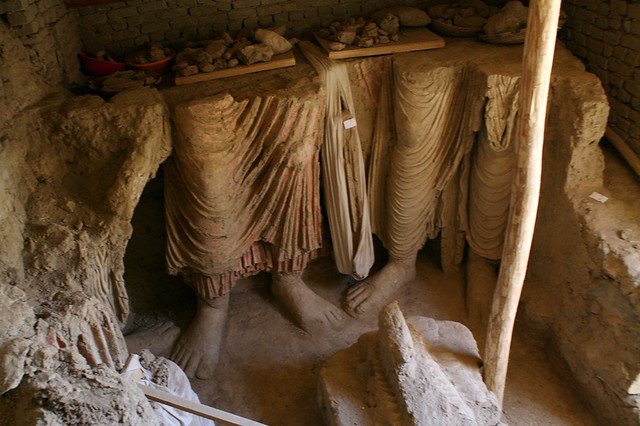
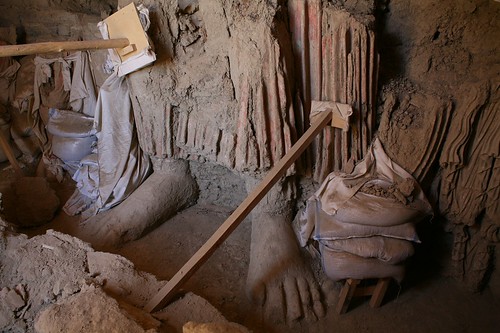
Excavations at Mes Aynak ("Copper Well"), Afghanistan, a massive Buddhist temple complex in danger of demolition due to US war, Afghan desperation, and Chinese greed (Science, Vol. 329, 7-30-10/Irtiqa).
  
To outrage the world and create a pretext for war, the CIA-created Taliban demolished some of the world's largest Buddha statues at Bamiyan, 125 miles to the northwest. The age of those statues is hard to pinpoint because long before they were converted to Buddhist images, monastic caves, and a rich cultural crossroads along the Silk Route, they were monolithic giants depicting humankind devolving slowly through the epochs, according to Russian psychic and Theosophist Madame Blavatsky.


Map of Mes Aynak, Afghanistan (SV)
A precious metal and rare earth mine 25 miles southeast of Kabul, the current Afghan capital, was an enormous Buddhist temple complex 2,600 years ago. Why? The Buddha was born in the ancient region (now called Logar Province), which was once India's northwest frontier.  Temples were often built near mines to draw raw materials for the ornate temple structures.
   
Buddhist archaeological discoveries: Mes Aynak, Tepe Naranj, Buddhist art of the Kabul River Valley -- the first new collections to enter the Nat'l Museum (Kabul) in 30 years come from the newly excavated Buddhist sites of ancient Kabulistan. The spectacular finds from two sites, Mes Aynak and Tepe Narenj, greatly expand our understanding of the artistic culture of the region during the expansion of Islam and the displacement of Buddhism and Zoroastrianism More

Mes Aynak jewelry treasure (SV)
That fabulous 1,000 hectare complex -- with various monasteries, nunneries, and other buildings -- is very ancient and is apparently set atop two older layers of a town. But Chinese government corporate interests are doing their best to make sure the world never sees most of what constitutes this archeological site. They seek to demolish it and extract its mineral wealth.
  
Millennia ago, this region served as a critical conduit in the spread of Buddhism to Central Asia [up to Europe and the only indigenously Buddhist portion of Europe, Kalmykia] and China [Buddhism flourished in ancient Greece before it got to China], says T. Richard Blurton, an archaeologist and curator at London's British Museum who has excavated in Afghanistan. 
  
The barren site hiding cultural wonders
Blurton says Mes Aynak could provide new data on both the origin and demise of the religion here. Researchers now believe that as late as the 7th century C.E., when Islam arrived in the area, Buddhism was still making inroads as far west as Iran and as far north as Turkmenistan. "It's quite tantalizing to consider how Buddhism coexisted with the new religion."

photo
Mes Aynak, Afghanistan (Michal Przedlacki, Dziadek/Flickr.com/GALLERY)
There are also Hindu deities from that late period at Tepe Sardar, a large monastery located in the eastern Afghan city of Ghazni. Further evidence from Mes Aynak could help provide a new picture of religious blending at an important historical juncture, explains Blurton. There is some hope for compromise and coexistence -- by creating a protected zone for archeology. But it looks like the decision is now directly in the hands of US-installed Afghan leader Karzai. Read full article (subscription may be necessary).

Friday, October 12, 2012

Northwest Buddhist treasures in NYC

Tribune.com.pk (2011); Dhr. Seven, Ashley Wells, Wisdom Quarterly (2012)
A vision of paradise (Mohammed Nagri, Khyber Pakhtunkhwa, 4th Cent.) BELOW: Maha Maya's Dream in Kapilvastu, Sikri, Khyber Pakhtunkhwa, 2nd-3rd Cent. (sites.asiasociety.org).
  
The Buddha's mother's dream
LAHORE, Pakistan [formerly Northwest India] - Fifty Gandhara Civilization artifacts from the Lahore Museum collection have received a tremendous response from media and visitors to the New Asia Society Museum in New York in the United States.
  
India before 1947 and Pakistan (leics.gov.uk)
Elaine Merguerian, Director of Communications at the New Asia Society Museum, said via email that the exhibition “has received much enthusiastic attention from the media and many, many visitors who are interested in Pakistan, Buddhist heritage, and the story behind the exhibition.”
   
She added that the exhibition was “probably a once in a lifetime opportunity to see these great works of art from Pakistan in the United States.”
  
Lahore Museum (Ed Sentner)
LAHORE MUSEUM Director Humaira Alam said museums in South Korea, Japan, and Sri Lanka had repeatedly asked the Lahore Museum for artifacts. “They are not sent until we are assured about the timely return of the artifacts and their security,” she said.
  
The collection was also displayed in Germany, France, and Switzerland between 2008 and 2010 and as part of an exhibition in Japan in 1999.

Last seen at home?
It was not clear when or if the pieces that have been winning rave reviews in New York were last on display at the Lahore Museum itself, since museum officials made conflicting statements. More
Discovering Buddhist-Afghanistan
Michal Przedlacki; edited by Dhr. Seven, Wisdom Quarterly

(Dziadek) Archeologists clean the remains of 2,600-year-old Buddhist monasteries and buildings in the MES AYNAK VALLEY. Of an area of roughly 1,000 hectares (1.5 km by 1.5 km) only a tiny portion has been uncovered to date. And not a single site has been fully excavated. Archeologists believe there are three distinct archeological levels in Mes Aynak ("Copper Well"). Excavations are currently underway only on the first (newest) layer, dating back to 2-9th century B.C.E. (PHOTOS)

Mes Aynak excavation site 25 miles east of Kabul (Jerome Starkey)

Buddhism in Iran

Mehrak Golestan (Iranian.com, 2004); Wisdom Quarterly (2012)
Buddha statues and relics priceless smuggled out of Pakistan and recovered (sfgate.com)
  
Lahore Museum, 500 BC (MOW)
The first instance of Buddhism entering Iran seems to have been during the life of the historical Buddha, Sakyamuni, roughly 5/6th century BCE. During the course of this paper, I will seek to examine the spread of Buddhism amongst Iranian people, a subject the significance of which is often overlooked by modern day scholars. The paper begins with a brief background of the region and then examines the circumstances under which Buddhism entered the Persian Empire and how it spread amongst the people of the region.
  
New borders divide old India (new-pakistan.com)
It then looks at the patterns of cross cultural influence and the mark that Buddhism left on Iranians and vice versa. To clarify, the area I am concerned with is not the region of modern day Iran, rather the area of Central Asia inhabited by Iranian people from roughly 500 BCE onwards. This would include modern day Iran, Tajikistan, Uzbekistan, Afghanistan, as well as parts of North-West Pakistan and India....
  
Shakyamuni [Bijapuri (Ed Sentner)]
The most obvious example of Iran's influence on Buddhism is to be found in the "Gandharan" style of art. It developed under the Kushans and is closely linked with the development of Mahayana Buddhism. Scholars agree with Emmerick (1983) that, "It seems probable that both [development of art as well as development of Mahayana school of thought] arose from the contact between Greek, Iranian, and Indian influences" (Emmerick, RE, "Buddhism amongst Iranian peoples" in: Yarshater, Ed, Cambridge History of Iran, vol 3.2, Cambridge, CUP).  More

Wednesday, October 10, 2012

Visiting Buddhist-Afghanistan (without a gun)

Edited and expanded by Dhr. Seven and Amber Dorrian, Wisdom Quarterly
Mes Aynak archaeological excavations
Michal Przedlacki (REPORTING)
LOCATION: Southern chapel, Kafiriat Tepe monastic complex, Logar Province, Afghanistan [ancient Gandhara, frontier India]

Gandhara-style Buddha (SF Asian Museum)
Of great interest in Mes Aynak ["Copper Well"] is the association of many Buddhist monasteries with the economic activity of copper mining. There is no doubt that the wealthy decoration of the monasteries is linked to the wealth that people living nearby derived from the mine.
   
In May 2012 I traveled to Afghanistan on an assignment for the Czech edition of National Geographic magazine. I photographed excavation and rescue efforts at the world’s largest archaeological excavation site, located in Mes Aynak (“copper well”) area, Logar Province, Afghanistan.

The Buddha's western face (buddhaskulptur.de)
Being an equally inspiring and unique place, experts on site believe that uncovering the ancient city of Mes Aynak would not only re-write the history of the Silk Route but also the history of Buddhism.
  
[According to maverick Indian archeologist Dr. Ranajit Pal, modern Bamiyan, Afghanistan, was ancient Kapilavastu, India, the Buddha's hometown. We at Wisdom Quarterly agree that the historical Buddhist sites were far west of modern Nepal.]

That is, however, unlikely to happen. At the end of December 2012, the first part of the ancient site will be destroyed [by corporate Chinese interests bent on extracting rare earth minerals, copper, and gold].

Policeman guards excavation (time.com)
Due to the economic interests of China and Afghanistan [the former desperately needs rare minerals for producing electronics like iPhones, whereas the latter desperately needs cash in the face of an invasion by a foreign army that has occupied the country with no end in sight] a massive open copper mine complex just where the ancient city lays will be established. 
  
US strike team soldier drives bulldozer through infrastructure to help make country "safe" for capitalism during US war on and continued occupation of Afghanistan (defense.gov)
  
Marks of a Great Man (en.wikipedia.org)
[The upshot is that this massive Buddhist archeological site located west of India in Central Asia will be destroyed and covered by a massive mining city before it is ever excavated or even fully documented. Afghanistan's Department of Archeology is working as fast as it can with no hope of even describing all of its wonders before the Chinese are contracted to start their demolition of the site. While China may have one billion uncounted Buddhists, it is ruled by an officially atheist Communist regime bent on capitalist riches.]
  
Mes Aynak is also a home to a second-largest unworked cooper deposit in the world.
  
To give you a hint, this earth-covered ancient city -- yet to be excavated -- sprawls across a territory of approximately 1.5 by 1.5 kilometers [distance, perhaps a temple complex a square mile in size. Wisdom Quarterly does not refer to it as "the World's Greatest Buddhist Site" for nothing].
  
Gandharan (flickrhivemind.net)
Recent findings suggest that underneath the 2,600 years-old town [which, not coincidentally, is the exact official age of Buddhism itself -- since Buddhism came to Afghanistan just seven years after Siddhartha's great enlightenment, when as the "Buddha" (Shakyamuni, "the Sage of the Shakya Clan") he visited his home town and converted his father King Suddhodana who entered the first and second stages of enlightenment and continued to rule (reaching full enlightenment on his death bed when the Buddha returned to help him awaken), his stepmother Maha Prajapati who became the first Buddhist nun, his son Rahula who at 7-years-old became the first Buddhist novice, his half-brother Nanda and half-sister Sundari Nanda, and many of his relatives like his cousin Ananda from the royal Shakya clan's territory, shakya meaning "grey earth," a reference to the strangely grey soil in this area of Afghanistan], Mes Aynak was inhabited in an organized manner as early as 5,000 years ago, well into Bronze Age.
It is considered a literal missing-link between worlds East and West, a trading hub, a money factory, a place where two civilizations met and interacted. 

Gandhara-style Buddha (SF Asia Museum)
According to international archaeologists on site, Mes Aynak is one of the five most important findings in the entire history of archaeology. It is in the same category as Petra and Machu Picchu. [It is, in fact, the world's greatest Buddhist site -- rivaling Indonesia's Borobudur, Cambodia's Angkor Wat, and Sri Lanka's Anuradapura.]
  
Unfortunately, we will never learn about it. For underneath Mes Aynak City exists the second-largest known unworked copper deposit in the world. MCC (China Metallurgical Group Corporation, a government-owned giant) bought rights to it for about $3 billion. It plans to excavate copper and rare earths for the next 30 years, aiming to extract approximately $100 billion worth. As such, a massive open copper mine visible from outer space will completely destroy this ancient site. 

Fitzgerald (InvisibleHistory.com)
So far only about 15% of the newest archaeological layer has been uncovered. A second earlier layer will never be accessed. The entire city’s history, including its administrative center, Buddhist burial mound/reliquary shrines (stupas), monasteries, nunneries, as well as evidence of its Bronze Age past will be forever lost.
  
CIA-funded Afghan Muslims (uberhumor.com)
Archaeologists say they would require 20 to 30 years to fully uncover and simply document this site -- to say nothing of preserving or restoring it. But they have no power to oppose decisions taken by the [CIA-corrupted Karzai] government of Afghanistan and MCC [just as mere archeologists could neither oppose or prevent the planned ransacking of priceless treasures in the Iraqi Museum, which the West considers the "Cradle of Civilization." A further complication exists: Islamic regimes are in no hurry to uncover their pre-Islamic/Buddhist pasts.
 
So sites in Pakistan, Iran/Persia (where the Buddha's mother, Maya Devi, was likely born, according to Dr. Ranajit Pal, who posits that she was from Seistan-Baluchistan, which is a border area between Afghanistan-Iran-Pakistan), Kazakhstan, and elsewhere go largely unprotected in spite of the meager efforts of earnest archeologists].
Kabul Bank bail out (Huff Po; NPR)
A team consisting of international and Afghan archaeologists is conducting so called “rescue archaeology” -- digging out as much as possible in the remaining few months before demolition begins.
  
Reporting (with text by Jiri Unger and Nicolas Engel) has been published exclusively in the September edition of the Czech version of National Geographic magazine.
  
Application for UNESCO protection
(Nadia, Afghan Treasures) Fantastic news! We have blown past our original goal of 10,000 signatures for our petition to protect the Afghan Mes Aynak site from Chinese mining developers.  Who can imagine these incredible archaeological treasures being destroyed for commercial profiteering?  More than 10,000 signatories think that is a bad idea. As of today, we have collected 10,360 signatures and are stretching the goal to 20,000 [2011]. We will report our progress the April newsletter, which features an exclusive article on Mes Aynak by Prof. Tarzi. (We welcome comments and feedback). Here are three things to do right now:
  1. Subscribe to Afghan Treasures.
  2. Sign the Care2 petition.
  3. Subscribe to the newsletter.

Tuesday, October 9, 2012

World's Greatest Buddhist Site (photos)

UPDATE: Seven, Wisdom Quarterly; photostream by Michal Przedlacki (dziadek/flickr.com)
Afghan archaeologist examines the remains of Buddha statues discovered inside an ancient monastic complex in MES AYNAK, Logar province, Afghanistan, on Nov. 23, 2010 (AP).

Wednesday, August 1, 2012

Stolen Buddhist relics seized in Pakistan

Munir Ahmed, Associated Press, July 7, 2012
In this July 6, 2012 photo, Pakistani workers unload ancient Buddhist sculptures from a container seized by police that smugglers were attempting to export (Shakil Adil/AP).
  
ISLAMABAD - Pakistani police seized a large number of ancient Buddhist sculptures smugglers were attempting to spirit out of the country and sell for millions of dollars on the international antiquities market, officials said Saturday.

The stash included many sculptures of Buddha and other related religious figures that experts say could be over 2,000 years old. The items were likely illegally excavated from archaeological sites in Pakistan's northwest, said Salimul Haq, a director at the government's archaeology department.

The northwest was once part of Gandhara, an ancient Buddhist kingdom that stretched across modern-day Pakistan and Afghanistan and reached its height from the first to the fifth century.

Police seized the items Friday from a 20-foot (6-meter) container in the southern port city of Karachi that was being trucked north toward the capital, Islamabad.

Sunday, July 1, 2012

The Big Buddha, Phuket; India; Central Asia

Wisdom Quarterly
Devi near the Big Buddha treasure in Phuket, southern Thailand (Julie0904/flickr.com)
  
(Phuket.com) A few years ago, if anyone traveled anywhere south of Phuket [poo-KIT] City and looked up at the ridge of hills running down the center of the island [peninsula], one would see a towering monument under construction right at the top. 
   
This is the Big Buddha, as it is known locally, destined to become a local landmark and a place for both tourists, pilgrims, and devout Thai Buddhists to visit.
  
The Big Buddha, Phuket, Thailand (media-cdn.tripadvisor.com)
   
About 10 years ago a group of friends were walking through the forest in the Nakkerd Hills between Chalong and Kata [Beaches] when they stumbled upon a place with stunning vistas of both sides of the island -- Chalong Bay lay in one direction, while on the other they looked down over Kata Beach and the Andaman Sea. It would, they thought, make a perfect place for a viewpoint -- something that could become as well known as Phuket’s favorite sunset viewpoint, Laem Phromthep.  More
 
Ananda Buddha Vihara, Hyderabad, India (VenkataSaiKrishna/flickr.com) video

  
Buddhist Temple in India
(Urban-India.net) I read a small byline in my Lonely Planet Guide about a quaint Buddhist temple on a hill in Hyderabad.
  
Off we went to the Ananda Buddha Vihara. We went up to East Maredpally and from there took a rickshaw to Mahendra Hills. Not surprisingly, the rickshaw driver hadn’t heard of the place either. We asked him to take us to Mata Amritanandmayi’s Ashrama, which is next to the temple, as he concentrated on coaxing the rickshaw up the steep streets. This Buddhist temple is the last building at the edge of a hillock [with a great view over the city]. More 
   
Western-style Buddha of Central Asia (Gandhara, Bactria, Greece)
Gandhara is an ancient region or province invaded in 326 B.C. by Alexander the Great, who took Charsadda (ancient Puskalavati) near present-day Peshawar (ancient Purusapura) and then marched eastward across the Indus into the Punjab as far as the Beas river (ancient Vipasa). Gandhara constituted the undulating plains, irrigated by the Kabul River from the Khyber Pass area, the contemporary boundary between Pakistan and Afghanistan, down to the Indus River and southward towards the Murree hills and Taxila (ancient Taksasila), near Pakistan's present capital, Islamabad.
  
Its [Westernized] Buddhist art, however, during the first centuries of the Christian era, had adopted a substantially larger area, together with the upper stretches of the Kabul River, the valley of Kabul itself, and ancient Kapisa, as well as Swat and Buner towards the north. More
  
Thai faith is strong (Wacharapol)

Friday, June 29, 2012

Facelift for Pakistan Buddha (Jahanabad)

Dawn.com; Wisdom Quarterly
Sculpture of the Buddha with face destroyed by Taliban, Jahanabad, Swat Valley, Pakistan (AP)
  
JAHANABAD, Pakistan (ancient Gandhara, India) - When the [CIA-created] Taliban blew the face off a towering, 1,500-year-old rock carving of the Buddha in northwest Pakistan almost five years ago, it fell to an intrepid  Italian archaeologist to come to the rescue.
  
Thanks to the efforts of Luca Olivieri and his partners, the 6-meter (nearly 20-foot)-tall image near the town of Jahanabad is getting a facelift. And many other archaeological treasures in the scenic Swat Valley are being excavated and preserved.
  
Extremists have a history of targeting Buddhist, Hindu, and other religious sites they consider heretical to Islam. Six months before the 9-11, 2001 attacks, the [CIA/]Taliban shocked the world by dynamiting a pair of 1,500-year-old Buddhist statues in central Afghanistan. [The plan was to create a pretext to invade, which included saving women from Islamic sexism and, apparently, imposing a Western Judeo-Christian brand.]
  
The Jahanabad Buddha, etched high on a huge rock face in the 6th or 7th century, is one of the largest such carvings in South Asia. It was attacked in the fall of 2007 when the Pakistani Taliban swarmed across the scenic Swat Valley. The army drove most of them out two years later, but foreign tourists who used to visit the region still tend to stay away.
 
Olivieri himself had to leave in 2008 after more than two decades of tending to the riches dating back to Alexander the Great and the Buddhist, Hindu, and Muslim invaders who followed. The 49-year-old head of the Italian Archaeological Mission in Pakistan returned in 2010 and is back at work. More (CBS News coverage)