Loading...

This is default featured post 1 title

Go to Blogger edit html and find these sentences.Now replace these sentences with your own descriptions.This theme is Bloggerized by Lasantha Bandara - Premiumbloggertemplates.com.

This is default featured post 2 title

Go to Blogger edit html and find these sentences.Now replace these sentences with your own descriptions.This theme is Bloggerized by Lasantha Bandara - Premiumbloggertemplates.com.

This is default featured post 3 title

Go to Blogger edit html and find these sentences.Now replace these sentences with your own descriptions.This theme is Bloggerized by Lasantha Bandara - Premiumbloggertemplates.com.

This is default featured post 4 title

Go to Blogger edit html and find these sentences.Now replace these sentences with your own descriptions.This theme is Bloggerized by Lasantha Bandara - Premiumbloggertemplates.com.

This is default featured post 5 title

Go to Blogger edit html and find these sentences.Now replace these sentences with your own descriptions.This theme is Bloggerized by Lasantha Bandara - Premiumbloggertemplates.com.

Showing posts with label Theravada country. Show all posts

Tuesday, November 27, 2012

"My Brother, Buddhist Monk" (film)

; Wisdom Quarterly
"My Brother, Buddhist Monk" 2012 documentary from Finland in Finnish with English subtitles

This approximately 26-minute film covers the spiritual adventure of a 26-year-old Finnish guy who is leaving the household life and his home country to become a Buddhist monk in an ancient Theravada school offshoot known as the "Forest Tradition," as inspired by Ajahn Chah and other prominent teachers many of whom were made famous by Jack Kornfield's Living Buddhist Masters, in the mountainous jungles of south central Thailand at a hermitage named Wat Map Chan. The journey was documented by the protagonist's sister. She provides the narration and video footage at the monastery and with their Scandinavian family. She spent a month in a Buddhist monastery. More at International Wanderings:

Monday, November 19, 2012

Obama in Buddhist Asia

Editors, Wisdom Quarterly (ANALYSIS)
Barry bathes the Buddha with sky-deva looking on and Hillary nosing in (Reuters).
 
The Dalai Obama
While the rest of America was in line to re-watch K-Stew out vamp T-Laut and R-Patz and some blended chimera kid, fearless leader President B-SOb (Barry Soetoro Obama, or B.S. Obama) was in Buddhist Burma, the most Orwellian police state in the world.  It was George Orwell's inspiration for Nineteen Eighty-Four.

He worked for England's Indian Imperial Police in Burma, having been born in colonial India, now Buddhist Bihar state, the site of the Buddha's great enlightenment. B-SOb continues his epic tour through Thailand and the formerly devastated "killing fields" of Cambodia.
B-SOb with parinirvana Buddha
These Theravada Buddhist countries welcomed the future leader of the planet, groomed by the MIC's clandestine services to assume the position post-disclosure. He will be a great speaker, the Great Communicator (scoot over, actor Ron Reagan), but he will wield no more actual power than anyone. That's what happens when you're just a hired teleprompter reader, as Zaphod Beeblebrox found out in The Hitchhiker's Guide to the Galaxy series. (He's "just some guy, y'know?") This is the way the MIC has been running the world for decades since at least the time of a short man with a neat mustache wowed the crowds. And it goes to show, on a positive note, that in the decision between a Brave New World and an Orwellian New World Order, the powers that be seem to be leaning toward the former.
President Barack Beeblebrox
Inside the Total Perspective Vortex
Like Barack or Barry, as he went by growing up, Zaphod is the renegade president of the galaxy. This sounds good, but it is a role that involves no power whatsoever. It merely requires the incumbent to attract attention so that no one asks, Who's really in charge?
 
This is a role for which Zaphod is perfectly suited. He is the only person to have survived the mind warping Total Perspective Vortex. The TPV is a machine that derives its hideous power from any material inserted into one end, say a slice of angel's food cake. It takes the holographic information contained in that material and reveals a boundless multiverse. 
  
When a person is inserted into the business end of the machine, s/he sees what that arrow is pointing at -- an infinitesimally small speck on an infinitesimally small speck in this vast spectacle of space. A sign attached to the arrow contains the confidence-destroying, reality-warping message, "You are here."
  
How did Zaphod survive the revelation? In the original BBC radio series, it was established that he survived because he was in an Electronically Synthesized Universe within the multiverse. It was created especially for him, making him the "most important being in that universe." He was thus uniquely equipped to survive that version of the vortex. 
  
His brain-care specialist (psychiatrist) Gag Halfrunt, constantly explains to anyone who will listen, "Vell, Zaphod's just zis guy, you know?"
  
The Lady Aung San Suu Kyi with Pres. Obama
President Zaphod used his position as President of the Galaxy to steal the Heart of Gold, a craft capable of taking advantage of Infinite Improbability Drive at its unveiling.  This is quite like the shocking but true reports of a young Barry Obama traveling to the surface Mars via an "elevator" (transporter room) in El Segundo, California. Believe it. Why? Because life and this universe is much, much stranger than fiction. And one thing is sure here: Like Zaphod, Barry is really, really cool. So all salute our handpicked (by the NSA, NSC, CIA, or MIC) leader!

We love him (as a person). We just can't stand those he represents, which are the same secretive behind-the-scenes movers-and-shakers Dick Cheney and the Bush Dynasty represented.
Nice Words are Easy  
Presidents Obama and Thein Sein during historic visit (zimbio)
(Reuters) "For too long, the people of this [Burmese] state, including ethnic Rakhine, have faced crushing poverty and persecution. But there's no excuse for violence against innocent people," Obama told a packed audience for a speech at Yangon University.

"The Rohingya...hold within themselves the same dignity as you do, and I do. National reconciliation will take time, but for the sake of our common humanity, and for the sake of this country's future, it's necessary to stop incitement and to stop violence."

Thein Sein, in a letter to U.N. Secretary-General Ban Ki-moon last week, promised to tackle the root causes of the problem, and Obama said he welcomed "the government's commitment to address the issues of injustice, and accountability, and humanitarian access and citizenship
."

PRISONERS RELEASED?
Some human rights groups objected to the
Burma visit, saying Obama was rewarding the government of the former pariah state for a job that was incomplete. Speaking in Thailand on the eve of his visit, Obama denied he was going to offer his "endorsement" or that his trip was premature. More
Letter from a soldier to Burmese people
Dictators hold fake elections (sjpaderborn)
(Original post in Burmese, Niknayman) I am a Burmese Army engineer from Division 905. Our captain, Ye Win Aung, from my division is forcing everyone in our division to recruit new soldiers. If we are not successful in our recruitment, he threatens to re-deploy us from well-paid positions at the base camp to other places. On top of that, he also demands that we must recruit at least one new soldier per month. We have also been given strict orders to recruit even underage kids, beggars, or homeless people by either offering them money or capturing them by force. Hence, everyone in the division is feeling miserable about having to carry out such orders. Army personnel close to obtaining pensions are especially worried that they might be punished if they do not carry out the orders.

Thursday, November 1, 2012

Angkor Wat mystery solved?

(LiveScience.com)
Aerial view of central temple at Angkor Wat, showing the moat and causeway and the central tower surrounded by four smaller towers. The suburbs surrounding the central city were the largest suburbs in the world all due to water management with 1,000,000+ inhabitants (Alexey Stiop/livescience.com).
  
Angkor Wat Buddha faces (Dvillaret/flickr.com)
The massive sandstone bricks used to construct the 12th-century temple of [Cambodia's] Angkor Wat were brought to the site via a network of hundreds of [artificial] canals, according to new research.
  
The findings shed light on how the site's 5 million to 10 million bricks, some weighing up to 3,300 pounds (1,500 kgs), made it to the temple from quarries at the base of a nearby mountain [with technology from space].
  
"We found many quarries of sandstone blocks used for the [Buddhist and Hindu] Angkor temples and also the transportation route of the sandstone blocks," wrote study co-author Estuo Uchida of Japan's Waseda University, in an email. More

Monday, October 29, 2012

Nagas in the News: The Killing Fields

Editors, Wisdom Quarterly; Tamjty (historical photo). HALLOWEEN SERIES
photo
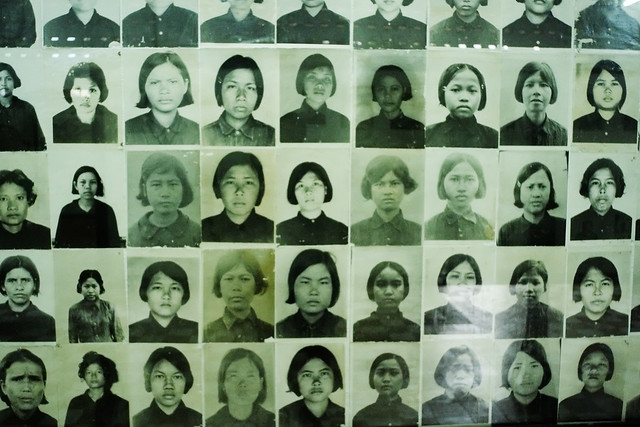
Prisoner portraits during atheist-Maoist-communist takeover of Buddhist Cambodia by Pol Pot and the NAGAS' own Khmer Rouge ("Red Army"). What followed in terms of police state war crimes and genocide of its own citizens is referred to as "Killing Fields."

Murder on an unimaginable scale: Killing Fields
(Tuol Sleng Genocide Museum) Upon arrival at the secret prison, victims were first photographed and required to give detailed autobiographies, beginning at childhood and ending with arrest. They were then forced to strip to their underwear, and all of their possessions were confiscated. The prisoners were then taken to cells.

Those taken to the smaller cubicles were shackled to the walls or concrete floor. Those who were held in the large mass blocks were collectively shackled to long pieces of iron bar. The shackles were fixed to alternating bars; the prisoners slept with their heads facing opposite directions. They slept on the floor without mosquito nets, mattresses, mats, or blankets. They were forbidden to talk to each other. More 

    Tuesday, August 21, 2012

    Burma officially ends censorship today!

    Aung Hla Tun, Reuters, Aug. 20, 2012, TheStar.com.my; Wisdom Quarterly
    Burma's Saffron Revolution saw Theravada monks and lay folk protesting the government
      
    1984 is about Burma and UK 
    YANGON, Burma - Myanmar abolished direct media censorship on Monday, the latest dramatic reform by its quasi-civilian regime, but journalists face other formidable restrictions including a ban on private daily newspapers and a pervasive culture of self-censorship.
      
    Under the new rules, journalists no longer have to submit reports to state censors before publication, ending a practice strictly enforced during nearly half a century of military rule that ended in March last year.
      
    "This is a step in the right direction and a good approach, but questions of press freedom will remain," said Aung Thu Nyein, a senior associate at the Vahu Development Institute, a Thailand-based think tank.
      
    "We can expect the government to still try to assert some control, probably using national security to keep the media in check," he added.
       
    Previously, every song, book, cartoon, news report and planned piece of art required approval by teams of censors rooting out political messages and criticisms of one of Asia's most repressive governments. More

    Saturday, June 16, 2012

    Riots in Burma: Buddhists vs. Muslims?

    Safety fears restrict relief work after Myanmar riots
    Reuters; Manny Mogato in Manila; writing Martin Petty; editing Andrew Heavens
    Armed troops patrolled Burma's northwest city of Sittwe on Friday [June 15, 2012] as a fragile peace held in the wake of days of sectarian violence that has stoked nationalist fervor and displaced 30,000 people, with many feared dead.
       
    Heavy rain kept many residents indoors in the Rakhine state capital as police and aid groups struggled to get food to thousands of ethnic Rakhine Buddhists and Muslim Rohingyas [next to formerly Buddhist now Islamic Bangladesh] displaced by rioting and arson that have presented a big test to Burma's post-military-dictatorship and new 15-month-old quasi-civilian government.
    Who are the tribes? (USCampaignforBurma.org)
    United Nations officials told Reuters three of their staff, two from the UNHCR refugee agency and one from the World Food Programme (WFP), all Burmese nationals, had been detained by police in the Rohingya-dominated town of Buthidaung for unknown reasons.
       
    The WFP had provided hundreds of sacks of rice to some areas, said Aye Win, spokesman for its operations in Burma.
      
    Dealing with anyone in the way of oil pipelines
    "We will try to get to other camps as soon as we can, when it is safe and secure. We are doing as much as we can. We will go in but security is paramount," he added.
      
    More than 20 houses were burned down late on Thursday in a village near Sittwe, residents said, adding to the 2,500 torched in the past week. But there were no reports of further deaths. More

    Why is there "ethnic" trouble?
    Wisdom Quarterly (COMMENTARY)
    Daw Suu Kyi, the new face of Burma with same dictators
    It is common to stoke up ethnic strife to cover up worse crimes. What could be worse than pitting Buddhists and Muslims against one another? Dictator Than Shwe's dreams of an oil pipeline around Bangladesh and into India (then secretly China). Who is in the way? Ethnic minorities displaced by the project. Burma is a police state and has been since at least 1948 (which inspired Burmese-British writer George Orwell to title his most important work 1984).
    Burma's dictator and head of the ruling junta General Than Shwe (Time.com)
      
    As such its ruling junta has remained in power -- changing the country's name, enslaving millions, relocating the capital, imprisoning its duly elected democratic leader (Daw Aung San Suu Kyi), and killing complainers at will -- even if they are Buddhist monastics engaged in peaceful demonstrations known as the Saffron Revolution. Actress Ellen Page referred to the little known  as less recognized Than Shwe as "Hitler." In response to world pressure, Burma has done what America has always done: put on a show of democracy while engaging in the same oligarchical/police state practices it was founded to oppose.
      
    Released from custody, Suu Kyi holds little power
    The US remains a colonial power of the military-industrial complex bankrolled by old European banking interests. Burma now hides behind the veneer of an elected president and even a minor minister (Daw Aung Suu Kyi).
       
    Where have all the dictators gone? They are at home at ease in futuristic mansions of a made up city called Naypyidaw. Corporations 1, People 0.
      
    If ethnic tribes want to stand in the way of Shwe Gas, there is going to be hell to pay. And where is America (aka "the police of the world") in all this? They are first in line to wheel and deal, as recent visits by Hillary Clinton demonstrated. We were not about to sit back and let China and India divide the spoils. Clinton only asked one thing: Pretend to respect human rights. (We'll show you how).
       
    Than Shwe with UN's Ban Ki Moon (AFP)
    So Daw Suu Kyi was given a nominal seat in government and has gone out into the world portraying the country as "reforming." It is far from reformed or reforming. It is merely becoming entrenched in a more sustainable deception. False appearances are much easier to maintain than shows of brute force, and it is especially nice when a government can do both and simply hide behind its reforms. We're not like the old Burma; we're the new progressive people's choice as shown by paid selections being called "free elections."

    SHWE GAS: Corporations and governments are commonly very secretive to the public regarding routes for construction and there has as yet been no mentioning of an Environmental and Cultural Impact Assessment along any of these routes.

    Wednesday, June 13, 2012

    "Poson" at Los Angeles Buddhist Vihara

    Lanka.com; Wisdom Quarterly; Los Angeles Buddhist Vihara

     
    Poson full moon observance day is a festival celebrated on the Buddhist island of Sri Lanka.

    It marks the  arrival of Buddhism in the 3rd century BCE. It is therefore of great historical and religious significance to the island's majority Sinhalese Buddhists, if less important to the nation's many Tamil Hindu, Indian and Maldivian Muslims, British and Portuguese Christians, and a tiny marginalized minority of indigenous aborigines, the Veddas.
     
    The full moon day of June commemorates the arrival of an enlightened emissary from India, the arhat son of Emperor Asoka. Over 2,000 years ago Arhat Mahinda converted Sri Lanka's King Devanampiyatissa to Buddhism.

    The center of celebrations is Mihintale, the ancient monastic complex where the royal missionary monk along with his enlightened sister gave a sermon to the island's ruler. Anuradhapura, the ancient capital, is also a place where large crowds of pilgrims converge. Mass religious observances and illuminated pageants are part of the celebrations.

    For the island's Buddhists, this sacred day is second only to Vesak. Long lines of devotees dressed in white climb the many steps to the top of Mihintale stone outcropping -- a kind of Plymouth Rock (Mihinthalaya) -- first to the temple then to the pagodas (dagabas) adorned in the nearby hills. The top of the rock is where Arhat Mahinda delivered his initial discourses.
      
    This area is called the cradle of Buddhism in Sri Lanka. With the establishment of a monastic order (Sangha) all the elements of a civilized society began to emerge: the art of writing, art, architecture, canals, reservoirs, song and dance forms, literature, all with royal patronage.
      
    [Oh wait, all of these "civilizing" elements were here before. But the Sinhalese trace their dominant culture to the civilizing influence of the Dharma's appearance on the island; they even trace their genes back to northern and northwestern India so as to make them Buddhist-Buddhists and somewhat nationalist in character, which has been quite harmful to the other inhabitants of the island.]

    Many religious activities are organized during Poson such as virtue (sila) campaigns, Bodhi tree rituals, dana-salas (freely donated food and refreshments), devotional songs, parades, and lanterns.
      
    Many temple fill with Eight Precept devotees and pilgrims from all over the island to mark the event. The devout are clad in pure white -- just as in the Buddha's day -- with no adornments like make up on their way to temple. There they spend the next 24 hours actually practicing the Dharma in quiet contemplation or meditation.
       
    Meanwhile, the rest of the village gathers on temple grounds after sunset to participate in less spiritual activities -- like reading sacred books, listening to saffron-clad monastics recite sutras (bhana), relate ancient stories from the Buddha's past lives (jatakas), or chant protections (parittas).
      
    During the Poson Festival the selling of alcohol and animal flesh is usually prohibited, and slaughterhouses are closed. Emperor Asoka made such decrees in ancient India (Bharat) as well after becoming a Buddhist. More