Loading...

This is default featured post 1 title

Go to Blogger edit html and find these sentences.Now replace these sentences with your own descriptions.This theme is Bloggerized by Lasantha Bandara - Premiumbloggertemplates.com.

This is default featured post 2 title

Go to Blogger edit html and find these sentences.Now replace these sentences with your own descriptions.This theme is Bloggerized by Lasantha Bandara - Premiumbloggertemplates.com.

This is default featured post 3 title

Go to Blogger edit html and find these sentences.Now replace these sentences with your own descriptions.This theme is Bloggerized by Lasantha Bandara - Premiumbloggertemplates.com.

This is default featured post 4 title

Go to Blogger edit html and find these sentences.Now replace these sentences with your own descriptions.This theme is Bloggerized by Lasantha Bandara - Premiumbloggertemplates.com.

This is default featured post 5 title

Go to Blogger edit html and find these sentences.Now replace these sentences with your own descriptions.This theme is Bloggerized by Lasantha Bandara - Premiumbloggertemplates.com.

Showing posts with label buddhist. Show all posts

Wednesday, January 16, 2013

A Goddess a Day

Amber Dorrian, Seth Auberon, TEAM BHUMI DEVA, Wisdom Quarterly; GoddessADay.org


Amatheia (pronounced ah-ma-THEE-uh) is an ancient Greek devi -- a daughter of Nereus, one of the goddesses of the sea or Nereids. "God and goddesses"? In Buddhist terms these are terrestrial and celestial (space) devas. They are born of Doris, an Okeanid. Sea nymphs are water elementals who care for bodies of water, the ocean, and its inhabitants. Ancients explained water-related phenomena and its functions as the activity of these powerful entities. Amathea (“nourisher”) was thought of as the devi or mermaid who looked after the development of young fishes (various species of fish).
 
Goddess of Mercy (elfwood)
Are there Buddhist goddesses? There are! The most famous is the bodhisattva of compassion Kwan Yin, often shown as a sea goddess riding a sea serpent (naga). The imagery symbolizes the power of compassion to soothe and smooth out samsara, frequently depicted as a flood, deluge, or ocean to cross over. Wisdom, a goddess called Prajna Paramita ("Perfection of Wisdom") or Khema (the Buddha's chief nun disciple "foremost in wisdom"), transcends samsara. 
 
Other "Buddhist goddesses" may not be devas at all but simply famous women honored with the title devi (queen, ruler, or stunning beauty): Taras (Buddhist Goddesses of India), Tibetan deities, Dharma guardians, particularly those from the realm of the Four Great Sky Rulers of the quadrants, Ven. Uppalavanna Theri (a Buddhist Lakshmi/Saraswati), princesses and female warriors of non-human tribes, Bhumi (Mother Earth), who saved Siddhartha when he outdid Mara the killer and obstacle to enlightenment.

Dealing with Anger.


Over the years, I have wrestled with anger and felt it's sting every time. A lot of times I get angry for reasons that I feel are justified, but even so, I pay a price for letting someone's rude actions disturb the calm waters of my mind. One example being rude drivers on the roads, but getting angry at them doesn't do any good for my mental health. I might feel justified, like I sometimes do, but striking-out at other people is like a bee stinging you when you try to take their honey. They strike-out in anger by stinging you, but in the process they are hurt worse because in the process of stinging you they die.

I'm learning through Buddha that there are other ways to react to problems, solve disagreements or process disappointments than through anger. There are other ways to resolve differences without lashing out in rage. People are less likely to compromise with you or change their behavior if you yell at them with angry words and insults. They simply yell back and you're even further away from resolving your problem with them!!

I'm trying to do meditation in the car to lessen my anger while driving. I simply try to focus on my breathing and remember that mistakes happen but how I react determines how much those mistakes will affect me in a painful way. Another method I try to use is seeing the rude drivers as people suffering greatly. They are unhappy inside, so they lash out at others because they don't know how to handle their pain. They are like a wounded animal that tries to bite you even though you aren't trying to hurt them. They are confused and don't know how to solve their problems, so they blame everyone out of ignorance and delusion. It helps me have compassion toward them instead of anger, which calms my mind rather than succumb to the ego's desire for vengeance.

~i bow to the buddha within all beings~ 


Thursday, November 8, 2012

First Buddhists elected to Congress

Wisdom Quarterly; Marco Garcia (AP); The Washington Post; RNS; Deseret News
US Senate, Washington, DC (peacecorpsconnect.org)
Colleen Hanabusa, right, congratulates Tulsi Gabbard after both women won their Hawaii Congressional district seats, Japanese Cultural Center, Honolulu (AP/Marco Garcia).
 
Senator Colleen Hanabusa (THR)
There were a lot of firsts in faith during the 2012 election season according to The Washington Post and some firsts in Congress. Among them are the election of a Buddhist to the Senate and a Hindu to the House, which will help make those chambers more accurately reflect the increasingly diverse religious landscape of the United States.
 
Tulsi Gabbard (chakranews.com)
Democrat Tulsi Gabbard of Hawaii was elected, succeeding Representative Mazie K. Hirono, who ran for the US Senate. An Iraq War veteran, Gabbard was born in American Samoa to a Hindu mother and a Catholic father and had served on the Honolulu City Council and in the state Legislature. Whereas California used to lead the way with firsts, now [the MIC is using] Hawaii has taken that distinction farther west.

I don't know how we lost in an Ayn Rand world.
Hirono, who is Japanese and Buddhist, was also elected on Tuesday. In 2006, she and Georgia Democrat Hank Johnson, who is African-American, were the first Buddhists elected to Congress.
  
In 2010, Buddhist Colleen Hanabusa, a Democrat from Hawaii, was elected. She will become the first Buddhist senator when the new Congress convenes in January, Religion News Service reported yesterday.
On the Darker Side
On the tragic side, Monsanto Corporation won its preposterous bid (Proposition 37) to continue keeping secret when its genetically-manipulated human-experiment grains and organisms are sold as food to the general population of California (and the rest of the world. Food insecure Russians no longer accept their corn, prompting the European Union to take another look at their policy).
  
Christian fundamentalist candidate Bachmann
And an anti-sex trafficking bill (Proposition 35) on steroids passed, perverting one of the most important causes of all to further the police state. And former Republican presidential candidate hopeful Michelle "Crazy Eyes" Bachmann and Romney running mate Paul Ryan (shown above) were re-elected, even as they failed in their other bids.

Monday, October 29, 2012

Nagas in the News: The Killing Fields

Editors, Wisdom Quarterly; Tamjty (historical photo). HALLOWEEN SERIES
photo
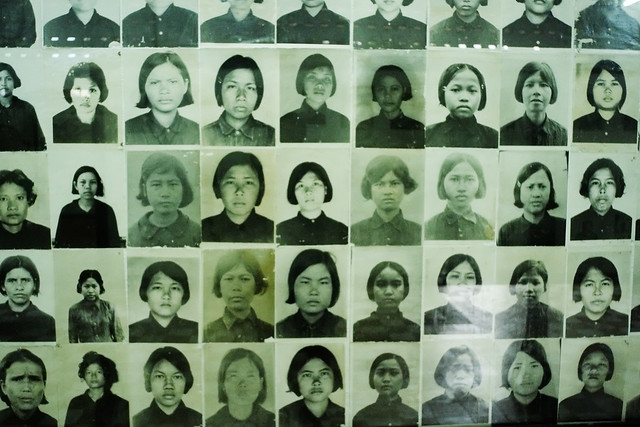
Prisoner portraits during atheist-Maoist-communist takeover of Buddhist Cambodia by Pol Pot and the NAGAS' own Khmer Rouge ("Red Army"). What followed in terms of police state war crimes and genocide of its own citizens is referred to as "Killing Fields."

Murder on an unimaginable scale: Killing Fields
(Tuol Sleng Genocide Museum) Upon arrival at the secret prison, victims were first photographed and required to give detailed autobiographies, beginning at childhood and ending with arrest. They were then forced to strip to their underwear, and all of their possessions were confiscated. The prisoners were then taken to cells.

Those taken to the smaller cubicles were shackled to the walls or concrete floor. Those who were held in the large mass blocks were collectively shackled to long pieces of iron bar. The shackles were fixed to alternating bars; the prisoners slept with their heads facing opposite directions. They slept on the floor without mosquito nets, mattresses, mats, or blankets. They were forbidden to talk to each other. More 

    Thursday, October 18, 2012

    Bhikkhu Bodhi WALKS to Feed the Hungry

    Bhikkhu Bodhi (Buddhist Global Relief, FirstGiving.com); Wisdom Quarterly

    Bhikkhu Bodhi, prolific translator
    LOS ANGELES, California - On Saturday, Oct. 20, 2012 beginning at 9:00 am, American Buddhist scholar-monk Ven. Bhikkhu Bodhi is helping raise money to provide for the hungry. All are invited to meet like minded fellows and have a great time! Donate now. Registration will start at 9:00 am at Santa Monica's New Crossroads School (3131 Olympic Bl., Santa Monica), where some parking is available. The walk will start at 10:00 am and follow a three-mile route ending at Against the Stream (1001a Colorado Bl.) in Santa Monica, where a potluck lunch will be served. Participants are welcome to drop off food and beverages at Against the Stream before the walk. More

    • Contact: Tom Moritz
    • 310-963-0199
    • tom.moritz@gmail.com
    The mission of Buddhist Global Relief (BGR) is to provide relief to the poor and needy throughout the world regardless of nationality, ethnicity, gender, or religion. Bearing in mind the Buddha's statements that "Hunger is the worst kind of illness" and "The gift of food is the gift of life," BGR focuses on providing food aid to those afflicted by hunger and food-insecurity. Its long-range goal, however, is to combat all manifestations of poverty that detract from the inherent dignity of human life.

    Thursday, September 13, 2012

    Obama Karma by Russell Razzaque.

    Greetings, friends and soon-to-be friends!! It has not been my intention to have been away for so long, but some trying times engulfed my wife and I this summer, which kept me away. Things are improving now and much better, so I am officially back!!

    I was recently sent an interesting book titled, "Obama Karma: Lessons on Living Inspired by the 44th President" by Russell Razzaque. I don't normally talk politics on here (I have a separate blog for that) but this book intrigues me.

    I voted for President Obama in 2008, but what I admire about him most isn't his politics necessarily, though many I do support. I admire him greatly for being calm under pressure, ability to listen and for his poise. Those are qualities that I can connect to from my Buddhist practice. Irregardless of his political beliefs, he is a wonderful example on how to calming deal with challenges in life, which is something I lack at times.

    Mr. Obama is Christian, but he has qualities of a Buddhist who has experience with mindfulness. He seems to approach issues with an open-mind, willing to listen to other viewpoints before sharing his personal opinions. This speaks of a natural ability to practice "right speech" which hinges upon being able to listen, and truly listen, which means not just waiting for your turn to speak again. It means being mindful enough to truly absorb the intention behind each word, rather than just the words themselves. If we are listening but get caught up in our own thoughts at the same time then we miss vital pieces of information that could be gleaned from body language and intentions behind words. Being able to perceive these other signals can only come when we are truly present and aware of our partner in discussion.

    This are some of but a few thoughts and lessons I learned from reading the book, "Obama Karma." The book also includes practical exercises on how we can ingrain similar traits into our personal lives. It's a book that straddles the political and spiritual without drowning in the overly political. It's a nice, short, read but deep with insights. I'd really recommend it. I'd give it 4 1/2 stars out of 5. A good gift idea for your political friends, Obama supporters or just people looking for lessons on how to be more mindful in political discussions.

    Bowing,
    -James

    ~I bow to the Buddha within all~

    Tuesday, August 14, 2012

    Buddhist Geeks (audio archive)

    BuddhistGeeks.com
    Emerging Science of Mindfulness Meditation
    Harvard Prof. David Vago, an instructor of psychology at Harvard Medical School, has held the position of Senior Research Coordinator for the Mind & Life Institute, a not-for-profit organization dedicated to fostering dialogue and research at the highest possible level between modern science and the great living contemplative traditions. Prof. Vago relates how his personal mindfulness practice has integrated with his professional scientific research. He talks about the thriving community of scientists interested in mindfulness that has taken root in contemporary academia and research, and he highlights some current projects and lines of inquiry that have benefited from this uniquely...
     
    Is Super Mario a Buddhist?
    Stanford Prof. Jane McGonigal is an author and game designer who wants to change the world through gaming. In this second part of a presentation recorded during the 2011 Buddhist Geeks Conference, she shares the details about games where people are going into the world and using gamer virtues for real life good. From better community organizing, to solutions for regional famine, to possible treatments for cancer, McGonigal and her gamers are changing the world one epic win at a time....
      
    The Angry Buddhist
    Fiction author Seth Greenland is also a playwright and screenwriter. For two seasons he was a writer-producer on the Emmy-nominated HBO series "Big Love." His latest novel, The Angry Buddhist, is the story of an ex-policeman seeking guidance from an online Buddhist teacher. The novel is currently in development with Showtime as a possible series for the network with Greenland writing and producing. Buddhism is really making its way onto the pop culture landscape. More

    2012 CONFERENCE
    Lama Surya Das (American lama), Amber Case (cyborg anthropologist), Stephen Batchelor (former Buddhist monk, author), Elizabeth Mattis-Namgyel (teacher and author), Matt Flannery (Kiva.org CEO), Martine Batchelor (former Buddhist nun, teacher, author), Michael Stone (Buddhist Activist), Daniel Ingram (practical Dharma teacher), Willoughby Britton (contemplative scientist), Ken McLeod (teacher, executive coach), Tami Simon (Sounds True CEO), Rohan Gunatillake (meditation entrepreneur), Stuart Davis (bodhisattva rocker), Vincent Horn (Buddhist Geek), Robert Spellman (contemplative artist)...

    Friday, July 6, 2012

    Audio Dharma by Bhikkhu Bodhi

    Afghan (Gandhara) style Buddha (San Francisco Asian Museum)
      
    From the wide range of meditation subjects found in the Buddha’s discourses [sutras], the ancient teachers of the Theravada tradition have selected four subjects and grouped them into a set known as “the four protective meditations”: 
    1. Recollection of the Buddha
    2. Loving-kindness meditation
    3. Contemplating the Unattractive Nature of the Body
    4. Mindfulness of Death
    The four are called “protective” meditations because each offers protection from a particular unwholesome tendency and reinforces a beneficial quality essential to the path. 
      
    The four can be developed either as a preparation for a more intensive type of meditation or as independent subjects.
    1. Recollection of the Buddha protects against dissatisfaction and generates faith [confidence] and devotion, which in turn give rise to joy. 
    2. Loving-kindness is the antidote to ill will and generates feelings of friendliness and altruistic concern.
    3. Contemplating the unattractive nature of the body debilitates sensual lust and inclines the mind toward disenchantment and [liberating] dispassion. 
    4. Mindfulness of death is a potent remedy for heedlessness, reminding us of the transience of everything we cherish.
    Over the next four weeks [the American monk] Bhikkhu Bodhi* will explain each of these meditation subjects in turn and conduct each as a guided meditation.
    • Buddhist Global Relief
    • A Critique of Bhikkhu Bodhi
    • Reading Bhikkhu Bodhi's translations and copious commentary, one clearly understands he has a dry-insight method bias [characteristic of the Theravada school of the past few centuries], to the detriment of absorption practice (jhana).
    • The Appeal of Buddhism in the West
    • Padmasambhava predicted that, "When the iron eagle flies and horses run on wheels, the Tibetan people will be scattered over the Earth and the Dharma will go to the land of the red man" (Westerners were considered reddish pink by Asians).
    *Ven. Bodhi teaches at Chuang Yen Monastery in Carmel, New York. He is currently translating the Anguttara Nikaya, The Numerical Discourses of the Buddha.

    Saturday, March 24, 2012

    Thai Buddhist Monk: The Hands of Change.

    Those tattooed and weathered hands and arms have seen a lot of change and yet they are still relaxed. They are a testament that the Buddha's teachings stand the test of time. The tattoos speak of the wisdom his body has absorbed from a lifetime of practicing the Dharma. If those hands could talk, I'm sure they'd have quite an inspiring story to tell!!

    ~I bow the Buddha within all beings~

    Friday, December 9, 2011

    Bodhi Day Message of 2011: The Gift of the Dharma.

    PHOTO CREDIT: Buddha sitting under the Bodhi tree gazing upon the morning star. Image provided by the American Public Broadcasting Service, which was used in their documentary titled, "The Buddha."

    Today marks the day that Buddha found his way out of the maze of suffering. Otherwise known as his "enlightenment." Countless Buddhists, worldwide, mark this day each year with personal reflection, meditation, and gratitude. For me, while the actual moment of enlightenment is to be honored, the essence of my celebration on Bodhi Day is that Buddha determined to share his discoveries in the first place!! Upon breaking free of the prison of the mind, he questioned sharing this information.

    He wasn't sure if he could be an effective teacher. Remember, he was just emerging from the life of a hermit aesthetic who had given up on society and organized spirituality. Throughout his laborious practice, he had studied under many spiritual teachers, only to realize that true liberation comes from within. No amount of teaching can replace personal insight and awareness achieved through meditative reflection. Given this reality, he wondered if sharing the particulars of his discovery would even make sense or gain interest in a society that was so immensely ingrained in the pursuit of worldly desires.

    Why would they listen to some barely clothed hermit who just wandered out of the forest talking about achieving spiritual freedom from just sitting still? Why wouldn't they ignore someone who would not only tell them that the way they'd been living for eons would never make them truly happy, but that even worse, it was causing them deep suffering!! Would he simply be wasting his and their time? But, luckily for us, the profound and unrelenting compassion that comes with the liberation of enlightenment compelled Buddha to share his discoveries. His compassion for those trapped in the suffering of materialism won out.

    One of his realizations during his final night of searching was that he was interconnected to all beings. He couldn't have achieved his liberation had it not been for the aid given to him by others who came before him. Thus, given his understanding, it would be like the brain not sharing life-saving information with the rest of the body for him to not offer his wisdom to those would seek him out. It was up to the individual to decide what to do with the information once learned.

    I believe that Buddha would be the first one to say that celebrating him on this day is kind but that the center of our focus on this day should be the Dharma itself. Perhaps he would politely remind us of its timelessness and that it is not something be created, but discovered. I think he would not want to be worshiped, because the Dharma belongs to no one and everyone at the same time. It is like oxygen or thermal heat -- universal and timeless. It is not something to own, or sell, or claim as solely yours. That would be like saying you own a patent on the sun. So, the Dharma itself is what I celebrate on Bodhi Day. For Buddha's part, I feel gratitude that he chose to sacrifice the rest of his life to share the discoveries he realized that night, under the Bodhi tree (the scientific name of a Bodhi tree is a banyan fig tree).

    Thus, instead of a having a Christmas tree during this month of December, we get into the American, holiday season by decorating a traditional "Christmas" pine tree with Buddhist themed ornaments. Including, a star at the top of the tree that I made from local pine twigs, which signifies the morning star that Buddha saw during the last minutes of the night before his first day as a Buddha. And, at the base of the tree, we place a Buddha statue to signify Buddha meditating under the Bodhi tree. I hope you had a peaceful and renewing Bodhi Day (Rohatsu)!!

    ~I bow to the Buddha within all beings~

    Saturday, November 19, 2011

    iLivelihood: Steve Jobs and Right Livelihood.


    It is true that the inventor of the iPhone, Steve Jobs, was a genius and a true visionary. His inventions revolutionized modern society, which rightfully gives him a place among legends such as Thomas Edison and Henry Ford. It is also true that he dabbled in Zen Buddhism but I feel it goes too far when Lama Surya Das describes Steve Jobs as exemplifying the Buddhist teaching of "Right Livelihood."

    Right Livelihood is one of numerous teachings by Buddha on how to live a life with less suffering for yourself, and others. One of those is "Right Livelihood" which (in brief) advises working in a job that does not promote the suffering of others. Unfortunately, Steve Jobs oversaw a multinational corporation that employed factories that did not treat their employees very well. In 2006, Apple was criticized for the working conditions in a factory that made iPods and Nanos.

    The workers in that factory (Foxconn) were made to work 15 hour days until 11:30 at night and could not live with their families but instead had to live in on-site dormitories. In return for such harsh labor they were only paid US$50 a month. It might be a decent wage in China, but if Jobs was a Buddhist who truly cared about Right Livelihood, he would have ensured better conditions, and wages. Especially when you consider how much those finished products cost and how much money they brought in for Apple and Steve Jobs. According to the article, workers are "lucky if they make two percent of the profit from an iPod."

    In response to the revelation of such working conditions, you'd think a Buddhist example of "Right Livelihood" would immediately put a stop to them. Sadly, no. As late as this year, Apple was still using the Foxconn factories to build iPads, and the conditions haven't changed. The working conditions are so terrible that 14 workers at Foxconn factories committed suicide in a 16 month period!! It became such a problem that Foxconn had to install giant nets around the tall factory building to prevent workers from leaping to their death. Supposedly workers could only work 36 hours of overtime but one record showed a worker having to work 98 stressful hours of overtime. It was also routine for less productive workers to be humiliated in front of their colleagues and all employees were banned from talking.

    Of course, such working conditions don't tarnish everything that Steve Jobs accomplished, but in light of them, let's not claim Steve Jobs was more than he turned out to be. He was a flawed being like all of us, and we do not need to make him a near-deified being to appreciate his genius.

    ~I bow to the Buddha within you all~

    Friday, April 22, 2011

    A Buddhist Earth Day Message.

    Buddha's foundational teaching of interconnection and interdependence, or co-arising demands that we live in balance with the environment. If we are just as apart of a towering tree as it's leaves, then to recklessly destroy our forests, rivers and oceans is to slowly but exponentially kill apart of ourselves.

    The Buddha's teaching on walking the middle ground between extremes of over-consumption and austerity fits perfectly into the modern, environmental practice of living in balance with nature. It's what we speak of today as "sustainability" or living within our means. It's not necessary to live like a cave man to be an environmentalist in the Buddhist sense, as that would be living out of balance in austerity. It's structuring our lives, so that when we utilize nature's resources, we do it in a balanced and sustainable way.

    This "one or the other" thinking that exists in the environmentalist debate today is a less skillful approach. We don't have to choose between environmental sustainability and destructive over-consumption. The environment uses our byproducts of exhaled carbon dioxide to live, and our body waste (or that of animals) as fertilizer, so it's a symbiotic relationship of give and take. The problem comes, of course, when we take much more than is given and the entire ecosystem is throw out of balance, endangering all.

    Another modern day environmental tenet is recycling, which, again fits snugly within the Dharma. Buddha's robes (and those of his fellow monks) where said to be fashioned from scraps of cloth found discarded and donated by generous families. They would even use scraps from the clothes of dead people donated by grieving families!! How many of us wear second-hand clothes made from discarded fabric?!! However, we don't have to adorn ourselves in tattered cloth in order to leave a soft footprint on the environment. It's a matter of repairing garments that are otherwise perfectly wearable, rather than throwing them in the trash.

    Buddha also didn't have a fancy, extensive wardrobe to choose from, but rather only what was necessary. For us, today, that means buying less clothes than we need, which is not only in keeping with the middle path, but also the Buddhist ideal of balanced consumption. It also means donating old clothes, instead of throwing them in the garbage. And less garbage means a less polluted environment; thus, a healthier place to live.

    In wrapping up the post, I want to come full circle back to interconnection. As Buddhists, we believe that all sentient beings are reborn upon death. Therefore, we should feel a strong commitment to leave a better world for those beings. To paraphrase a famous quote, the environment is on loan to us from future generations. Let's not ruin it for them--and us. Happy Earth Day everyone!!

    ~Peace to all beings~

    Monday, February 14, 2011

    Interview with an American Buddhist Soldier Serving in Afghanistan. Part II.

    And, now, the second half of my inteview with American Buddhist Lieutenant Hunnewell who is currently serving in the U.S. military in the war in Afghanistan (to read the first half of the interview, click on this sentence):

    4). How do your other soldiers feel about your Buddhist practice?


    On occasion I will receive questions about what the Buddhist practice entails and am increasingly receiving questions pertaining to the subjects of meditation and mindfulness. The Army is educating Soldiers more and more about the practice of meditation in order to assist Soldiers with the stressors of combat.

    5). What tradition of Buddhism do you practice. Or, do you practice your own version?
    I practice in the Mahayana Buddhist tradition and am looking to join a sangha upon return home that follow the practices of Plum Village and Thich Nhat Han.

    And, lastly...

    6). Is there anything special that we in the Buddhist community can do to help the soldiers, and you in particular? Are they things we could send you to help you practice your faith? Or, any personal items that would improve your time there? Any books?

    The Buddhist community could assist with the creation of a Buddhist Field Guide for members of the military which is being created in conjunction with a Buddhist Chaplain from the Navy. The information can be found on www.buddhistmilitarysangha.blogspot.com.

    I have an amazing support network with consistent care packages from my wife, who continues to mail me packages even though she is a little over eight months pregnant. We are expecting our first child. I am very much interested in reading the following works from Thich Nhat Han “Savior”, “Chanting From the Heart: Buddhist Ceremonies and Daily Practices”, and “Being Peace”.

    PHOTO CREDIT: Ancient Buddha statue in Afghanistan.

    ~Peace to all beings~

    Thursday, February 10, 2011

    Interview with an American Buddhist Soldier Serving in Afghanistan.

    (Above: 1st Lt. Stephen J. Hunnewell)

    Recently I was given the opportunity and honor to interview Buddhist Soldier and two-time Bronze Star Medal recipient, 1st Lt. Stephen J. Hunnewell, who is currently serving with the U.S. Army in Afghanistan. I just first want to say how wonderful it is to know that there are Buddhists in the military. It is my hope that the calming teachings of Buddhism are helping the soldier deal with the stresses of combat.

    I was humbled to be able to interview such a unique and courageous individual. As a Buddhist, I find war a particularly vicious extension of suffering that causes deeps wounds of the spirit and body. Yet, I am also a realist and understand that sometimes such abhorrent measures are unfortunately necessary to protect the innocent and maintain a semblence of humanity. Otherwise, the merchants of endless suffering pour forth rivers of blood that is unabated. That is an ugly picture to paint, to be sure. However, it is necessary that we Buddhist realize that we don't live in a Utopian world. It would be nice to believe that ending war on Earth is possible but, so long as there is attachment to power, greed and hatred, it will exist.

    This doesn't mean that we shouldn't do everything in our power to reduce violence, war and bloodshed. We can also pressure our leaders to ensure that we will only go to war when all other methods of settling disputes has been thoroughly exhausted. It also means that we conduct war in a way that lessens innocent casualties and utilizes non-violent methods to bring an end to hostilities. Lieutenant Hunnewell is engaged in such non-violent projects within the Afghanistan war-zone and we are thankful for his sacrifice, work and inspiration.
    As a Civil Affairs Team Leader, Hunnewell is responsible for overseeing a three Soldier team whose primary objective is to advise local Afghan officials on the implementation of productive governance processes and assist them in forming meaningful connections with the local population and ensuring they are properly serving the citizens which they represent.
    So, now that you know his role better; lets proceed to the interview, shall we?

    1). How do you maintain your Buddhist practice while out in the field?

    I make a concerted effort each day to take some personal time for reflection and meditation. I am lucky in that where I live now I have my own personal space, wood walls separate myself and other Soldiers, and I am able to meditate whenever I am at the Combat Outpost. I spent the majority of this deployment living amongst the Afghan people and when I was living with them I usually woke-up before dawn, sat outside, and centered myself.

    2). There are so many great and historic Buddhist sites in Afghanistan. How do you feel about the destruction of the Bamiyan Buddhas by the Taliban in Afghanistan?

    The destruction the Bamiyan Buddhas is not only a great loss to Buddhists, but to all humanity. The sites were works of art and pieces of history which we have all been robbed of. Currently, the Government of the Islamic Republic of Afghanistan (GIRoA) is assisting the Chinese government in excavating the ancient site of Meys Aynak in Logar province.

    3). How has your Buddhist practice helped you reach out to the Afghan people and communicate with them on the same level?

    With regards to the reintegration process and conducting negotiations and mediations my practice has helped me tremendously. A short story; I was conducting a civic negotiation with local farmers in the Pech Valley, Kunar province, which is the most violent area in eastern Afghanistan and where the majority of my accumulated 18 months of service in Afghanistan has been spent. I was accompanied by a representative from the United States Department of Agriculture (USDA). We were assisting GIRoA officials in engaging local farmers in order to educate them on diversifying their crops to produce more nutrient dense feed for themselves and their animals as well as to deny the insurgents fields to hide and stage ambushes in. The farmers were very stubborn and would not listen to the government officials or the USDA representative and I.

    I continued to engage in calm negotiations and eventually the farmers were convinced that diversifying the crops was not only good for them and their animals but also in the best interest of the coalition forces (CF) and the Afghan National Security Forces (ANSF). The representative from the USDA then said to me, “Wow! You have a tremendous amount of patience with these people.”

    I feel that my practice helps me to enter a situation with a beginners mind. I try to see the world from their view and not bring in preconceived notions. How would an Idaho potato farmer react to someone trying to tell them to grow blueberries? The people of the valley have grown corn for thousands of years and it had worked for them, why change? The operation, which was dubbed “Operation Crop Diversification”, resulted in over 1000 farmers in the valley diversifying their crops with the help of government subsistence and no attacks from the fields on both CF and ANSF.

    Furthermore, I have engaged with insurgent leaders within days of being personally attacked by their troops and possibly themselves. A few of the incidents resulted in serious injuries and the loss of life, which harmed me as well. But I would continue to engage them in civil discourse in order to give hope to the reintegration process. Many times groups and individuals have been fighting due to a feeling of being wronged and many times they only want to have their grievances heard...

    (...to be continued tomorrow).

    ~Peace to all beings~

    Tuesday, February 1, 2011

    Colorado Town Allows Funeral Pyre Cremation.

    CRESTONE, Colo. -- Belinda Ellis' farewell went as she wanted. One by one, her family placed juniper boughs and logs about her body, covered in red cloth atop a rectangular steel grate inside a brick-lined hearth. With a torch, her husband lit the fire that consumed her, sending billows of smoke into the blue-gray sky of dawn. The outdoor funeral pyre in this southern Colorado mountain town is unique. Funeral and cremation industry officials say they are unaware of any other place in the nation that conducts open-air cremations for people regardless of religion. A Buddhist temple in Red Feather Lakes, Colo., conducts a few funeral pyres, but only for its members. (Article by Ivan Moreno of the Associated Press)

    James: I have long told family and close friends that my wishes upon death are to have my body cremated and the ashes spread through the four elements of nature: earth, fire, air and water. It is my hope that those ashes will be of benefit to the natural world that made this current life possible. It is a good reminder of the impermanence of life, and a powerful, visual aid to help us let go of the deceased. It seems as though it would help loved ones accept the reality of the death easier than dressing them in fancy clothes and applying make-up as though they are off to a party, rather than no longer alive. I feel that sealing that costumed corpse into a box, to bury in the ground, frozen in time, seems like it often makes the suffering of those left behind more painfully drawn out; leaving them lost to the enslavement of denial.

    So, I am pleased to see my home state of Colorado taking the lead on allowing cremation by funeral pyre; especially when you consider the growing Buddhist population here who tend to favor cremation. I like the visual impact of it because so much of the death process in the West is hidden from view--even the current manner of cremating remains occurs behind closed doors. It seems very natural and fittingly appropriate for family and friends to be active participants in the disposal of the body. I don't think there is anything wrong with burying your family in the ground, if that's your style. However, I don't see why there should be laws outlawing cremation by funeral pyre if the proper regulations, authorities and guidelines are established. As well as a location deemed safe and sanitary for such a ceremony.

    ~Peace to all beings~

    PHOTO: Cremation by funeral pyre in Crestone, Colorado, USA by Ivan Moreno for the Associated Press.

    Wednesday, December 15, 2010

    Blogisattva Award Results are In.

    The Blogisattva Awards have been announced and as usual they represent some of the most thought-provoking, English-speaking, Buddhist blogs on the internet today. I am honored to know these valuable writers, and highly recommend ALL of the blogs honored. Online Buddhists have really carved out a vibrant and supportive sangha over the past decade. I am quite excited about the future and know that Buddhism is in good hands on the internet.

    ~Peace to all beings~

    Thursday, December 9, 2010

    The Buddhist Blog Honored with Award Nominations.

    Wow. The 2010 Blogisattva Award nominations have been announced and The Buddhist Blog has been honored. The blog was nominated in three categories: Best Engage-the-World Blog, Best Achievement in Kind and Compassionate Blogging and Best "Life" Blog. The blog also received honorable mentions in other, categories: Best Achievement Blogging Opinion Pieces or Political Issues, Best Blogging on Matters Philosophical, Psychological or Scientific and Best Blog of the Year!!

    I know that some of you nominated the blog for these nominations and I am humbled by your appreciation. You, and the Blogisattva Awards committee honor the blog greatly and I will use this positive energy toward keeping the voice of the reclusive Buddhist alive. Perhaps the boring side of the blog is that I write mainly because it aids my practice but it also is a labor of love in honor of the Dharma. It is a testament of how amazingly beneficial Buddha's teachings are to humanity. I credit the Dharma in being the catalyst to helping me emerge from a very dark, angry and self-destructive life-pattern that I was on before.

    It is fitting perhaps that these honors come on a day when we recognize the enlightenment of Buddha (Bodhi Day) and the priceless gift that he bestowed upon all humanity. None of us would be benefiting from the Dharma without his self-sacrifice. After his great awakening (or, enlightenment), he could have wandered off into the mountains to live out the rest of his last incarnation before merging into parinirvana. Instead he chose to share the path he realized with the world and we are his heirs.

    But I digress. Buddhism has been a great help in reducing the symptoms of my psychiatric condition and that is another reason that I write. To show others that Buddhism can be of great benefit to the restless mind wrapped up in psychiatric turmoil. The Dharma has been like another medication but one without negative side effects. So, any recognition that I am honored with must be given back to Buddha and those who honored me with these nominations. I cherish my readers as friends and family. It is my hope that this new year will bring greater acceptance of online interaction in the Buddhism community at-large.

    Whether the blog actually "wins" any awards is secondary to what I have gained through interacting with all of you. You have truly enriched my life and I look forward to our interactions each day. May this next year be a wonderful year for Buddhist blogging. There are a lot of great blogs out there that keep the online Buddhist community going and I am forever honored to be mentioned alongside them all. Be sure to check them out!! Thank-you, again for the humbling honor that you have shown. Here's to a new year!!

    P.S. - It's hard to sound honored without coming across as cliche but I really, really mean what I wrote. Every word. Thanks again to the judges and everyone else at The Blogisattva Awards.

    ~Peace to all beings~