Prof. Malalasekera, Dictionary of Pali Names (palikanon.com); Dhr. Seven, Wisdom Quarterly

 Māyā: ("illusion," vision of beauty) or Mahāmāyā ("Great Maya") Devi (Queen, "shining one," deva, goddess).
Dandapāni and Suppabuddha were her brothers, and Mahā Pajāpatī her sister. Both sisters were married to King Suddhodana in their youth, but it was not until Māyā was between 40 and 50 that Siddhartha was born (Vibhā.278).
She had all the qualities necessary for one who was to bear the exalted rank of being the mother of the Buddha: she was not too passionate, she did not take intoxicants, she had practiced the pāramīs for 100,000 aeons, and had not since her birth violated the Five Precepts.
Maya's Dream
On the day of her conception she fasted. And in her sleep that night she had the following dream: the Four Great Sky Kings (Catu Mahārājas) took her in her bed to Himavā and placed her under a Sal tree on Manosilātala. Then their wives came and bathed her in Anotatta Lake and clad her in deva robes. They then led her into a golden [space or ethereal] palace [craft, mansion, platform] and laid her on a deva couch; there the Bodhisat (the Buddha-to-be), in the form of a white elephant, holding a white lotus in his gleaming trunk, entered into her right side. This was on the day of the Uttar-āsālha-nakkhatta, after a festival lasting seven days, in which she had already taken part.
From the day of her conception she was guarded by the Four Great Sky Kings; she felt no desire for men, and the child in her womb could be seen from outside.
At the end of the tenth lunar month, she wished to return to her parents' home in Devadaha to give birth as was the Indian custom. But on her way there, she stopped at the Sal tree grove in Lumbinī [exact location disputed, likely in Northwest India, toward Iran, which became part of Persia].
The child was born as Maya stood holding the branch of a Sāla tree (J.i.49ff) -- the imagery here being that of a particular kind of Indian tree goddess: Salabhanjika.
Seven days later Māyā died and was reborn as a male in the Tusita world in space, under the name of Māyādevaputta (Thag.vss.533f.; ThagA.i.502) or "Maya-born-among-devas."
After Siddhartha became the Buddha he visited Tāvatimsa ("The Space World of the Thirty-Three") immediately after the performance of the Twin Miracle in Kapilavastu at the foot of the Gandamba tree, on the full moon day of the month of āsālha. That is where, for the three months of the rainy season, the Buddha taught the Collection of "Higher Teachings" (Abhidharma Pitaka) to his former mother, who came down from the Tusita world to listen to him.
The Buddha sat on King Sakka's royal seat (pandukambalasilāsana) at the foot of the Pāricchattaka tree. It is said that during this time, at certain intervals, the Buddha would return to Earth, leaving a seated image of himself (a division body in Mahayana terms) in Tāvatimsa to continue teaching while he attended to his human bodily needs, searching for alms in Uttarakuru and eating his meals on the banks of Lake Anotatta, where Sāriputra waited on him and learned what he had been telling the devas (DhSA.i.15; DhA.iii.216f); Ananda was not yet his attendant.
The commentaries (UdA.276f) state the view, still held by some, that had Māyā been alive the Buddha would not have been reluctant to bestow monastic ordination on women. This view, says Dhammapāla is erroneous. It would have made no difference. Why? It is the dhammatā of all buddhas that women receive ordination. Monks argue that while this may be true, ordination is subject to certain important restrictions.
It happens that the mothers of all buddhas die very soon after the birth of a bodhisattva because no other child is fit to be conceived in the same womb as a future buddha.

 |
| Queen Maya, living in the crossroads of East and West, as the future-Buddha takes birth. Siddhartha is born with blue eyes, golden skin, and black curly hair. |
 Māyā: ("illusion," vision of beauty) or Mahāmāyā ("Great Maya") Devi (Queen, "shining one," deva, goddess).
 Maya was the biological mother of the Buddha (D.ii.52; see Thomas: op. cit., 25).
Her father was the Shākyan Añjana of Devadaha, son of Devadahasakka. Her mother was Yasodharā, daughter of Jayasena. [Mhv.ii.17ff.; elsewhere her father is called Mahā Suppabuddha (ThigA.141), while the Apadāna (ii.538) gives the name of her mother as Sulakkhanā) quite like the Persian Sulakhan].
 |
| The Buddha had blue eyes (CP) |
She had all the qualities necessary for one who was to bear the exalted rank of being the mother of the Buddha: she was not too passionate, she did not take intoxicants, she had practiced the pāramīs for 100,000 aeons, and had not since her birth violated the Five Precepts.
 |
| Sistan and Baluchistan, Iran/Afghanistan/Pakistan, ancient Northwest India (Maha Bharat) |
 |
| Maya had a dream, a comforting dream that a magnificent event was in the offing. |
Maya's Dream
On the day of her conception she fasted. And in her sleep that night she had the following dream: the Four Great Sky Kings (Catu Mahārājas) took her in her bed to Himavā and placed her under a Sal tree on Manosilātala. Then their wives came and bathed her in Anotatta Lake and clad her in deva robes. They then led her into a golden [space or ethereal] palace [craft, mansion, platform] and laid her on a deva couch; there the Bodhisat (the Buddha-to-be), in the form of a white elephant, holding a white lotus in his gleaming trunk, entered into her right side. This was on the day of the Uttar-āsālha-nakkhatta, after a festival lasting seven days, in which she had already taken part.
 |
| Maya returns to Tusita, awaits the arising of the fully awakened teacher down on Earth |
From the day of her conception she was guarded by the Four Great Sky Kings; she felt no desire for men, and the child in her womb could be seen from outside.
At the end of the tenth lunar month, she wished to return to her parents' home in Devadaha to give birth as was the Indian custom. But on her way there, she stopped at the Sal tree grove in Lumbinī [exact location disputed, likely in Northwest India, toward Iran, which became part of Persia].
The child was born as Maya stood holding the branch of a Sāla tree (J.i.49ff) -- the imagery here being that of a particular kind of Indian tree goddess: Salabhanjika.
Seven days later Māyā died and was reborn as a male in the Tusita world in space, under the name of Māyādevaputta (Thag.vss.533f.; ThagA.i.502) or "Maya-born-among-devas."
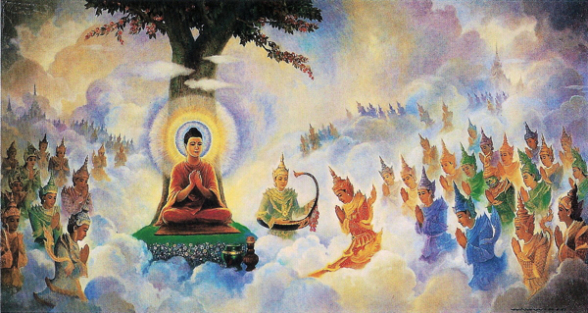 |
| Buddha visits Tavatimsa to teach |
The Buddha sat on King Sakka's royal seat (pandukambalasilāsana) at the foot of the Pāricchattaka tree. It is said that during this time, at certain intervals, the Buddha would return to Earth, leaving a seated image of himself (a division body in Mahayana terms) in Tāvatimsa to continue teaching while he attended to his human bodily needs, searching for alms in Uttarakuru and eating his meals on the banks of Lake Anotatta, where Sāriputra waited on him and learned what he had been telling the devas (DhSA.i.15; DhA.iii.216f); Ananda was not yet his attendant.
 |
| Visiting Tavatimsa to hear the liberating Higher Teaching (theindiespiritualist.com) |
The commentaries (UdA.276f) state the view, still held by some, that had Māyā been alive the Buddha would not have been reluctant to bestow monastic ordination on women. This view, says Dhammapāla is erroneous. It would have made no difference. Why? It is the dhammatā of all buddhas that women receive ordination. Monks argue that while this may be true, ordination is subject to certain important restrictions.
It happens that the mothers of all buddhas die very soon after the birth of a bodhisattva because no other child is fit to be conceived in the same womb as a future buddha.
Māyā is mentioned in several "Rebirth Tales" (Jātakas) as the mother of the Bodhisat:
- the Alīnacitta
- the Katthahāri
- the Kurudhamma
- the Kosambī
- the Khandahāla
- the Dasarath
- the Bandhanāgāra
- the Mahāummagga
- the Mātuposaka
- the Vessantara
- the Susīma
- the Somanassa
- the Hatthipāla
According to some contexts, after her birth as Phusatī in the Vessantara Jātaka, Māyā became one of the daughters of King Kikī.
Māyā's resolve to be the mother of a buddha was formed 91 aeons ago in the time of Vipassī Buddha (J.vi.480f). She was then the elder daughter of King Bandhumā. One of the king's vassals sent him a piece of priceless sandalwood and a golden wreath worth 100,000 units of money. The sandalwood the king gave to his elder daughter and the wreath to the younger.
The elder daughter powdered the sandalwood and took it in a golden casket to the Buddha Vipassī. Some of the powder she offered to the Buddha to be rubbed on his body, the rest she scattered in his living quarters. It was the sight of the Buddha's golden body that inspired her with the desire to be the mother of such a being. Her sister later became Uracchadā.
A Question of Race
Dhr. Seven, Wisdom Quarterly (COMMENTARY)
Unfortunately, living in the very implicitly racist West (not that anyone will admit it), the question of race comes up. Was the Buddha white, yellow, brown, or black?
(What about biblically black Jesus or sacrosanct Mohammad?)
Those are the only four color choices modern Americans recognize (our British forbears and European may have more), although we are slowly warming to the idea of "mixed." What about white geopolitical Middle Easterners? No one calls them white; Jews aren't allowed in the club; even some of the whitest people on the planet only recently got to use the mantle (those people being the Gingers of Ireland). Often the whitest people are not considered "white" at all.
But this is not how "race" has been reckoned in the past -- not in America and certainly not in ancient India -- nor is it how the world does it now. More usual is the three shade distinction: light, medium, dark. In the Buddha's day those lighter skinned individuals were called golden. He was golden. He had curly black ringlet and blue eyes. He was not dark like so many of his followers in non-frontier India [called Bharat or Maha (Great) Bharat, as in the epic Mahabharata, since it was an expansive "empire," later re/united by Asoka, of affiliated family-centered rulers with dynamic territorials boundaries called janapadas or "holdings," literally "foothold of a tribe"].
A prophetic dream mentions that in the future he would have many very dark-faced followers wrapped in white garments, as happened in Magadha, India, where throngs of citizens interested in the Buddha-Dharma and this wise teacher wore white when visiting monastic centers.
We would like it all to be clean and like our own time. But it simply is not. There were no "countries" or "races" as such. These social constructs are categories that evolve and are greatly affected by politics, economics, and circumstances so much so as to be misleading. It is very hard to judge the past, given that we assume our standards are universal and absolute. It is not even possible to objectively judge other geographical regions at present, given that standards, terminology, customs, and judgments are neither universal nor absolute. The Bodhisattva was brilliant to choose neither East nor West but the conflux of the two. The same wise choice was made as to where to attain final nirvana (the nirvana entered into as one passes away as distinct from glimpsing or re-experiencing nirvana during one's lifetime).
Ananda asked, "Why have you chosen this Podunk town!?" (Kusinara/Kushinagar, thought to be near modern Gorakhpur, India, but possibly much farther west). The Buddha explained that it was between powerful kingdoms/republics (janapadas) of followers. This way they would not fight for the relics or be able to claim them as the property of one ruler to hoard. Indeed, the cremation remains were amicably distributed with at least one portion going into space (as hard as that may be to believe, so hard that history quaintly imagines "heaven" got a portion. But records state that an actual lower world in the sky -- in the akasha deva loka, maybe just somewhere flown to the equivalent of Mt. Olympus/Mt. Sumeru -- near enough to visit from Earth).
What do his parents or where he was born matter?
Four Places of Pilgrimage
Sister Vajira and Francis Story, Last Days of the Buddha (DN 16)
...16. "There are four places, Ananda, that a pious person should visit and look upon with feelings of reverence.[Note 42] What are the four?
17. "'Here the Tathagata was born!'[43] This, Ananda, is a place that a pious person should visit and look upon with feelings of reverence.
18. "'Here the Tathagata became fully enlightened in unsurpassed, supreme enlightenment!'[44] This, Ananda...
19. "'Here the Tathagata set rolling the unexcelled Wheel of the Dharma!'[45] This, Ananda...
20. "'Here the Tathagata passed away into the state of nirvana in which no element of clinging remains!' This, Ananda...
21. "These, Ananda, are the four places that a pious person should visit and look upon with feelings of reverence. And truly there will come to these places, Ananda, pious male and female recluses, laymen and laywomen, reflecting: 'Here the Tathagata was born! Here the Tathagata became fully enlightened in unsurpassed, supreme enlightenment! Here the Tathagata set rolling the unexcelled Wheel of the Dharma! Here the Tathagata passed away into the state of nirvana in which no element of clinging remains!'
22. "And whoever, Ananda, should die on such a pilgrimage with his heart established in confidence/faith/conviction (saddha), at the breaking up of the body, after death, will be reborn in a realm of heavenly happiness" (DN 16).
Sister Vajira and Francis Story, Last Days of the Buddha (DN 16)
41. When this had been said, Ven. Ananda spoke to the Blessed One, saying: "Let it not be, venerable sir, that the Blessed One should pass away in this mean place, this uncivilized township in the midst of the jungle, a mere outpost of the province. There are great cities, venerable sir, such as Campa, Rajagaha, Savatthi, Saketa, Kosambi, and Benares -- let the Blessed One have his final passing away in one of those. For in those cities dwell many wealthy nobles (warrior caste royals or kshatriya's) and Brahmins and householders who are devotees of the Tathagata, and they will render due honor to the remains of the Tathagata."
42. "Do not say so, Ananda! Do not say: 'This mean place, this uncivilized township in the midst of the jungle, a mere outpost of the province.' In times long past, Ananda, there was a king by the name of Maha Sudassana, who was a universal monarch, a king of righteousness, a conqueror of the four quarters of the Earth, whose realm was established in security, and who was endowed with the seven jewels.[53] And that King Maha Sudassana, Ananda, had his royal residence here at Kusinara (Kushinagar), which was then called Kusavati, and it extended 12 yojanas from east to west, and seven from north to south.
43. "And mighty, Ananda, was Kusavati, the capital, prosperous and well populated, much frequented by people, and abundantly provided with food. Just as the royal residence of the devas, Alakamanda, is mighty, prosperous, and well populated, much frequented by devas [from space] and abundantly provided with food, so was the royal capital of Kusavati.
44. "Kusavati, Ananda, resounded unceasingly day and night with ten sounds -- the trumpeting of elephants, the neighing of horses, the rattling of chariots, the beating of drums and tabors, music and song, cheers, the clapping of hands, and cries of 'Eat, drink, and be merry!'..." (DN 16).
The elder daughter powdered the sandalwood and took it in a golden casket to the Buddha Vipassī. Some of the powder she offered to the Buddha to be rubbed on his body, the rest she scattered in his living quarters. It was the sight of the Buddha's golden body that inspired her with the desire to be the mother of such a being. Her sister later became Uracchadā.
A Question of Race
Dhr. Seven, Wisdom Quarterly (COMMENTARY)
 |
| Indo-Aryan (Iranian) Buddhism reaches Island of Sri Lanka (NH53/flickr) |
Unfortunately, living in the very implicitly racist West (not that anyone will admit it), the question of race comes up. Was the Buddha white, yellow, brown, or black?
(What about biblically black Jesus or sacrosanct Mohammad?)
Those are the only four color choices modern Americans recognize (our British forbears and European may have more), although we are slowly warming to the idea of "mixed." What about white geopolitical Middle Easterners? No one calls them white; Jews aren't allowed in the club; even some of the whitest people on the planet only recently got to use the mantle (those people being the Gingers of Ireland). Often the whitest people are not considered "white" at all.
 |
| The Buddha's golden body (TB) |
A prophetic dream mentions that in the future he would have many very dark-faced followers wrapped in white garments, as happened in Magadha, India, where throngs of citizens interested in the Buddha-Dharma and this wise teacher wore white when visiting monastic centers.
We would like it all to be clean and like our own time. But it simply is not. There were no "countries" or "races" as such. These social constructs are categories that evolve and are greatly affected by politics, economics, and circumstances so much so as to be misleading. It is very hard to judge the past, given that we assume our standards are universal and absolute. It is not even possible to objectively judge other geographical regions at present, given that standards, terminology, customs, and judgments are neither universal nor absolute. The Bodhisattva was brilliant to choose neither East nor West but the conflux of the two. The same wise choice was made as to where to attain final nirvana (the nirvana entered into as one passes away as distinct from glimpsing or re-experiencing nirvana during one's lifetime).
Ananda asked, "Why have you chosen this Podunk town!?" (Kusinara/Kushinagar, thought to be near modern Gorakhpur, India, but possibly much farther west). The Buddha explained that it was between powerful kingdoms/republics (janapadas) of followers. This way they would not fight for the relics or be able to claim them as the property of one ruler to hoard. Indeed, the cremation remains were amicably distributed with at least one portion going into space (as hard as that may be to believe, so hard that history quaintly imagines "heaven" got a portion. But records state that an actual lower world in the sky -- in the akasha deva loka, maybe just somewhere flown to the equivalent of Mt. Olympus/Mt. Sumeru -- near enough to visit from Earth).
What do his parents or where he was born matter?
Four Places of Pilgrimage
Sister Vajira and Francis Story, Last Days of the Buddha (DN 16)
 |
| Buddhist pilgrimage sites across India (Buddhisttraintour) |
...16. "There are four places, Ananda, that a pious person should visit and look upon with feelings of reverence.[Note 42] What are the four?
17. "'Here the Tathagata was born!'[43] This, Ananda, is a place that a pious person should visit and look upon with feelings of reverence.
18. "'Here the Tathagata became fully enlightened in unsurpassed, supreme enlightenment!'[44] This, Ananda...
19. "'Here the Tathagata set rolling the unexcelled Wheel of the Dharma!'[45] This, Ananda...
20. "'Here the Tathagata passed away into the state of nirvana in which no element of clinging remains!' This, Ananda...
21. "These, Ananda, are the four places that a pious person should visit and look upon with feelings of reverence. And truly there will come to these places, Ananda, pious male and female recluses, laymen and laywomen, reflecting: 'Here the Tathagata was born! Here the Tathagata became fully enlightened in unsurpassed, supreme enlightenment! Here the Tathagata set rolling the unexcelled Wheel of the Dharma! Here the Tathagata passed away into the state of nirvana in which no element of clinging remains!'
22. "And whoever, Ananda, should die on such a pilgrimage with his heart established in confidence/faith/conviction (saddha), at the breaking up of the body, after death, will be reborn in a realm of heavenly happiness" (DN 16).
- Does all of this hold true if we go to the wrong locations? Some argue that it does, saying that the intention is what matters. So why not make these sights in my own back yard? No, there is something important about the place, the geography, the fact that the Buddha really was there. Just as it mattered to him and was important that he choose these places, so too it will matter to some of us to find those exact places rather than geopolitically and economically advantageous places. Sorry, Nepal, one of the most beautiful countries on Earth. And sorry, too, modern India. But the real locations have been appropriated, forged, been made the subject of political and economic advantage. Allow those sights to remain and the visitors to enjoy themselves. But some of us want to see the real thing even if nothing (excavated) is left.
Sister Vajira and Francis Story, Last Days of the Buddha (DN 16)
 |
| Statue of the Buddha reclining into final nirvana, Kusinagar, India (tripadvisor.com) |
41. When this had been said, Ven. Ananda spoke to the Blessed One, saying: "Let it not be, venerable sir, that the Blessed One should pass away in this mean place, this uncivilized township in the midst of the jungle, a mere outpost of the province. There are great cities, venerable sir, such as Campa, Rajagaha, Savatthi, Saketa, Kosambi, and Benares -- let the Blessed One have his final passing away in one of those. For in those cities dwell many wealthy nobles (warrior caste royals or kshatriya's) and Brahmins and householders who are devotees of the Tathagata, and they will render due honor to the remains of the Tathagata."
42. "Do not say so, Ananda! Do not say: 'This mean place, this uncivilized township in the midst of the jungle, a mere outpost of the province.' In times long past, Ananda, there was a king by the name of Maha Sudassana, who was a universal monarch, a king of righteousness, a conqueror of the four quarters of the Earth, whose realm was established in security, and who was endowed with the seven jewels.[53] And that King Maha Sudassana, Ananda, had his royal residence here at Kusinara (Kushinagar), which was then called Kusavati, and it extended 12 yojanas from east to west, and seven from north to south.
43. "And mighty, Ananda, was Kusavati, the capital, prosperous and well populated, much frequented by people, and abundantly provided with food. Just as the royal residence of the devas, Alakamanda, is mighty, prosperous, and well populated, much frequented by devas [from space] and abundantly provided with food, so was the royal capital of Kusavati.
 |
| The culmination of the Relics Tour, the proposed future Buddha monument at Kusinara |
44. "Kusavati, Ananda, resounded unceasingly day and night with ten sounds -- the trumpeting of elephants, the neighing of horses, the rattling of chariots, the beating of drums and tabors, music and song, cheers, the clapping of hands, and cries of 'Eat, drink, and be merry!'..." (DN 16).
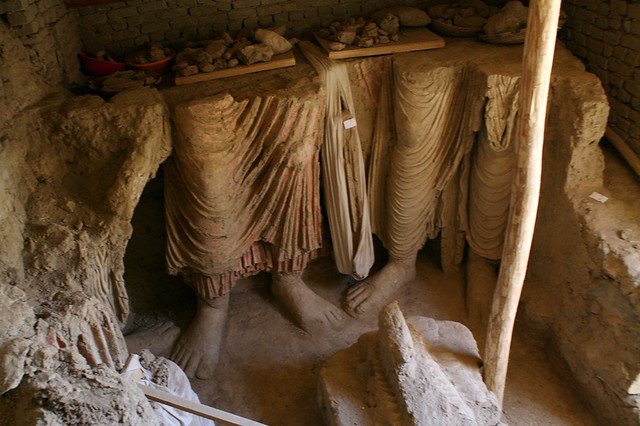
- Surely it will happen in the future that the West and whites will claim the Buddha. Now they say it is just a Greco-Roman influence on the art depicting the Buddha. But when it comes out that Mes Aynak and Tepe Naranj, Afghanistan are storehouses of splendor and that lost treasures buried and hidden in Iran (ancient Indo-Persia) and maybe even Iraq, and Gandhara (Pakistan and Afghanistan), as well as Central Asia (Tajikistan, Kazakhstan, other 'stans, and Russia at least up to Kalmykia, Europe) are recovered -- then the world will see Dr. Pal was right. The pieces of the puzzle fit together to match the texts. And what we have been presenting for years is not motivated by self-interest or any hope of doing to the Buddha what was done to the Christ -- turning him from an African (as recorded in the only physical description of him not cut out of the Bible), to a Middle Eastern Jew, to a tall Nordic blond suitable for European consumption.