Edited and expanded by Dhr. Seven and Amber Dorrian, Wisdom Quarterly
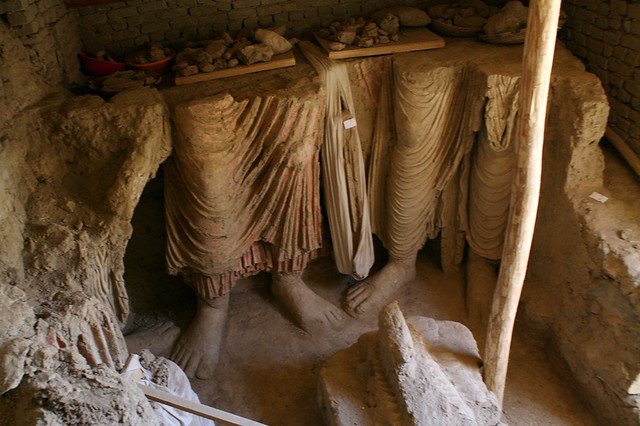
Mes Aynak archaeological excavationsLOCATION: Southern chapel, Kafiriat Tepe monastic complex, Logar Province, Afghanistan [
ancient Gandhara, frontier India]
Of great interest in
Mes Aynak ["Copper Well"] is the association of many Buddhist monasteries with the economic activity of copper mining. There is no doubt that the wealthy decoration of the monasteries is linked to the wealth that people living nearby derived from the mine.
In May 2012 I traveled to Afghanistan on an assignment for the Czech edition of National Geographic magazine. I photographed excavation and rescue efforts at the world’s largest archaeological excavation site, located in Mes Aynak (“copper well”) area, Logar Province, Afghanistan.
Being an equally inspiring and unique place, experts on site believe that uncovering the ancient city of Mes Aynak would not only re-write the history of the Silk Route but also the history of Buddhism.
[According to maverick Indian archeologist
Dr. Ranajit Pal, modern Bamiyan, Afghanistan, was ancient Kapilavastu, India, the Buddha's hometown. We at Wisdom Quarterly agree that the historical Buddhist sites were far west of modern Nepal.]
That is, however, unlikely to happen. At the end of December 2012, the first part of the ancient site will be destroyed [by corporate Chinese interests bent on extracting rare earth minerals, copper, and gold].
 |
| Policeman guards excavation (time.com) |
Due to the economic interests of China and Afghanistan [the former desperately needs rare minerals for producing electronics like iPhones, whereas the latter desperately needs cash in the face of an invasion by a foreign army that has occupied the country with no end in sight] a massive open copper mine complex just where the ancient city lays will be established.
 |
| US strike team soldier drives bulldozer through infrastructure to help make country "safe" for capitalism during US war on and continued occupation of Afghanistan (defense.gov) |
[The upshot is that this massive Buddhist archeological site located west of India in Central Asia will be destroyed and covered by a massive mining city before it is ever excavated or even fully documented. Afghanistan's Department of Archeology is working as fast as it can with no hope of even describing all of its wonders before the Chinese are contracted to start their demolition of the site. While China may have one billion uncounted Buddhists, it is ruled by an officially atheist Communist regime bent on capitalist riches.]
Mes Aynak is also a home to a second-largest unworked cooper deposit in the world.
To give you a hint, this earth-covered ancient city -- yet to be excavated -- sprawls across a territory of approximately 1.5 by 1.5 kilometers [
distance, perhaps a temple complex
a square mile in size. Wisdom Quarterly does not refer to it as "the World's Greatest Buddhist Site" for nothing].
Recent findings suggest that underneath the 2,600 years-old town [which,
not coincidentally, is the exact official age of Buddhism itself -- since Buddhism came to Afghanistan just seven years after Siddhartha's great enlightenment, when as the "Buddha" (Shakyamuni, "the Sage of the Shakya Clan") he visited his home town and converted his father
King Suddhodana who entered the first and second stages of enlightenment and continued to rule (reaching full enlightenment on his death bed when the Buddha returned to help him awaken), his stepmother Maha Prajapati who became the first Buddhist nun, his son Rahula who at 7-years-old became the first Buddhist novice, his half-brother Nanda and half-sister Sundari Nanda, and many of his relatives like his cousin Ananda from the royal
Shakya clan's territory,
shakya meaning "
grey earth," a reference to the strangely grey soil in this area of Afghanistan], Mes Aynak was inhabited in an organized manner as early as 5,000 years ago, well into Bronze Age.
It is considered a literal missing-link between worlds East and West, a trading hub, a money factory, a place where two civilizations met and interacted.
According to international archaeologists on site,
Mes Aynak is one of the five most important findings in the entire history of archaeology. It is in the same category as
Petra and
Machu Picchu. [It is, in fact, the world's greatest Buddhist site -- rivaling Indonesia's
Borobudur, Cambodia's
Angkor Wat, and Sri Lanka's
Anuradapura.]
Unfortunately, we will never learn about it. For underneath Mes Aynak City exists the second-largest known unworked copper deposit in the world. MCC (China Metallurgical Group Corporation, a government-owned giant) bought rights to it for about $3 billion. It plans to excavate copper and rare earths for the next 30 years, aiming to extract approximately $100 billion worth. As such, a massive open copper mine visible from outer space will completely destroy this ancient site.
So far only about 15% of the newest archaeological layer has been uncovered. A second earlier layer will never be accessed. The entire city’s history, including its administrative center, Buddhist burial mound/reliquary shrines (
stupas), monasteries, nunneries, as well as evidence of its Bronze Age past will be forever lost.
 |
| CIA-funded Afghan Muslims (uberhumor.com) |
Archaeologists say they would require 20 to 30 years to fully uncover and simply document this site -- to say nothing of preserving or restoring it. But they have no power to oppose decisions taken by the [CIA-corrupted Karzai] government of Afghanistan and MCC [just as mere archeologists could neither oppose or prevent the planned ransacking of priceless treasures in the Iraqi Museum, which the West considers the "Cradle of Civilization." A further complication exists: Islamic regimes are in no hurry to uncover their pre-Islamic/Buddhist pasts.

So sites in Pakistan,
Iran/Persia (where the Buddha's mother,
Maya Devi, was likely born, according to
Dr. Ranajit Pal, who posits that she was from
Seistan-Baluchistan, which is a border area between Afghanistan-Iran-Pakistan),
Kazakhstan, and elsewhere go largely unprotected in spite of the meager efforts of earnest archeologists].
A team consisting of international and Afghan archaeologists is conducting so called “rescue archaeology” -- digging out as much as possible in the remaining few months before demolition begins.
Application for UNESCO protection (Nadia,
Afghan Treasures) Fantastic news! We have blown past our original goal of 10,000 signatures for our petition to protect the Afghan Mes Aynak site from Chinese mining developers. Who can imagine these incredible archaeological treasures being destroyed for commercial profiteering? More than 10,000 signatories think that is a bad idea. As of today, we have collected 10,360 signatures and are stretching the goal to 20,000 [2011]. We will report our progress the April newsletter, which features an exclusive article on Mes Aynak by Prof. Tarzi. (We welcome comments and feedback). Here are three things to do right now:
- Subscribe to Afghan Treasures.
- Sign the Care2 petition.
- Subscribe to the newsletter.




+Gandhara_BuddhawikipediaMarksofaGreatPersonwikipediaorg.jpg)


