Loading...

This is default featured post 1 title

Go to Blogger edit html and find these sentences.Now replace these sentences with your own descriptions.This theme is Bloggerized by Lasantha Bandara - Premiumbloggertemplates.com.

This is default featured post 2 title

Go to Blogger edit html and find these sentences.Now replace these sentences with your own descriptions.This theme is Bloggerized by Lasantha Bandara - Premiumbloggertemplates.com.

This is default featured post 3 title

Go to Blogger edit html and find these sentences.Now replace these sentences with your own descriptions.This theme is Bloggerized by Lasantha Bandara - Premiumbloggertemplates.com.

This is default featured post 4 title

Go to Blogger edit html and find these sentences.Now replace these sentences with your own descriptions.This theme is Bloggerized by Lasantha Bandara - Premiumbloggertemplates.com.

This is default featured post 5 title

Go to Blogger edit html and find these sentences.Now replace these sentences with your own descriptions.This theme is Bloggerized by Lasantha Bandara - Premiumbloggertemplates.com.

Showing posts with label attachments. Show all posts

Wednesday, November 7, 2012

Meditation Guilt.

(gassho)

As I'm sure you've noticed, I've been away. I needed a break. I took some time to empty my mind of everything Buddhist and simply live my life. I was holding onto Buddhism too tightly and needed to let go for awhile, so that I didn't loose perspective. It was a great reminder that even Buddhism itself can be an attachment. The time-off has reinvigorated my mind, my writing and commitment to the Dharma.

Today I wanted to write about meditation guilt. What do I mean by "meditation guilt?" Well, often the perception in western society of Buddhism is a religion centered upon meditation. Hollywood gives the impression that Buddhists are epitomized by a statuesque monk sitting endlessly for hours. While that is partly true, most can not maintain the commitment and practice of monks--they are essentially the professional athletes of meditation. If we expect to meditate like the monks do then we are surely setting ourselves up for disappointment, disillusionment and failure.

Traditionally, meditation hasn't been as central to the average Buddhist's life as is often the case in America. Kusala of the "Urban Dharma" blog elaborates:
For the most part, laity in immigrant Buddhism, like laity in Asia, don't engage in meditation -- a practice for the ascetic monks who are imitating the Buddha's lifestyle of renunciation. They don't expect to become enlightened beings like the Buddha.
Yet it seems a lot of "American Buddhists" are obsessed with meditation. I think some feel that meditation is a bit like prayer in Christianity. The perception being, if you aren't meditating daily then you are somehow "failing" as a Buddhist. The truth, of course, is that expecting to meditate daily like the monks is like expecting yourself to run a marathon without the time, body and training that regular runners can afford to give to their fitness. Monks have the luxury of not having a job and living in an environment where all worldly burdens are stripped, enabling the kind of focus and dedication needed to maintain a steady, meditation regime.

Does that mean meditation is pointless for non-monks? Or, that we shouldn't meditate? No, not at all. I think any monk would encourage meditation but I think we have too many expectations about meditation. We have to be realistic if we are going to stay committed to the Dharma, long-term. We expect ourselves to live up to a standard that few can do, and when we can't do it we punish ourselves with guilt. The guilt is truly unnecessary when you simply accept that you don't need to worry so much about enlightenment in this lifetime. Unless you are a monk, most of us Buddhists are just trying to be a better person for not just family, friends and strangers but for ourselves, too. Meditation is a wonderful way to re-calibrate and remind ourselves to stop and enjoy the moment. As well as the beauty and peace of being alive, in this moment, together--as one.

If a lay Buddhist finds they can, and want to meditate daily then by all means continue. I encourage meditation as a beneficial tool in dealing with the chaos of societal demands for greed, hatred and delusional thinking. However, don't expect yourself to be the Dalai Lama, Thich Nhat Hanh or even the average monk. I am of the belief that the number of monastics is low compared to the general population because their karma has prepared them for this moment for countless lifetimes. We don't have to become monks or "marathon meditation masters" to benefit to be faithful Buddhists.

Use this life to become better people, so that perhaps in a future life we will be ready, able and willing to reborn into better circumstances. The beauty, compassion and optimism about Buddhism is that we can be reborn anew each lifetime, so that we have plenty of opportunities to develop along the path of enlightenment. I think a lot of convert Buddhists (who are former Christians, like myself) still harbor the absolutism of that belief system. We haven't fully abandoned the subconscious fear of "not getting it right" in this one lifetime. In Christianity, of course, there is only this lifetime to "get it right" and if you "fail," that's it--no more chances. I think we still harbor that "all or nothing" mentality as newly converted Buddhists, which is often carried over into our expectations of meditation practice.

If you can meditate daily then obviously you'll get more from such a regular practice, but even irregular meditation can bring benefits. The key is to not feel guilty because you can't meditate like the monks--not many can. You aren't a "bad Buddhist" if you can't formally meditate daily. Besides, there are numerous forms of meditation, such as walking meditation. As you walk, you focus on your breath to be fully present in the moment and aware of the oneness between yourself, the natural world and those you encounter upon your walks. As well as being aware of how we are apart of the greater family or sangha of humanity. It is an active form of meditation that the physically restless often find easier and more beneficial. If you need other suggested ways of meditation, look into the writings and teachings of Zen master, Thich Nhat Hanh.

~I bow to the Buddha within you all~
Friday, January 7, 2011

Goals versus Desires in Buddhism.

Img2005-06-04_0032
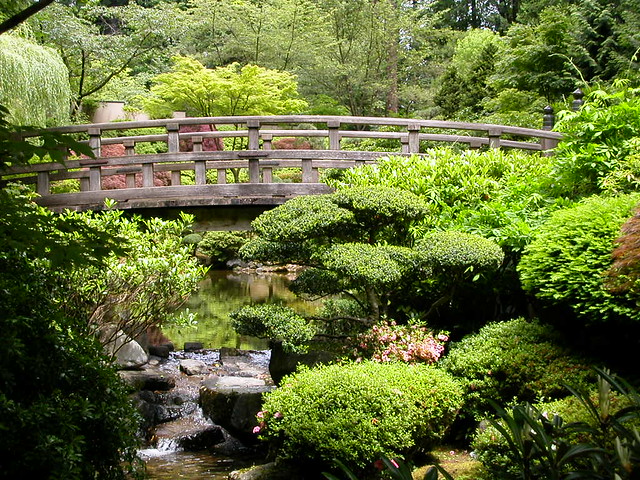
Bridge at Japanese garden in Portland, Oregon. By James R. Ure. Creative Commons apply. You may use for non-commercial purposes only; with attribution to photographer.

I wrote this piece as a response to a commenter on my recent post about expectations, titled, "Letting Go of Expectations." They wanted to know how a person can still go about wanting to do certain things in life without desires. So, the following is my response, which I decided to make a post from in case others had the same question, because I did when I was first starting out on the Dharmic path: I think desires aren't necessarily "bad" but rather the attachment to them is what causes the suffering. The idea that we can't be happy without the constant fulfillment of our desires. It's a cyclical trap of suffering.

Instead of desires, I think a more skillful approach is to have goals. Goals are about setting achievable and realistic outcomes based on a flexible plan; grounded in the reality that not every detail might work out the way it was planned. So, that from the beginning you know that you might have to adjust those goals as you go along—in other words, with goals, you’re prepared for revisions.

Whereas, desires are based on pure craving and expectations, which demand a particular outcome to be happy. These expectations are unreasonable and will always let us down. And having placed, so much energy into the desired outcome we are devastated when they don't come true--and we suffer greatly. Again, with goals, we are ready or prepared for set-backs and have a back-up plan on what to revise in that instance. So, we aren’t as attached to a particular outcome with goals. We temper your desires in this manner.

The whole meaning of a desire is to dream big and have HUGE expectations that those dreams will unfold EXACTLY how we desire them to.

So, set manageable goals with back-up plans and you should be less driven and attached by desired expectations. That’s the way I understand the difference and how to go about planning and living life without being pulled into the unmanageable cravings of desire. I’m not a teacher though and I struggle with desires versus goals daily but I have picked up a small bit of knowledge and experience in my years of practicing Dharma. But I’m not an expert by any means. Still, I hope this advice helps.

~Peace to all beings~

Friday, December 31, 2010

Rocky Mountain Buddhist Hermit.

Growing up at the foot of the Rocky Mountains, (Colorado) spending decades climbing their heights and summer's backpacking into remote, mountain lakes for a week's stay, has been monumental in helping my Dharma practice.

It is also why I am so attracted to the way of the Buddhist hermit who's monastery is the mountain-tops (or forests) and his sangha the wildlife. Nature teaches you patience, paying attention, doing more with less, appreciating what you have and expecting the unexpected. In short -- it teaches you how to live in the present moment.

In the high mountains, (10,000 ft above sea level and higher) circumstances can change faster than a blink of an eye. The altitude changes everything to where you have to be alert at all times to survive. It can be warm, short's weather down in town during the month of August when we go backpacking; yet you still have to pack winter gear. You can be hiking in shorts and sunshine one minute and the next minute find yourself in a driving snowstorm. I have spent more than one August, summer's day held up inside a tent at 11,000 ft. above sea level, gazing out of the tent at a snow storm settling in around the camp site.When backpacking you take a fold-out backpacking stove (seen above, with fuel canister) to cook freeze-dried food, which isn't gourmet but when eaten after hiking up an 11,000 foot mountain, it tastes better than what any five-star chef in Paris could whip up. That's because you appreciate it more after having busted your ass-off and spent all your energy on putting one foot in front of another, slowly, up and up the mountain. It is the best food you've had all year because it is literally the only food you have. You take care not to let one drop hit the ground because each bite is precious for needed calories. Yet, how much food do we waste at home? Each bite of food is savored mindfully like it was the first meal to cross your lips in ages--even the bowls and kettle are licked clean of sustenance. It teaches you to focus on simply eating and enjoying it.

Everything in the mountains must be done with great care and attention to detail, which, again is why it's a great place to practice and live the Dharma. For example, getting a drink of water entails an entire process of purification pumps and water storage bottle balancing. It's not like flipping on the tap at home; but that water is the best water you'll ever taste because of the attention you put into gathering it. And, you see it as a lot more precious than the water you pour out of the tap at home. You find yourself rationing it out throughout the day because if you guzzle it all at lunch, then you have to hike back up to the glacier to pump some more because you don't ever want to be caught out in the wild without water.

Then there is shelter, which takes on a whole other importance when backpacking. Carrying everything you need for a week on your back means you're near-homeless and that makes you cherish your flimsy tent as though it were a palace. It makes you thankful for a warm place to sleep with some cover over-head. And you begin to realize that you don't need a big house let alone a mansion. I guess I relate so much to these hermit monks because I have lived the last two decades preparing for just such a life. One day perhaps, when, (and if) I feel the time is right, I will disappear into the mountains and build my small hut to spend the rest of my days meditating in. Not out of searching for the, "enlightenment treasure chest" but out of letting go of it.

Not to become some fabled "mountain-top guru." In fact, if you try, and come looking for me to be my student, I will shoo you away because there are much better qualified teachers than this crazy-eyed Buddhist. It's about being an anonymous being living out the rest of his days in the natural world--our true home. A home that humans have nearly abandoned for the accouterments and attachments of city life. We need to reclaim that home. I don't think everyone can or should become a mountain hermit but for me, it's in my karma. I have known from a young age that my life would find me living a life of solitude in the mountains at some point.

I will no longer feel attached to the desires of city life; and the choice will be made for me. I'll leave that city life chaos to more capable hands. At that stage of spiritual life, the best place for me would be in nature, where life exists at it's most basic foundation. A good place to leave this world from when the moment arrives.

~Peace to all beings~