Dhr. Seven, Wisdom Quarterly translation (Methuna Sutra, AN 7.47)  |
| What does Buddhist philosophy say about sexuality? (Suite101.com) |
WARNING: These "bonds" are applicable only to monastics and intensive practitioners (such as those on retreat) adopting Eight Precepts, which goes beyond the ordinary Five Precepts.
SAVATTHI, ancient India - The Brahmin Jāṇussoṇī approached the Buddha and exchanged greetings with him. When this courteous exchange was concluded, Jāṇussoṇī sat down respectfully at one side and said:
“Does the Blessed One profess to be a celibate practitioner (
brahmachari)?”
“Brahmin,” the Buddha replied, “if rightly speaking one were to say of anyone, ‘He lives the perfect and pure supreme (brahmachari) life, unbroken, untorn, undiluted, spotless,’ he would rightly be speaking of me. For, Brahmin, I live the perfect and pure supreme life, unbroken, untorn, undiluted, spotless.”
“But, Master Gautama, what is the break, the tear, the dilution, the blotch of the supreme life?”
7 Faults of the False Brahmachari
 |
| Prince Siddhartha prior to his spiritual quest |
1. “Herein [within this Dharma], Brahmin, a certain ascetic or Brahmin, declares that he is a real brahmachari. For he does not indulge in sexual intercourse (coupling) with women. But he consents to being rubbed, massaged, bathed, and kneaded by women. He relishes it, longs for it, and savors it. This, Brahmin, is a break, tear, dilution, and a blotch of the supreme life.
“This, Brahmin, is called one who leads the impure supreme life, who is devoted to indulging in coupling. He is not freed from birth, decay-and-death, sorrow, lamentation, physical pain, mental pain: He is not freed from
disappointment, I say!
2. “Furthermore, Brahmin, a certain ascetic or Brahmin, declares himself to be a total brahmachari. Nor does he indulge in coupling with women. Nor does he consent to being rubbed, massaged, bathed, or kneaded by women. But he jokes with women, plays with them, jests with them. He relishes it, longs for it, and savors it.
“This, Brahmin, is a break, tear, dilution, and a blotch of the supreme life. This, Brahmin, is called one who leads the impure supreme life, who is devoted to indulging in coupling. He is not freed from birth, decay-and-death, sorrow, lamentation, physical pain, mental pain: He is not freed from disappointment, I say!
3. “Furthermore, Brahmin, a certain ascetic or Brahmin, declares himself to be a real brahmachari. For he does not indulge in coupling with women. Nor does he consent to being rubbed, massaged, bathed, or kneaded by women. Nor does he joke, play, or jest with women. But he gazes and looks eye to eye at women. He relishes it, longs for it, and savors it.... He is not freed from disappointment, I say!
4. “Furthermore, Brahmin, a certain ascetic or Brahmin, declares himself to be a real brahmachari.... But he listens to the sounds of women through a wall or through a fence as they laugh, talk, sing, or weep. He relishes it, longs for it, and savors it.... He is not freed from disappointment, I say!
5. “Furthermore, Brahmin, a certain ascetic or Brahmin, declares himself to be a real brahmachari.... But he recollects his former laughing and chatting and playing with women. He relishes it, longs for it, and savors it.... He is not freed from disappointment, I say!
6. “Furthermore, Brahmin, a certain ascetic or Brahmin, declares himself to be a real brahmachari.... But he sees a householder or a householder’s son being entertained, showered, and serviced with the cords of sense-pleasures.... He relishes it, longs for it, and savors it.... He is not freed from disappointment, I say!
7. “Furthermore, Brahmin, a certain ascetic or Brahmin, declares himself to be a real brahmachari. For he does not indulge in coupling with women. Nor does he consent to being rubbed, massaged, bathed, or kneaded by women. Nor does he joke, play, or jest with women. Nor does he gaze or look eye to eye at women. Nor does he listen to the sounds of women through a wall or through a fence as they laugh, talk, sing, or weep. Nor does he recollect the previous laughing and chatting and playing with women. Nor does he see a householder or a householder’s son being entertained, showered, and serviced with the cords of sense-pleasures.
“But he lives the supreme life aspiring for rebirth among one of the groups of
devas (
shining ones) thinking, ‘By this observance or vow or austerity or supreme life, I shall become a
deva or one [reborn] among them.’ He relishes it, longs for it, and savors it. This, Brahmin, is a break, tear, dilution, and a blotch of the supreme life.
“This, Brahmin, is called one who leads the impure supreme life, who is devoted to indulging in coupling. He is not freed from birth, decay-and-death, sorrow, lamentation, physical pain, mental pain: He is not freed from disappointment, I say!”
The Buddha has overcome all bonds
 |
| Ascetic Siddhartha accepts food from a woman |
“And as long as I noticed that one or more of these seven bonds of sexuality were as yet unabandoned by me, to that extent, Brahmin, I did not claim to be supremely awakened in the peerless
full enlightenment in this world with its
devas, maras, brahmas, this generation with its recluses and Brahmins, its rulers, and people.
“But, Brahmin, when I did not notice any of these seven bonds of sexuality unabandoned in me, to that extent, Brahmin, I claimed to be supremely awakened in the peerless full enlightenment in this world with its devas, maras, brahmas, this generation with its recluses and brahmins, its rulers and people.
“And the knowledge and vision arose in me, ‘Unshakable is this liberation of mind/heart. This is my last birth. There is no more rebirth to come.’”
Jāṇussoṇī goes for guidance
When this was spoken, the Brahmin Jāṇussoṇī said this to the Buddha: “Excellent, Master Gautama! Excellent! Master Gautama! It is just as if one were to set upright what had been overturned, or were to reveal what was hidden, or were to show the way to one who was lost, or were to hold up a lamp in the dark so that those with eyes could discern forms. In just the same way, by numerous examples, has the Dharma been made clear by Master Gautama.
“I go to Master Gautama for guidance and to the Dharma and to the community of [
accomplished] disciples. May Master Gautama remember us as lay followers who have gone for guidance from this day forward as long as life shall last.”


 Seeing him, the Buddha requested monastics to accept additional robes for their hardship. One robe in particular, the special kathina robe, was to go to a monastic who had successfully completed the rigors of the Rains Retreat. (At this time those in robes are not allowed to travel or venture from the nunnery/monastery for overnight trips; instead they stay in one place and meditate in a loosely cloistered setting).
 Thereafter Buddhist devotees have provided hermitages with a specially made robe, which is awarded to the one who has most successfully completed the Rains Retreat.
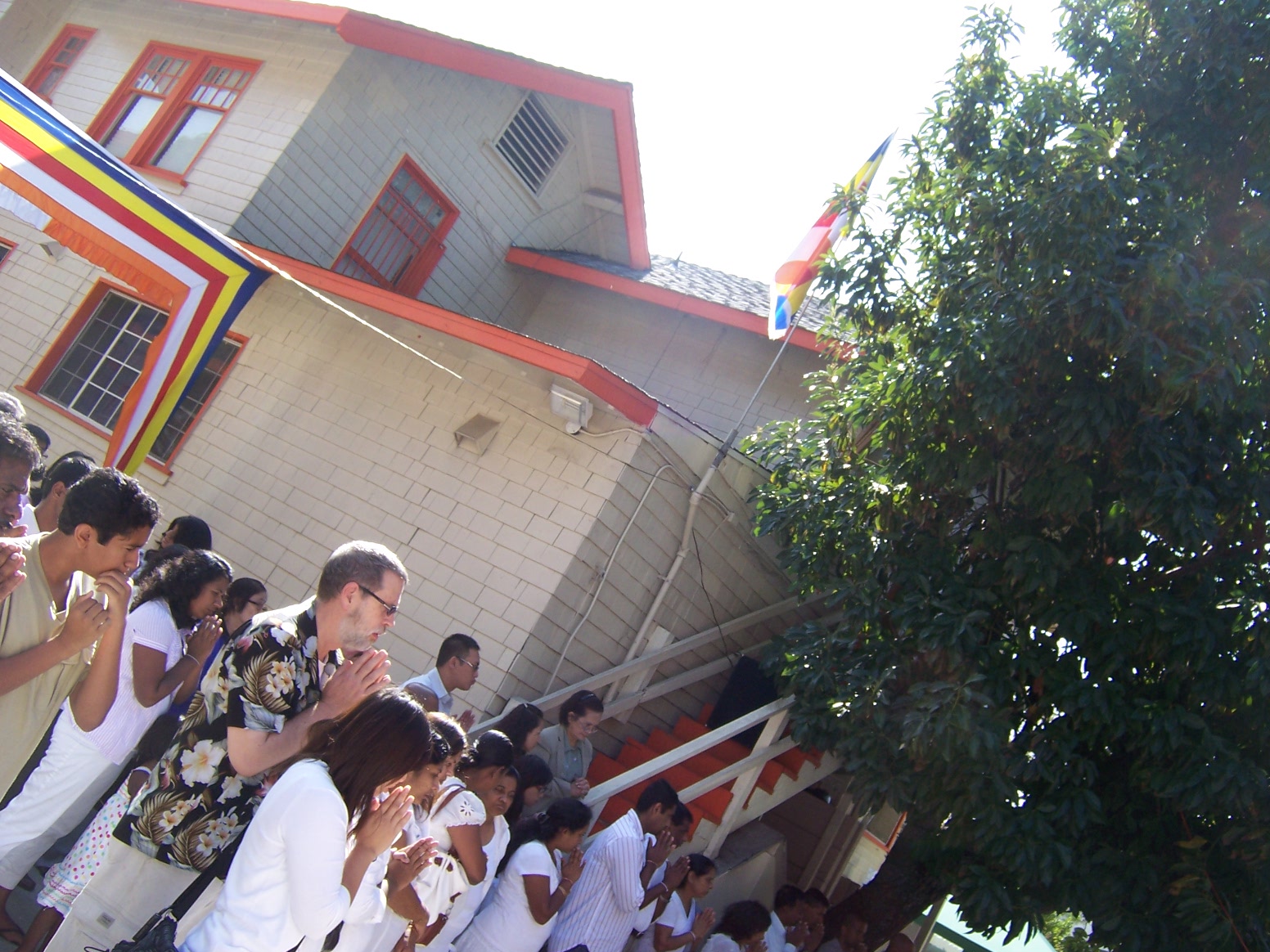 Whereas the monastic who receives the robe gains five mundane benefits, the donor of the robe accrues a tremendous amount of merit (anisangsa, punya). The Pali word for the robe is kathina, Bengali kathin.
 Traditionally, devoted Buddhists undertake to strictly observe moral and ethical precepts during the period of the retreat culminating in the sacred ceremony. However, even the simple act of participating (attending in approval of this gift) they are able to share in the remarkable merit of this special gift-giving.


