


Elizabeth Howell (Space.com, Jan. 12, 2013); Wisdom Quarterly on Buddhist Cosmology


A team of amateurs has discovered evidence for 42 alien planets, including a Jupiter-size world that could potentially be habitable, by sifting through data from a NASA spacecraft.
Forty volunteers with the crowd-sourcing Planet Hunters project discovered the new planet candidates, which include 15 potentially habitable worlds and PH2 b, a Jupiter-size planet that the team confirmed to be in the habitable zone of its parent star.
This is the second time Planet Hunters project, which is overseen by Zooniverse, has confirmed a new exoplanet discovery. What's more, several candidate planets found by the project may be in the habitable zones of their parent stars. These candidates are awaiting confirmation by professional astronomers.
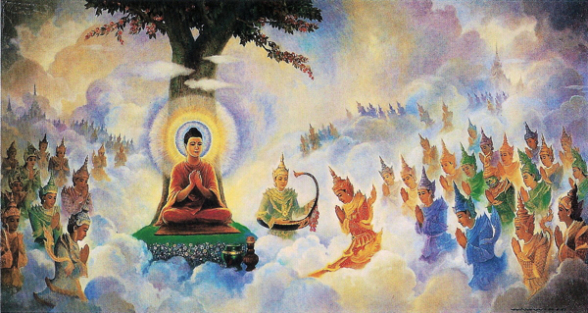 |
| The Buddha teaching in Tavatimsa, "Space World of the Thirty-Three" (mettarefuge) |
Researchers suggested this bonanza of planets in the so-called Goldilocks zone around a star, a habitable zone in which conditions are liquid water to exist on a planet’s surface and potentially supportlife, could mean there is a "traffic jam" of worlds where life could exist, project officials said.
"These are planet candidates that slipped through the net, being missed by professional astronomers and rescued by volunteers in front of their web browsers,” said the University of Oxford's Chris Lintott, who helms the Zooniverse, in a statement. “It's remarkable to think that absolutely anyone can discover a planet.”
Life on an "Avatar"-like moon
The planet PH2 b was found using data from NASA's prolific Kepler Space Telescope and confirmed with 99.9 percent confidence by observations at the W. M. Keck Observatory in Hawaii. More
The Buddha taught in Space?
Dhr. Seven, Amber Dorrian, monks of the Los Angeles Buddhist Vihara

Yes. The Buddha and many of his monastic disciples frequently visited space. There are many such worlds described. Two spheres of planes are material, one dense and sensual the other fine and ethereal, and those worlds can be reached from here.
Not only were their various forms of conveyance (vimanas) in space (akasha, limitless sky) at the time of the Buddha, but there had been overt extraterrestrial contact many times in the ancient prehistoric past of the planet. (There are long-lived beings who visit and reside on this planet as well as on nearby sectors in space who told the Buddha of the past; however, he was capable of discerning the past independent of their reports).
 |
| Mother Maya dreams of conceiving a baby |
One spectacular case of the Buddha visiting space is when he went to go visit his biological mother, Maya Devi. She died seven days after his birth and was reborn in space. As Buddhism is divided into three sections (sutras, disciplinary code, and "higher teachings") a question arises as to who formulated the ultimate-teachings known as the Abhidharma.
In the commentaries of the oldest existing Buddhist school, the Theravada ("Teaching of the first generation Elder Disciples of the Buddha"), it is held that the Abhidharma was first taught by the Buddha himself.

Other traditions argue that it was a later addition by monastic commentators systematizing the Teachings. According to legend, shortly after his great enlightenment the Buddha spent a long time in meditation.
During this time he formulated the Abhidharma, a very systematic way of presenting the highest truths or ultimate realities that lead to liberation from ignorance and suffering in this very life.
He later traveled into space -- by his own means (roughly speaking by, for lack of a better term, astral projection that produces a physical counterpart body appropriate to the realm being visited) -- to teach the "heavenly" space beings dwelling there the Abhidharma. This included his deceased mother Māyā, who had been reborn as a male by the name of Maya-deva-putta (which is more description than name, "Maya born among the devas") in a higher "celestial" or akashic (space) world known as Tusita.
 |
| Buddhist depiction of space worlds |
Tradition holds that the Buddha gave daily summaries of the teachings delivered in space to his chief male disciple "foremost in wisdom," Shariputra, who then passed them on to the other monastics (Red Pine, The Heart Sutra: The Womb of the Buddhas, 2004).
The Abhidharma is presented as a pure and undiluted form of the Dharma that was usually too difficult for most (earthling) practitioners of the Buddha's time to grasp. Instead, the Buddha taught by the method related in the various sutras, giving appropriate, immediately-applicable teachings as each situation arose, rather than attempting to set forth the complete Abhidharma in all its complexity.
There is a similarity between the Theravada tradition of the Adhidharma and that of the later and larger Mahayana school, which also claimed to be too difficult for the people living in the Buddha's time.


