Loading...

This is default featured post 1 title

Go to Blogger edit html and find these sentences.Now replace these sentences with your own descriptions.This theme is Bloggerized by Lasantha Bandara - Premiumbloggertemplates.com.

This is default featured post 2 title

Go to Blogger edit html and find these sentences.Now replace these sentences with your own descriptions.This theme is Bloggerized by Lasantha Bandara - Premiumbloggertemplates.com.

This is default featured post 3 title

Go to Blogger edit html and find these sentences.Now replace these sentences with your own descriptions.This theme is Bloggerized by Lasantha Bandara - Premiumbloggertemplates.com.

This is default featured post 4 title

Go to Blogger edit html and find these sentences.Now replace these sentences with your own descriptions.This theme is Bloggerized by Lasantha Bandara - Premiumbloggertemplates.com.

This is default featured post 5 title

Go to Blogger edit html and find these sentences.Now replace these sentences with your own descriptions.This theme is Bloggerized by Lasantha Bandara - Premiumbloggertemplates.com.

Showing posts with label rains. Show all posts

Saturday, November 3, 2012

Sacred Robe Offering: Kathina 2012 (video)

Ven. Karunananda, Ph.D., Ven. Bibekananda, Dharmachari Seven, Wisdom Quarterly
The Buddha under the Bodhi tree, Dharma Vijaya Buddhist Monastery, Crenshaw Bl. (WQ)
The sacred saffron kathina robe, Dharma Vijaya Buddhist Vihara, Los Angeles, California, 2011 (Wisdom Quarterly).
   
The offering (dana) of the sacred robe is an annual event, traditionally held in October. It marks the end of the three-month Rains Retreat or Vas. During this time Buddhist nuns and monks retire to their hermitages to engage in intensive meditation, study, teaching, and other practices for rapid spiritual advancement.

Buddhist History
One one occasion, in ancient India, monks took up residence practicing sane-austerities for the rainy season. At the end of their seclusion, they set out to visit the Buddha, who was residing in distant Savatthi.

Their travel was arduous. At times, they had to endure inclement weather. At the end of their long journey, one of the monks was soaking wet as he approached.

Seeing him, the Buddha requested monastics to accept additional robes for their hardship. One robe in particular, the special kathina robe, was to go to a monastic who had successfully completed the rigors of the Rains Retreat. (At this time those in robes are not allowed to travel or venture from the nunnery/monastery for overnight trips; instead they stay in one place and meditate in a loosely cloistered setting).
  
Thereafter Buddhist devotees have provided hermitages with a specially made robe, which is awarded to the one who has most successfully completed the Rains Retreat.

This robe is revered as the most important for a monastic to receive AND the most meritorious for a devotee to give.
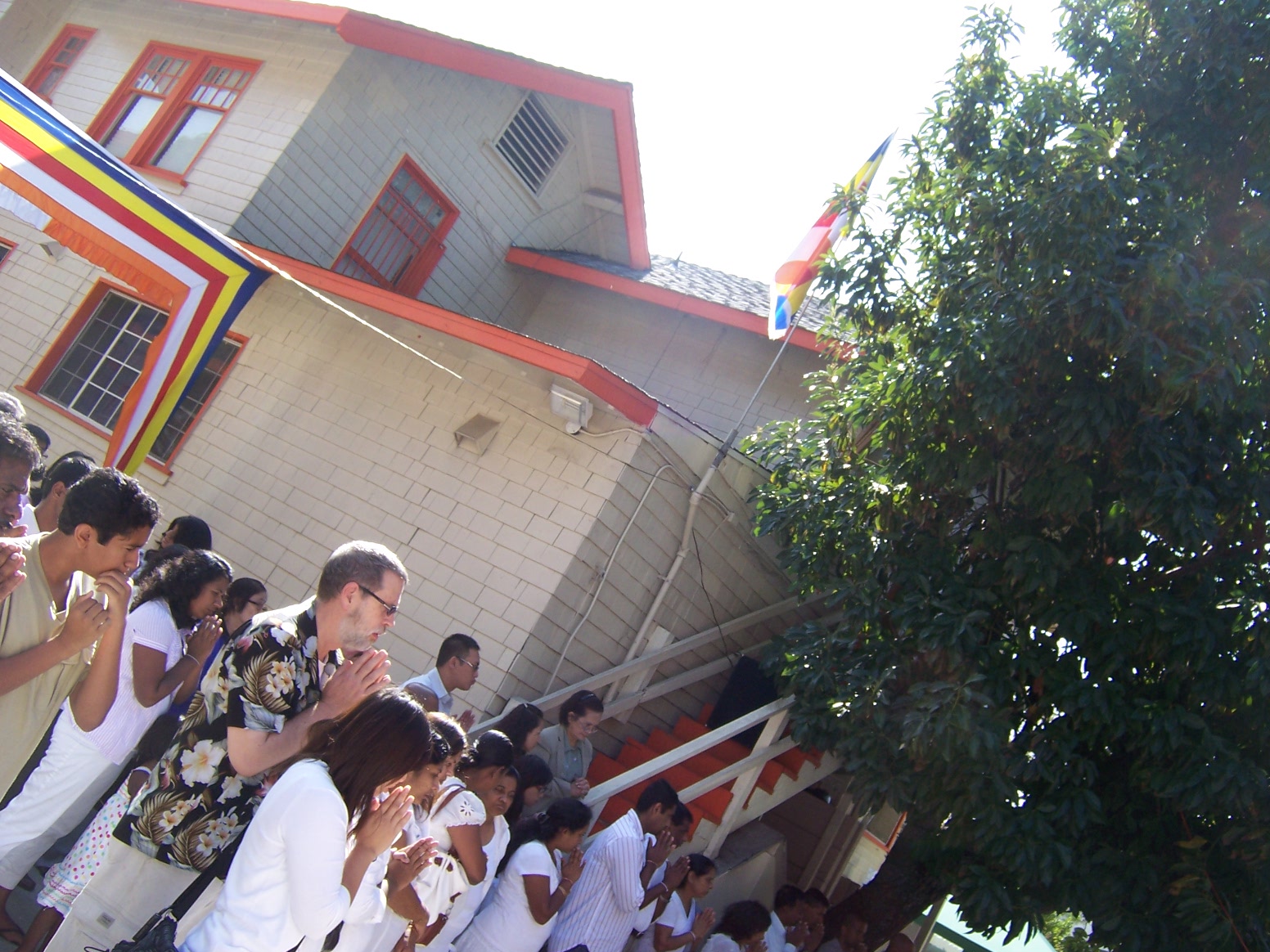
Whereas the monastic who receives the robe gains five mundane benefits, the donor of the robe accrues a tremendous amount of merit (anisangsa, punya). The Pali word for the robe is kathina, Bengali kathin.
  
It means hard [to come by], firm, steadfast -- indicating the greatness of the merit, which is difficult to obtain and is a firm and reliable source of spiritual as well as material benefit unshakable in the face of minor bad karma.

Traditionally, devoted Buddhists undertake to strictly observe moral and ethical precepts during the period of the retreat culminating in the sacred ceremony. However, even the simple act of participating (attending in approval of this gift) they are able to share in the remarkable merit of this special gift-giving.
  • California Bodhi Vihara will celebrate the Sacred Robe Offering Ceremony today, Nov. 3, 2012 in Long Beach. Moreover, various Theravada temples throughout Los Angeles and the country are holding this ceremony as they end their Rains Retreat observance. (Contact local temples for dates).
Why?
Buddha, Lahore Museum (tribune.com.pk)
What would make the offering of this robe so meritorious? If the monastics were to practice sincerely, practice diligently and mindfully in accordance with the Dharma, some would be sure to gain mundane and supramundane attainments, such as the Eight Meditative Absorptions (jhanas) and the Eight Path-and-Fruition consciousnesses. These latter attainments are the penetrating insights that lead to enlightenment by stages from stream-entry to full realization. Giving to someone who has attained any of these is extremely meritorious, each more rare and powerful than the previous one. There is great merit in giving to anyone who emerges from the first absorption. But the merit of giving to one who has gain full enlightenment is uncountable, off the scale, so precious as to be considered beyond reckoning.

    Thursday, October 4, 2012

    Wisdom springs from Meditation

    Seth Auberon, Wisdom Quarterly
    (h.koppdelaney/flickr.com)
     
    Sit. Rest. Bring up attention. Pick an object, any object will do. You've chosen the breath -- a present time object that always exists only in the present. Breathing is now. I breathe in; I breathe out. I am aware for the entire length and duration of the in-phase, of the out-phase, and any small residual resting phase in between, clearly comprehending BREATH.
    My mind wanders to something less subtle, more entertaining, less "boring," more stimulating, less regular, more varied. As soon as I notice I've drifted, that is the Choice Point. Congratulate self. Pat self on the back. Smile. Return to noticing the NOW. What am I doing now? I'm breathing. I breathe in, I breathe out, and I notice it all the way through. 

    There is the Automatic Mind, which is distracted, which produces thoughts, which makes me miserable. I am aiming at the joyful, restful, intuitive, alert, ready-for-enlightenment state: Peaceful Mind. How do I get there? 

    I stay alert. I stay noticing every time the mind wanders. Meditation is about noticing. I abandon expectations, which only get in the way. Sleeping is losing attention. Meditation is staying alert. Rest. Peaceful Mind is resting there, alert.

    Absorption (jhana) awaits.
    Thanks to Against the Stream meditation instructor JoAnna Harper for adding the "pat on the back" step. For the one sure way to ruin a meditation is to scold the mind for wandering. It's natural. It's been a wild beast in the wilderness for a long time. Mindful meditation is tranquilizing the mind then emerging with purified-intensified attention ready for insight practices that produce results. Let it R.A.I.N: Recognize, Allow (accept), Investigate, Non-identification.

    Overcoming difficulties: Let it R.A.I.N.

    Tara Brach [adapted from her book True Refuge (Bantam, 2013)]; Wisdom Quarterly
     
    Tara Brach (examiner.com)
    Years ago some American Buddhist teachers began to share a new mindfulness tool that offers in-the-trenches support for working with intense and difficult emotions. 
      
    Called RAIN (an acronym for the four steps of the process), it can be accessed in almost any place or situation. It directs our attention in a clear, systematic way that cuts through confusion and stress. 

    The steps give us somewhere to turn in a painful moment. And as we call on them more regularly, they strengthen our capacity to come home to our deepest truth. Like the clear sky and clean air after a cooling rain, this mindfulness practice brings a new openness and calm to our daily lives. 

    I have now taught RAIN to thousands of students, clients, and mental health professionals, adapting and expanding it into [True Refuge]. I’ve also made it a core practice in my own life. Here are the four steps of RAIN presented in the way I’ve found most helpful:
    • R Recognize what is happening
    • A Allow life to be just as it is
    • I Investigate inner experience with kindness
    • N Non-Identification.
    RAIN directly de-conditions the habitual ways in which we resist moment-to-moment experience. It doesn’t matter whether we resist “what is” by lashing out in anger, by having a cigarette, [by sex, drugs, rock 'n roll or rap], or by getting immersed in obsessive thinking.

    Our attempt to control the life within and around us actually cuts us off from our own heart and from this living world. RAIN begins to undo these unconscious patterns as soon as we take the first step.  
      
    Recognize what is, accept that it is, investigate what's going on inside, and realize that there's no reason to identify with situations. More

    Saturday, June 16, 2012

    Riots in Burma: Buddhists vs. Muslims?

    Safety fears restrict relief work after Myanmar riots
    Reuters; Manny Mogato in Manila; writing Martin Petty; editing Andrew Heavens
    Armed troops patrolled Burma's northwest city of Sittwe on Friday [June 15, 2012] as a fragile peace held in the wake of days of sectarian violence that has stoked nationalist fervor and displaced 30,000 people, with many feared dead.
       
    Heavy rain kept many residents indoors in the Rakhine state capital as police and aid groups struggled to get food to thousands of ethnic Rakhine Buddhists and Muslim Rohingyas [next to formerly Buddhist now Islamic Bangladesh] displaced by rioting and arson that have presented a big test to Burma's post-military-dictatorship and new 15-month-old quasi-civilian government.
    Who are the tribes? (USCampaignforBurma.org)
    United Nations officials told Reuters three of their staff, two from the UNHCR refugee agency and one from the World Food Programme (WFP), all Burmese nationals, had been detained by police in the Rohingya-dominated town of Buthidaung for unknown reasons.
       
    The WFP had provided hundreds of sacks of rice to some areas, said Aye Win, spokesman for its operations in Burma.
      
    Dealing with anyone in the way of oil pipelines
    "We will try to get to other camps as soon as we can, when it is safe and secure. We are doing as much as we can. We will go in but security is paramount," he added.
      
    More than 20 houses were burned down late on Thursday in a village near Sittwe, residents said, adding to the 2,500 torched in the past week. But there were no reports of further deaths. More

    Why is there "ethnic" trouble?
    Wisdom Quarterly (COMMENTARY)
    Daw Suu Kyi, the new face of Burma with same dictators
    It is common to stoke up ethnic strife to cover up worse crimes. What could be worse than pitting Buddhists and Muslims against one another? Dictator Than Shwe's dreams of an oil pipeline around Bangladesh and into India (then secretly China). Who is in the way? Ethnic minorities displaced by the project. Burma is a police state and has been since at least 1948 (which inspired Burmese-British writer George Orwell to title his most important work 1984).
    Burma's dictator and head of the ruling junta General Than Shwe (Time.com)
      
    As such its ruling junta has remained in power -- changing the country's name, enslaving millions, relocating the capital, imprisoning its duly elected democratic leader (Daw Aung San Suu Kyi), and killing complainers at will -- even if they are Buddhist monastics engaged in peaceful demonstrations known as the Saffron Revolution. Actress Ellen Page referred to the little known  as less recognized Than Shwe as "Hitler." In response to world pressure, Burma has done what America has always done: put on a show of democracy while engaging in the same oligarchical/police state practices it was founded to oppose.
      
    Released from custody, Suu Kyi holds little power
    The US remains a colonial power of the military-industrial complex bankrolled by old European banking interests. Burma now hides behind the veneer of an elected president and even a minor minister (Daw Aung Suu Kyi).
       
    Where have all the dictators gone? They are at home at ease in futuristic mansions of a made up city called Naypyidaw. Corporations 1, People 0.
      
    If ethnic tribes want to stand in the way of Shwe Gas, there is going to be hell to pay. And where is America (aka "the police of the world") in all this? They are first in line to wheel and deal, as recent visits by Hillary Clinton demonstrated. We were not about to sit back and let China and India divide the spoils. Clinton only asked one thing: Pretend to respect human rights. (We'll show you how).
       
    Than Shwe with UN's Ban Ki Moon (AFP)
    So Daw Suu Kyi was given a nominal seat in government and has gone out into the world portraying the country as "reforming." It is far from reformed or reforming. It is merely becoming entrenched in a more sustainable deception. False appearances are much easier to maintain than shows of brute force, and it is especially nice when a government can do both and simply hide behind its reforms. We're not like the old Burma; we're the new progressive people's choice as shown by paid selections being called "free elections."

    SHWE GAS: Corporations and governments are commonly very secretive to the public regarding routes for construction and there has as yet been no mentioning of an Environmental and Cultural Impact Assessment along any of these routes.

    Saturday, March 21, 2009

    Leaving on a Jet Plane

    I'm sorry that I haven't been writing lately. I have been getting ready for a big trip to Indiana and Chicago to visit family. I'll be back in about a week with some new posts. I hope you are all doing well and I'll miss you!!

    Oh and Michael? The one who put their name into the hat for the Zen enso t-shirt? You won the contest awhile back but haven't heard from you. If you don't reply to this post by the time I get back I'll have to give it to someone else. So I'll leave you with a quote to chew on:


    Listen to the cicadas in treetops near the

    waterfall;
    See how last night's rains have washed away
    all grime.
    Needless to say my hut is as empty as can
    be,
    But I can offer you a window full of the most

    intoxicating air !

    -Ryokan, Zen monk of Japan

    James: O.k., I'm off. Be well in your practice.

    I bow to you all....

    ~Peace to all beings~