Loading...

This is default featured post 1 title

Go to Blogger edit html and find these sentences.Now replace these sentences with your own descriptions.This theme is Bloggerized by Lasantha Bandara - Premiumbloggertemplates.com.

This is default featured post 2 title

Go to Blogger edit html and find these sentences.Now replace these sentences with your own descriptions.This theme is Bloggerized by Lasantha Bandara - Premiumbloggertemplates.com.

This is default featured post 3 title

Go to Blogger edit html and find these sentences.Now replace these sentences with your own descriptions.This theme is Bloggerized by Lasantha Bandara - Premiumbloggertemplates.com.

This is default featured post 4 title

Go to Blogger edit html and find these sentences.Now replace these sentences with your own descriptions.This theme is Bloggerized by Lasantha Bandara - Premiumbloggertemplates.com.

This is default featured post 5 title

Go to Blogger edit html and find these sentences.Now replace these sentences with your own descriptions.This theme is Bloggerized by Lasantha Bandara - Premiumbloggertemplates.com.

Showing posts with label clinging. Show all posts

Tuesday, December 11, 2012

The World is on Fire!

Seven, Amber Dorrian, CC Liu, Wisdom Quarterly translation, The Fire Sermon (SN 35.28)
Calm, cool, and collected, the Buddha at Ayutthaya,Thailand (Perstephone/flickr.com)
  
Some say the world will end in fire,
Some say in ice.
From what I've tasted of desire
I hold with those who favor fire.
But if it had to perish twice,
I think I know enough of hate
To say that for destruction ice
Is also great
And would suffice.
("Fire and Ice," Robert Frost)
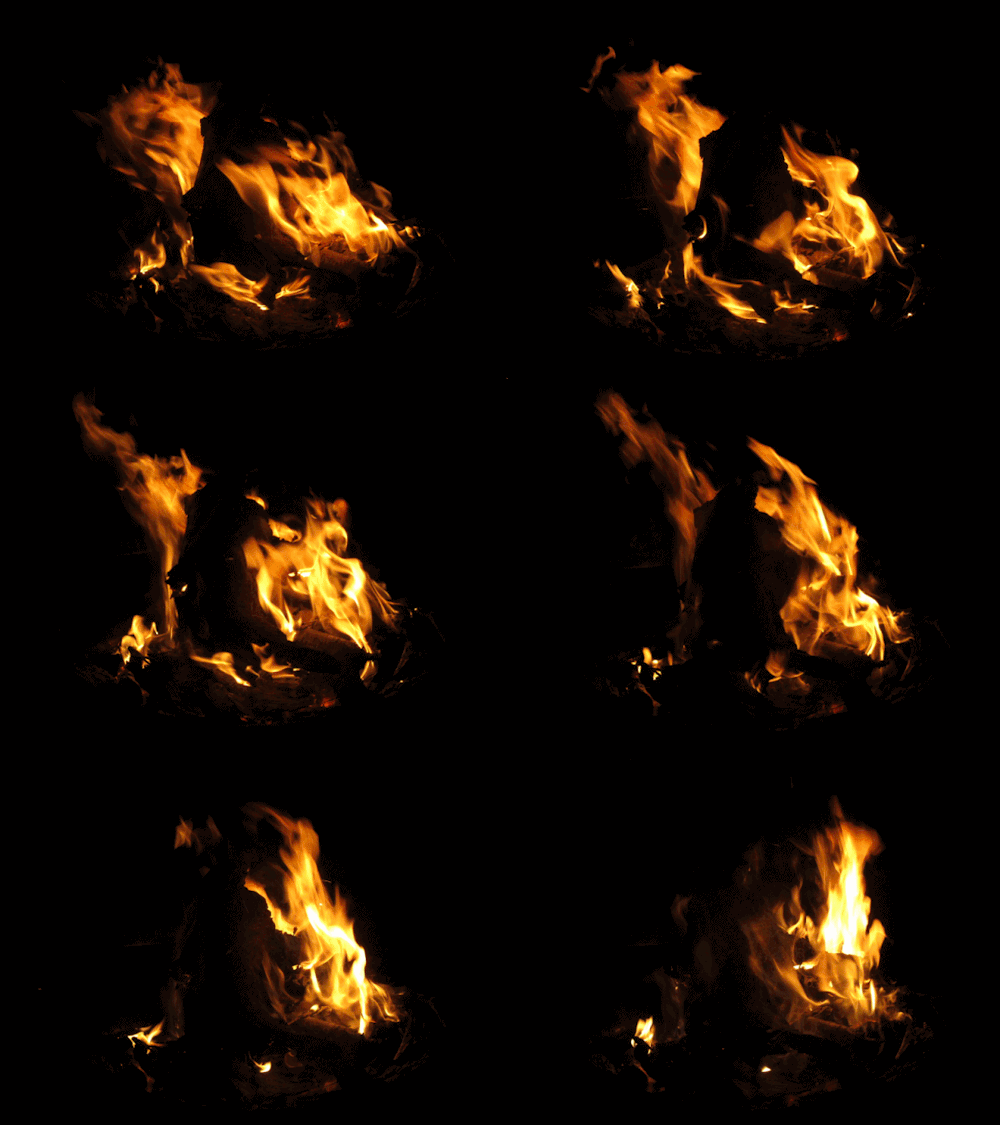
"self" immolates (xfilledwithdoubt-)
Thus have I heard. On one occasion the Buddha was living in Gaya, on Gaya Hill, together with a thousand ascetics. There he addressed them.

"Meditators, ALL is burning! What 'all' is burning?

"The eye is burning, forms [seen by the eye] are burning, eye-consciousness is burning, eye-contact is burning, and whatever is felt as either pleasant or painful or neither-painful-nor-pleasant that arises with eye-contact as supporting condition, that too is burning!
 
ArticMonkeyss/tumblr.com)
 
"Burning with what? Burning with the fire of craving [lust, greed, selfishness], with the fire of aversion [fear, hate, revulsion], with the fire of delusion [wrong view, ignorance, illusion].

"I say it is burning with rebirth, aging, and death, with sorrow, weeping, pain, grief, and despair.

"The ear is burning, sounds [heard by the ear] are burning... The nose is burning, odors [sensed by the nose] are burning... The tongue is burning, flavors [savored by the tongue] are burning... The body is burning, tangibles [felt by the body] are burning...

"The mind is burning, ideas are burning, mind-consciousness is burning, mind-contact is burning, and whatever is felt either as pleasant or painful or neither-painful-nor-pleasant that arises with mind-contact as supporting condition, that too is burning!

"Burning with what? Burning with the fire of craving, with the fire of aversion, with the fire of delusion. I say it is burning with rebirth, aging, and death, with sorrow, weeping, pain, grief, and despair.
 
The world is on fire -- the whole world known through the senses (winds-of-desolation).
 
"Meditators, when a noble follower who has heard (the Dharma) sees this, one becomes estranged [alienated and indifferent] regarding the eye, regarding forms, regarding eye-consciousness, regarding eye-contact, and whatever is felt as either pleasant or painful or neither-painful- nor-pleasant that arises with eye-contact as supporting condition. With regard to all of these, one becomes estranged.
 
Cool (Rzoont/flickr.com)
"One becomes estranged regarding the ear... sounds... One becomes estranged regarding the nose... odors... One becomes estranged regarding the tongue... flavors... One becomes estranged regarding the body... tangibles...

"One becomes estranged regarding the mind, regarding ideas, regarding mind-consciousness, regarding mind-contact, and whatever is felt as either pleasant or painful or neither-painful-nor-pleasant that arises with mind-contact as supporting indispensable condition. With regard to all of these, one becomes estranged.

"When one becomes estranged (alienated, disaffected, indifferent), passion fades out. 

"With the fading of passion, one is liberated. When liberated, there comes certainty that one is liberated. 

Nirvana is extinguishing, cooling
Cooling (Rzoont/flickr.com)
"One understands that, 'Birth is exhausted, the supreme life has been lived, what can be done has been done, and there is no more [suffering] beyond.'"

That is what the Buddha said. Those gathered were glad and approved of his words.

Now during his utterance, the hearts of those thousand ascetics were liberated from the taints by abandoning clinging.

The "World"?
Ven. Nyanaponika Thera ("Karma and its Fruit")
"World" as self (weakonomics.com)
"In this fathom-long body with its perceptions and thoughts there is the world, the origin of the world, the ending of the world, and the path leading to the ending of the world" (AN 4.45).
 
The "world" of which the Buddha speaks is comprised in this aggregate [heap, collection, composite] of body-and-mind. For it is only by the activity of our physical and mental sense faculties that a world can be experienced and known at all. 

The sights, sounds, smells, tastes, and bodily impressions which we perceive, and our various mental functions, conscious and unconscious -- this is the world in which we live. 

And this world of ours has its origin in that very aggregate of physical and mental processes that produces the karmic act of craving for the six physical and mental sense objects.

[The Buddha asked:] "Ananda, if there were no karma ripening in the sphere of the senses, would there appear any sense-sphere existence?" — "Surely not, venerable sir!" (AN 3.76)

Thus karma is the womb from which we spring (kamma-yoni), the true creator of the world and of ourselves as the experiencer of "the world."
 
And through our karmic [intentional] actions in deed, word, and thought, we unceasingly engage in building and rebuilding this world and [rebirth in] worlds beyond. Even our good actions, as long as they are still under the influence of craving... More

Monday, November 26, 2012

Detachment and Compassion in Buddhism

Elizabeth J. Harris,* Detachment and Compassion in Early Buddhism; Wisdom Quarterly
Wisdom Quarterly: Think detachment and non-clingy compassion go together?
 
Bodhi leaf hearts (Gabrielgs)
To people looking at Buddhism through the medium of English, the practice of compassion and detachment can appear incompatible, especially for those who consider themselves to be socially and politically engaged. 
 
In contemporary usage, compassion brings to mind outward-moving concern for others, while detachment suggests aloofness and withdrawal from the world.
Yet Buddhism recommends BOTH as admirable and necessary qualities to be cultivated. This raises questions such as:
  • If compassion means to relieve suffering in a positive way, and detachment to remain aloof from the world, how can the two be practiced together?
  • Does detachment in Buddhism imply lack of concern for humanity?
  • Is the concept of compassion in Buddhism too passive, connected only with the inward-looking eye of meditation, or can it create real change in society?
Kwan Yin (Avalokita), bodhsattva of compassion, Kayosan, Japan (Massimiliano Troiani)
 
It is certainly possible to draw sentences from Buddhist writers which seem to support a rejection of outward concern for others. For example, [classic Mahayana translator] Edward Conze has written, "The Yogin can only come into contact with the unconditioned when he brushes aside anything which is conditioned" (Buddhist Thought in India, 1960, Ch.5).
Similarly, G.S.P. Misra writes (Development of Buddhist Ethics, p. 44), "In the final analysis, all actions [karma] are to be put to cessation... The Buddha speaks of happiness involved in non-action which he further says is an integral part of the Right Way (samma patipada).
 
Taken in isolation and out of context, these remarks can give the impression that the path to [Sanskrit nirvana, Pali nibbana] implies developing a lack of concern towards everything in samsara. But is this inference sound? I would argue that it is not.
This is an issue which touches on the whole question of transferring concepts across linguistic barriers, in this case Pali and English. It calls not only for an understanding of how the concepts are used within the framework of the Pali Buddhist texts, but also for an awareness of how the English terms used in translation function and whether they are adequate.
 
Inevitably, a dialogical approach between two linguistic frameworks is necessary.
 
Detachment
Laugh more, stay cool (zazzle.com)
Viveka [withdrawal] and viraga [dispassion, cooling] are the two Pali words which have been translated as "detachment." The two, however, are not synonymous. The primary meaning of viveka is separation, aloofness, seclusion. Often physical withdrawal is implied. The later commentarial tradition, however, identifies three forms of viveka: physical withdrawal (kaya-viveka), mental withdrawal (citta-viveka), and withdrawal from the roots of suffering (upadhi-viveka).

Physical withdrawal, as a chosen way of life, was not uncommon during the time of the Buddha. To withdraw from the household life, renounce possessions, and adopt a solitary mendicancy was a recognized path. 
 
The formation of the Buddhist monastic Order (Sangha) was grounded in the belief that going out from home to homelessness could aid concentrated spiritual effort. 

Yet, to equate the renunciation which the Buddha encouraged with a physical withdrawal, which either punished the body or completely rejected human contact would be a mistake. More
  • ABOUT THE AUTHOR: Dr. Harris studied Buddhism in Sri Lanka from 1986-1993 obtaining a Ph.D. from the Postgraduate Institute of Pali and Buddhist Studies, Univ. of Kelaniya. She is now Secretary for Inter-faith Relations in The Methodist Church in London. Previous BPS publications include Violence and Disruption in Society (Wheel No. 392/393) and Journey into Buddhism (Bodhi Leaves No. 134).

Thursday, August 30, 2012

"It will pass" (meditation)

James Khan (detoxifynow.com); Meditation Committee, Wisdom Quarterly
A student went to a meditation teacher and complained:
  
"My meditation is horrible! I feel so distracted! My legs ache! I'm constantly falling asleep! It's just horrible!"
 
"It will pass," the teacher replied matter of factly.
 
A week later, the student came back to the teacher to report:
  
"My meditation is wonderful! I feel so aware! I feel so peaceful! I feel so alive! It's just wonderful!'
 
"It will pass," the teacher replied matter of factly.

Commentary
"Oh, of course! Why did I let myself get clingy?"
Goenka once lamented (as anyone who sits the free 10-day course will hear him tell) that many students grasp at their meditative successes and want to know how to re-experience them, how to bring them back, how to have just good sits without the "wasted" time sessions. The lament is that it is just this sort of grasping we sit to let go of. While letting go, much more comes. But we cannot easily let go to get more to come. That is a subtle form of grasping and clinging. Long after the Buddha but long before Goenka, the Western poet Alexander Pope immortalized this message, perhaps never realizing how much it describes attempts at meditating, in this stanza:

"Oh thoughtless mortals! ever blind to fate,
Too soon dejected, and too soon elate!"