Loading...

This is default featured post 1 title

Go to Blogger edit html and find these sentences.Now replace these sentences with your own descriptions.This theme is Bloggerized by Lasantha Bandara - Premiumbloggertemplates.com.

This is default featured post 2 title

Go to Blogger edit html and find these sentences.Now replace these sentences with your own descriptions.This theme is Bloggerized by Lasantha Bandara - Premiumbloggertemplates.com.

This is default featured post 3 title

Go to Blogger edit html and find these sentences.Now replace these sentences with your own descriptions.This theme is Bloggerized by Lasantha Bandara - Premiumbloggertemplates.com.

This is default featured post 4 title

Go to Blogger edit html and find these sentences.Now replace these sentences with your own descriptions.This theme is Bloggerized by Lasantha Bandara - Premiumbloggertemplates.com.

This is default featured post 5 title

Go to Blogger edit html and find these sentences.Now replace these sentences with your own descriptions.This theme is Bloggerized by Lasantha Bandara - Premiumbloggertemplates.com.

Showing posts with label saffron robes. Show all posts

Saturday, November 3, 2012

Sacred Robe Offering: Kathina 2012 (video)

Ven. Karunananda, Ph.D., Ven. Bibekananda, Dharmachari Seven, Wisdom Quarterly
The Buddha under the Bodhi tree, Dharma Vijaya Buddhist Monastery, Crenshaw Bl. (WQ)
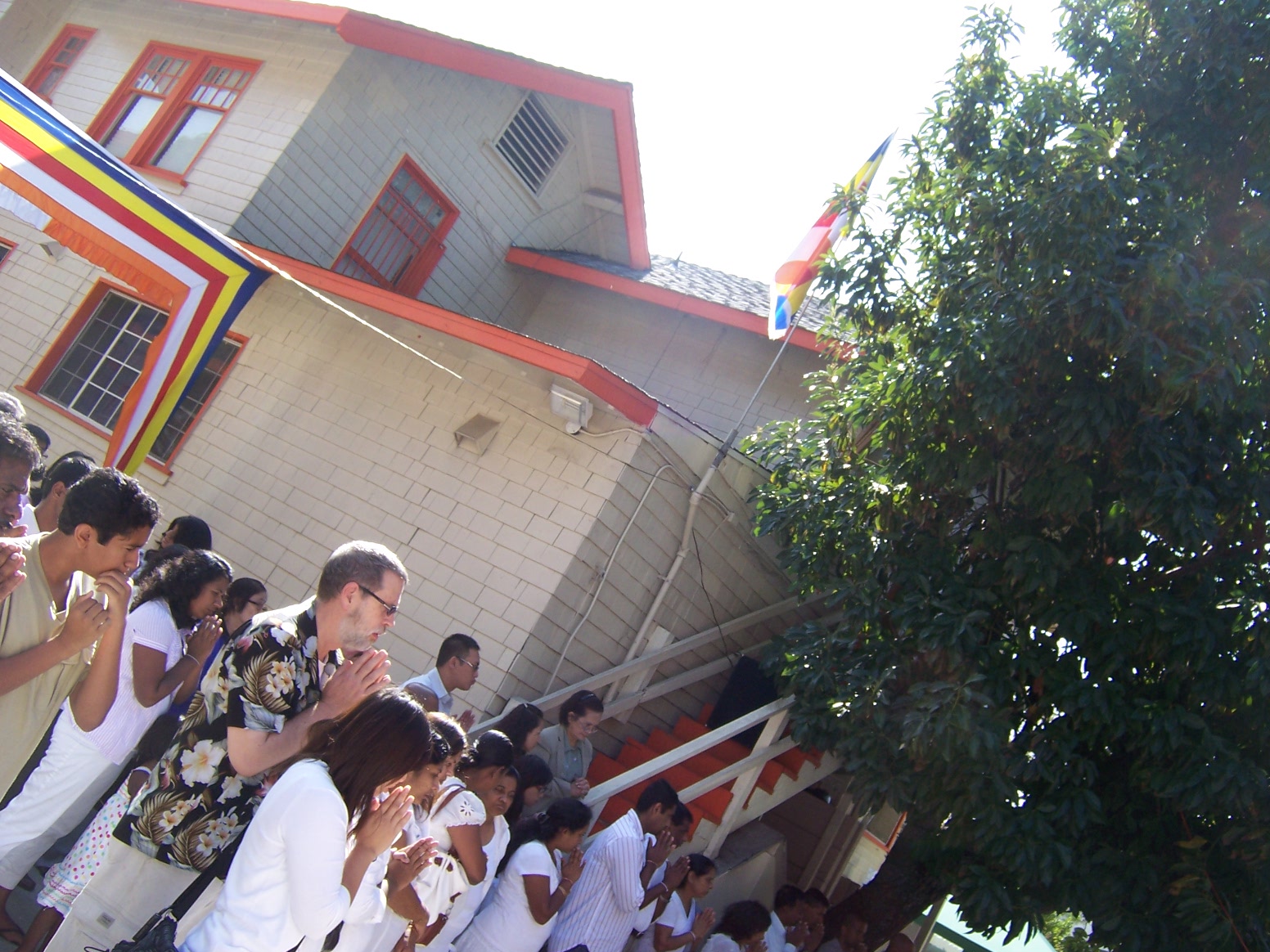
The sacred saffron kathina robe, Dharma Vijaya Buddhist Vihara, Los Angeles, California, 2011 (Wisdom Quarterly).
   
The offering (dana) of the sacred robe is an annual event, traditionally held in October. It marks the end of the three-month Rains Retreat or Vas. During this time Buddhist nuns and monks retire to their hermitages to engage in intensive meditation, study, teaching, and other practices for rapid spiritual advancement.

Buddhist History
One one occasion, in ancient India, monks took up residence practicing sane-austerities for the rainy season. At the end of their seclusion, they set out to visit the Buddha, who was residing in distant Savatthi.

Their travel was arduous. At times, they had to endure inclement weather. At the end of their long journey, one of the monks was soaking wet as he approached.

Seeing him, the Buddha requested monastics to accept additional robes for their hardship. One robe in particular, the special kathina robe, was to go to a monastic who had successfully completed the rigors of the Rains Retreat. (At this time those in robes are not allowed to travel or venture from the nunnery/monastery for overnight trips; instead they stay in one place and meditate in a loosely cloistered setting).
  
Thereafter Buddhist devotees have provided hermitages with a specially made robe, which is awarded to the one who has most successfully completed the Rains Retreat.

This robe is revered as the most important for a monastic to receive AND the most meritorious for a devotee to give.
Whereas the monastic who receives the robe gains five mundane benefits, the donor of the robe accrues a tremendous amount of merit (anisangsa, punya). The Pali word for the robe is kathina, Bengali kathin.
  
It means hard [to come by], firm, steadfast -- indicating the greatness of the merit, which is difficult to obtain and is a firm and reliable source of spiritual as well as material benefit unshakable in the face of minor bad karma.

Traditionally, devoted Buddhists undertake to strictly observe moral and ethical precepts during the period of the retreat culminating in the sacred ceremony. However, even the simple act of participating (attending in approval of this gift) they are able to share in the remarkable merit of this special gift-giving.
  • California Bodhi Vihara will celebrate the Sacred Robe Offering Ceremony today, Nov. 3, 2012 in Long Beach. Moreover, various Theravada temples throughout Los Angeles and the country are holding this ceremony as they end their Rains Retreat observance. (Contact local temples for dates).
Why?
Buddha, Lahore Museum (tribune.com.pk)
What would make the offering of this robe so meritorious? If the monastics were to practice sincerely, practice diligently and mindfully in accordance with the Dharma, some would be sure to gain mundane and supramundane attainments, such as the Eight Meditative Absorptions (jhanas) and the Eight Path-and-Fruition consciousnesses. These latter attainments are the penetrating insights that lead to enlightenment by stages from stream-entry to full realization. Giving to someone who has attained any of these is extremely meritorious, each more rare and powerful than the previous one. There is great merit in giving to anyone who emerges from the first absorption. But the merit of giving to one who has gain full enlightenment is uncountable, off the scale, so precious as to be considered beyond reckoning.

    Wednesday, October 17, 2012

    The trouble with Burma (audio)

    TheWorld.org, PRI, Public Radio Int'l (audio); Wisdom Quarterly
    Dictator Gen. Than Shwe crushed Buddhist "troublemakers" with backing from China until US Sec'y of State Hillary Clinton started coming by and acting like the highest bidder.


    The monks rose up for the Saffron Revolution
    RANGOON, Burma - Myanmar is emerging from decades of repression and international isolation. The one-time military government has enacted democratic reforms, and the U.S. and others have responded by suspending sanctions. 

    Now the country also known as Burma is viewed as a promising frontier economy. But there’s a downside. A rush of foreign investment could imperil Yangon’s collection of colonial-era buildings, an emblem of a time when the city was a cosmopolitan hub in the English empire.
     
    The generals who ruled [and renamed Burma] Myanmar since the 1960s isolated the country and drove its economy into the ground. Being stuck in time has been a curse for Myanmar’s people, among the poorest in Asia. But it’s also had the unforeseen effect of preserving hundreds of ornate buildings from the 19th and early 20th century. More

    Burma's Pagan or Bagan, an ancient city of thousands of pagodas and shrines (Wiki commons)
       
    What was the "Saffron Revolution"?
    Seven, Wisdom Quarterly
    Burma's Saffron Revolution (Amnesty Seattle)
    An explosive situation in Burma was fueled in 2007 by crushing price hikes for basics opposed by 35,000 Buddhist monks and their supporters, who defied the military dictatorship. Rising prices for essentials set off protests. A junta of generals warned peaceful demonstrators as they staged days of anti-government protests. Military leaders reacted by imposing a nighttime curfew and banned gatherings of more than five people. The country's hard-line military rulers soon resorted to extreme force to stop the biggest anti-government demonstrations Burma had seen in nearly two decades, led by the country's Theravada Buddhist monks. Soldiers in full battle gear were deployed throughout the country's largest city, Rangoon, setting the stage for a showdown with a determined pro-democracy movement previously led by "The Lady," Daw Aung San Suu Kyi, who rather than being allowed allowed to rule was deposed in a military coup immediately after democratic election and kept under house arrest for years.
    Burma’s "Frontier" Investor
    Burma is going through some rapid transitions. In just the last year, the country’s military dictators have freed Burmese opposition leader Aung San Suu Kyi from house arrest and allowed [rigged] elections [that keep them in control] to be held. Now the country is opening up to foreign business as well. [Enter Hillary Clinton and other suitors.]

    Tuesday, October 9, 2012

    F Rodeo Drive! "A People's Guide to LA"

    LAWeekly.com; Ven. Piyananda; Wisdom Quarterly
    Saffron Days in L.A. (Read excerpts)
    Let the tour buses take the throngs to visit Marilyn Monroe's handprints at Grauman's Chinese Theater or to press their noses up to the windows on Rodeo Drive and wander Beverly Hills like they're Julia Roberts. 
      
    Despite what the entertainment industry would have us believe, the city of Los Angeles and its surrounding neighborhoods have a much richer, often conflicted history than just those landmarks -- and A People's Guide to Los Angeles, just released by UC Press, would like to make sure we don't forget it.
        
    Researched for more than 15 years by Laura Pulido, Laura Barraclough, and Wendy Cheng -- three Southern California natives and academics with backgrounds in ethnic studies or sociology -- and cultivated from published and personal accounts of Los Angeles' long-standing political, social, and racial power struggles, the travel guide was released this month and includes 115 sites of interest for the progressive-minded explorer. 
      
    "We're looking to reach a whole group of tourists who might find themselves dissatisfied..." More

    "Hello" - When Karmin moved from Nebraska to LA, capital of the world