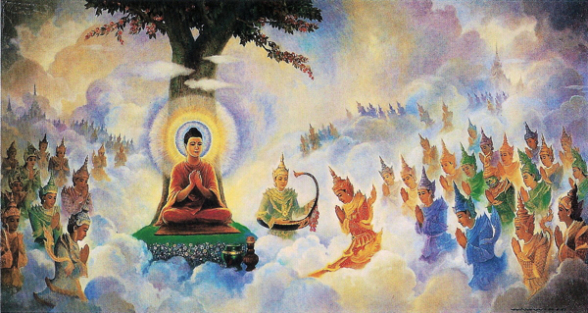
Gary Sanders (Against the Stream), Wisdom Quarterly |
| The Buddha (FFlittleD/flickr.com) |
"Good article. [I'm] interested to know how [your] "the Buddha mastered them and found they weren't the 'be all, end all,' so why bother?" thinking came [about] for you... being that the Buddha spoke so highly of jhana and that it is the eighth factor of the Eightfold Path?"
There are two reasons why I previously thought the jhanas weren't all that. And I'm not really sure which came first, or if it even matters.
1. Most of the Western teachers I sit with seem to just gloss over the jhanas. It's been my perception that they do not place any real importance on the practice [of tranquility and deep prerequisite "right concentration," or samma samadhi, the eighth factor, defined by the Buddha as the first four absorptions].
2. I just assumed that the jhanas were another practice the Buddha learned, mastered, and discarded (like other extreme ascetic practices) before going to sit under the Bodhi tree.
After reading books and listening to talks from Ayya Khema, Leigh Brasington, Daniel Ingram, and others, I have found great, almost indispensable, value in jhana practice, not just to sharpen the quality of my concentration, but really as part of my path.
The Buddha and jhanaSeth Auberon, Dhr. Seven, Amber Dorrian, Wisdom Quarterly |
| Deep meditation (mysecretpsychiclife.com) |
 |
| (AlisonRyde/flickr.com) |
Having edited the article, I have a different explanation. Siddhartha, who only became "the Buddha" after opening himself to the blissful absorptions, had NOT mastered them. He had rushed through them precisely without gaining mastery or lingering in the supersensual bliss and eventual equanimity they offer. One can move through them rather rapidly like a stone skipping on the surface of a very deep lake.
This explanation, which is not my own but that of advanced jhana masters like Ven. Dhammadipa and his teacher, the foremost living expert on Buddhist meditation, Pa Auk Sayadaw, resolves a historical problem.
That problem is understanding why Siddhartha's experience under the Bodhi tree makes it sound as if jhana were a new concept when he must have experienced the jhanas to some degree -- however lightly -- to have become disappointed with the teachings of his former teachers.
After all, those teachers called their highest jhanic attainments "enlightenment" and "nirvana" (moksha or "final liberation").
The worlds those rarefied jhanas lead one to be reborn in have staggeringly long average lifespans of as many as 80,000 aeons, or relative "eternities," which is nevertheless nowhere near one actual eternity.
Under the Bodhi tree the Bodhisat is said to have remembered a childhood absorption experience. And this led him to wonder why he had been meditating fearing pleasure divorced from sensuality? Problem: Buddhist history is told as if the ascetic Siddhartha had been immersed in the jhanas for years.
After all, had he not already used the first jhana, recalled from childhood, within those other dharmas (the Doctrines and Disciplines of Alara Kalama and Uddaka Ramaputta) to get to the equanimous immaterial (fifth through eighth) jhanas?
Technically yes, but not if he just zipped through the material (first through fourth) without mastering them or permitting himself to bask in the bliss they offer.
"Mastery" is defined in Buddhism as being able to enter them at will, emerge from them as predetermined, and to choose which to enter and abide in. One may, if one wishes, stay absorbed for seven days, and that can be done without breathing. Although Siddhartha climbed to the seventh and eighth
jhanas with his teachers, he was striving toward a goal that was not to be found in these attainments. Those teachers taught that those attainments themselves were the goal -- the consummate accomplishment of liberation (
moksha).
But the Bodhisat understood -- due to a great deal of past life experience with the absorptions -- that no
jhana is
bodhi (enlightenment), nirvana
(the end of all suffering), or the final solution to the problem of rebirth (
samsara).
Jhanas are temporary liberations, not final liberation (
moksha).
All of the
jhanas are heavy good-karma and therefore lead to rebirth within
samsara, to destinations corresponding to superhuman worlds beyond the Sensual Sphere.
Each
jhana has three rebirth-levels corresponding to the level of mastery attained. Full mastery of the first
jhana, for example, leads to a "heaven" or space plane called Great Divinity (the plane of
Maha Brahma), whereas merely touching that
jhana leads only to rebirth (if held at the dying moment) to rebirth in "7th Heaven" called
Brahma's Retinue, a world of shining ones in space (parisajja brahma akasha deva loka, Large Chart: 31 Planes of Existence, p. 80).
Right Concentration
Moreover, in answer to your question, we are rarely taught that the Buddha "spoke highly of the absorptions." In fact for a few centuries now, Theravada teachers fearfully dissuade practitioners from taking up a serenity practice (samatha). They seem to suffering from the same obstacle Siddhartha faced that blocked his attainment of enlightenment. Who thinks jhanic bliss is a trap?
The fear is that meditators will become attached to the joy and cling detrimentally to the conditioned phenomena of meditative experience.
What is more important, samadhi or vipassana, concentration or insight? The question is misleading because suggests a false dichotomy. It is not one OR the other.
There is no mindfulness without concentration, no concentration without mindfulness. And without mindfulness there can be no insight. Mindfulness helps everything, but it is concentration, whether as access or absorption, that purifies and intensifies heart/mind to breakthrough.
What is more important, the top half of the pyramid or the bottom half?
The top half, obviously! Is it "obvious"? No, the top half! What top without a bottom, what height without a foundation, what upstairs access without a firm downstairs? There is no elevated part without a supporting foundation part, except in the abstract. In practice, no one gets to liberating-insight without a necessary and sufficient amount of concentration. The weaker the mind/heart's ability to focus and stay on the object of insight, the less likely any breakthrough is to be expected.
But here's the thing. Getting to the pinnacle of insight does not technically take mastery in absorption, although mastery in absorption certainly makes it much more likely!
Without mastery up to the fourth absorption, the sustained practice of Dependent Origination (going backward from current circumstances to their origin rooted in karma and past lives) or seeing existential phenomena such as particles and mind-moments (kalapas and cittas) is very difficult and unsustainable.
Can it happen, can it be accomplished? Yes. As unlikely as it is, it can. Access concentration, which is inferior to full absorption even to the weakest level of the first jhana, is enough. This is a technical point; however, it is taken as gospel. No one is allowed a choice. Access is all that is offered nowadays as if absorption were impossible.
Although access is technically enough, it does not mean most meditators will succeed; it only means that at least one person has succeeded.
For example, a person may win a battle against a titan with just a sling and a single stone. But every human who embarks on such a battle would be wise to arm him or herself far better than that!
Fear of what jhana might be or lead to with no actual experience of it is like a sinister plot to make sure no one succeeds in reaching stream entry. In a popular misconception of Mahayana, this might seem a welcome thing. Gawd forbid anyone actually enter upon becoming enlightened before having "saved" everyone else.
Mara Devaputra, the arch-angelic Cupid/Lucifer figure residing in the highest Sense Sphere world, known as Brahma's Retinue, wants no one to attain stream entry or jhana. For that entails escape from samsara and his influence, be it temporary (by higher rebirth) or permanent (by making an end of rebirth).
Since the jhanas lead to rebirth beyond the Sense Sphere, in the Fine Material and Immaterial Spheres, Mara does not want anyone attaining jhana. Strangely, Mahayana speaks only of six planes of existence when the historical Buddha spoke of 31 such planes, most of them deva worlds of light.
The six planes Mahayana teaches are merely those within the Sense Sphere. Why is that?
And within Theravada meditation circles, why are various monastic communities and communities of practitioners still opposing the Buddha's teachings and his urgings that we establish ourselves in at least the first four absorptions? It is one of the bases of success.
Parable of the Raft
In the "Parable of the Raft," the Buddha says that if one want
s to cross over from this shore fraught with dangers over to a further shore beyond
danger, one should gather just enough wood and material for a raft and strive diligently with
just the strength of one's paddling limbs to get across. That
might be enough. That would be
viriya, a "virile" effort and exertion. Such outbursts are rarely fruitful. Instead, persistent balanced-effort is the gradual path the Buddha taught. Or one might die trying by such an outburst. One might find that poorly fabricated raft is not nearly enough to cross over the great flood (
ogha, samsara). Yes, "enough" concentration is enough, but more is safer and gives one greater certainty that the goal will be reached.
Sadly, not everyone can attain absorption, so access concentration becomes the only route available. But this is no reason to disparage absorption or dissuade others from following the gradual path the Buddha taught. If someone only has a flimsy foundation, one may try to use it. Or it may be wiser to make it more stable before trying
, and failing, and giving up. A human life is an extraordinarily rare opportunity to reach the goal. Maybe that is why some of us were reborn here. It is easier to glimpse nirvana from the lower
deva worlds, BUT it is less likely that one will have the impetus to strive for it. Who needs "the end of suffering" when living on a plane without much overt suffering. Obvious suffering in the human world reminds us of the true nature of
samsara (that all things are impermanent, unsatisfactory, and impersonal) and the great danger inherent in it. Danger? Until stream entry there is an ever-present danger of falling into unfortunate realms (rebirth destinations) for indeterminate periods of time during which one forgets the goal because one is simply trying to survive and endure the misery. Then one neglects the goal when reborn in fortunate superhuman worlds, so that it can be aeons before one gets back to any vision of freedom through enlightenment and nirvana.