Loading...

This is default featured post 1 title

Go to Blogger edit html and find these sentences.Now replace these sentences with your own descriptions.This theme is Bloggerized by Lasantha Bandara - Premiumbloggertemplates.com.

This is default featured post 2 title

Go to Blogger edit html and find these sentences.Now replace these sentences with your own descriptions.This theme is Bloggerized by Lasantha Bandara - Premiumbloggertemplates.com.

This is default featured post 3 title

Go to Blogger edit html and find these sentences.Now replace these sentences with your own descriptions.This theme is Bloggerized by Lasantha Bandara - Premiumbloggertemplates.com.

This is default featured post 4 title

Go to Blogger edit html and find these sentences.Now replace these sentences with your own descriptions.This theme is Bloggerized by Lasantha Bandara - Premiumbloggertemplates.com.

This is default featured post 5 title

Go to Blogger edit html and find these sentences.Now replace these sentences with your own descriptions.This theme is Bloggerized by Lasantha Bandara - Premiumbloggertemplates.com.

Showing posts with label stress. Show all posts

Saturday, January 14, 2012

The Power of Living in the Present Moment.

PHOTO CREDIT: Kyodo for the Japan Times

The Dalai Lama comforts a child in Japan following the tsunami of 2011. Here we see the Dalai Lama less as a revered leader, and more like a benevolent grand-father. Time stands still as the cool water of the Dalai Lama's compassion soothes the terrifying flames of this child's fear and depression. When we are present for one another with no other motive than compassion and love, there truly isn't anything we can't survive together.

Times of extreme stress often have a way of stripping through the layers of the ego to expose a seemingly lost ability to co-operate as a society. During times of crisis and disaster, the self melts away to expose the innate goodness in all sentient beings. It is our dedication and practice as Buddhists and other spiritual believers to bring this co-operation to all moments.

It is in that unison, I believe, where we can prevent disasters before they unfold with their tragic results. And while a certain level of tragedy is the reality of life, we should do everything in our power to lessen the impact. In being present and aware of changes gives us additional information to head of problems and lessen consequences. That's the power of living in the present moment.

---I bow to the Buddha within all beings---

Friday, July 8, 2011

Growing Like a Tree.

Voila!! Our new Chinese, kanji scrolls (click picture to enlarge). Here is the site where I bought them--they were hand painted by a trained calligrapher. The closest meaning of the left-hand character, in English, is "love" but to explain it further I have included the description from the website:
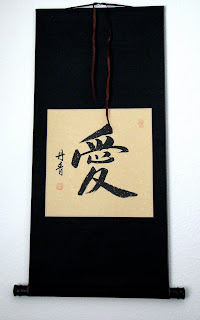
This character can also be defined as affection, to be fond of, to like, or to be keen on. It often refers to romantic love, and is found in phrases like, "I love you". This may be hard to imagine as a westerner, but the strokes at the top of this love character symbolize family & marriage. The symbol in the middle is a little easier to identify. It is the character for "heart" (it can also mean "mind" or "soul").

I guess you can say that no matter if you are from the East or the West, you must put your heart into your love. I suppose you could say that the full meaning of this love character is to love your family, spouse, and friends with all of your heart, since all three elements exist in this character.

James
: The scroll on the right-hand side, is best translated into English as the following:

The simplest form of peace and harmony. This can also be translated as the peaceful ideas of gentle, mild, kind, and calm. With the more harmonious context, it can be translated as union, together with, on good terms with, or on friendly terms. Most people would just translate this character as peace and/or harmony. This is a very popular character in Asian cultures - you can even call it the "peace symbol" of Asia. In fact, this peace and harmony character was seen repeatedly during the opening ceremony of the 2008 Olympic Games in Beijing (a major theme of the games).

James: The picture in the middle, is a close up of a forest of bamboo that I often gaze upon in meditation and contemplation. On days when I can't get to the meditation cushion because of depression, or a busy schedule, I find a picture of nature to be an effective way to concentrate my energy and ground myself in the richness and stability of the present moment.

The present moment, is the only moment, and therefore, connecting with that moment keeps us growing and remembering that the depressing days won't always hang over us. But, it also means keeping us from getting too arrogant and comfortable in our successes by remembering that everything changes. In this way, we are better able to enjoy the pleasures when we have them because we realize they will soon fade.

A stand of trees or bamboo doesn't fight the wind; it survives the inevitable winds of change by swaying with its energy. If it tried to resist powerful gusts, it would break apart. It's deep roots help anchor the tree by steadily pushing deeper and deeper into the ground. In this way, the tree itself can bend and adapt without uprooting itself from overwhelming stress upon a weak root system.

We deepen our roots by staying anchored in the knowledge that the present moment is where growth occurs. If a mature tree's roots stopped growing deeper than the surface area it occupied as a sapling, then the smallest breeze would uproot it and knock it down. The same is true if we stubbornly stop growing, out of fear of failing, or just plain arrogantly thinking that we know it all already and can therefore stop adapting. This is when the roots of a tree rot from neglect; as well as from failing to dig deeper to create stronger roots that widen out into a broad network of stability.

I have been happily reminded of this with a recent slump in my Dharma practice; it's been awhile since I've formally meditated. However, I adapted (like the trees) by meditating other ways; such as focusing deeply upon nature, simple breathing exercises while sitting upon the couch and letting music break down my perceived walls of imprisonment. And, within the past few days, I have found I weathered the storm; the deep and diversified root system, I've been growing these past ten years of Buddhist practice has helped me bend with the strong head-winds but not break.

-I bow to the Buddha within you-

Friday, July 9, 2010

Adapting to Rising Heat.

This post started as a comment in regards to Genkaku's post about the current heat wave on the East coast of America. Thanks Genkaku for the inspiration:

The Earth is our only home but for too long humans have forgotten our close interdependent relationship with her, which has led us to neglect the relationship and abuse her. Yet as we know well from studying the Dharma, we can not hurt the environment without hurting ourselves. We can ignore science all we want but the reality is that it's been getting warmer and warmer at a faster pace than prior warming periods. Direct observations have linked it to fossil fuel use. Seeing how corrosive factory and car pollution is to the human body I will trust science when they conclude that it's changing our climate adversely. Schooling has a funny way of doing that. Science has been right in countless ways because it is based on direct observations and experiments, which incidentally is not entirely unlike the Dharma's teachings of awareness and mindfulness.

This isn't a political issue because we all physically and emotionally suffer when our environment is degraded but besides that it affects the only home we are lucky to enjoy. Regardless of how we got to this point of a warming climate, I think our society needs to adapt to nature better and follow the rest of the world that take siestas (afternoon naps) during the hottest parts of the day. Let nature do it's thing and not fight it. We should take the opportunity to rest and take a nap. What a novel idea!! When I lived in West Africa the whole place would nearly completely shut down between the hours of noon and 2pm. It's only two hours but many Americans would see that as lost productivity, and that unwillingness to accept limitations causes a lot of suffering. Both physically and mentally. It's not being lazy as the American, Puritan work ethic would suggest. It's being aware of our limitations and being fully accepting of the present moment.

I think we push the human body in our modern society too much. We have delusions about what the human body can take and how far we can push it but the human body is perfectly aware of the moment and it's capacities. Whether we accept those limitations or not the body will shut down when the present moment finds it unable to function. Our mind might ignore the present moment but our bodies are finely tuned to it.

Perhaps we can learn from that and accept our limitations instead of forcing and pushing everything. In today's western world (I can't speak for elsewhere) we're over-worked, get less sleep and eat bad food in an impossible chase to "save time" and stay one step ahead in this fast paced world. And I can't help but wonder if that's partly why there's been such an increase in anger, hatred and selfishness. So I say we slow down a bit and bring about noon siesta time here to America.

PHOTO CREDIT: Napping monk by Brian Keathley on Flickr.

Thursday, December 18, 2008

Musical Interlude: Jason Mraz, "I'm Yours." Buddhism and Music.

I thought I'd post a fun, happy and relaxing song this morning. The artist is Jason Mraz and I really dig his reggae sound. Reggae is one of my favorite musical styles because it is so calming and gets me to dance around a bit and let my body relax to the beat. I also really like the message of this song of living in the now, letting go of our hang-ups and enjoying what he have and not worrying about what we don't have. As well as rejoicing in the power of love.
Music can be very spiritual as I think sound is something that our brain can easily absorb without too much thinking. Songs are great ways to express feelings, ideas and emotions that might be otherwise difficult to express through language. For me, It's about letting go to the present moment of the songs to just enjoy the beauty and power of sound. When I'm having a bad day it's hard too continue feeling glum after listening to say, Bob Marley.

Music is very meditative in that it can relax the body and mind to better enable deep contemplation and peacefulness. It's also a way to release stress and anxiety as music is for me a kind of audio massage and/or way to channel and safely discharge my less skillful thoughts and energy. I have found listening to positive music and/or chanting before meditation to be a great way to calm the brain and prepare it for sitting meditation.

The vibrations from the musical tones of chanting vibrates throughout the body and I have found relaxes the muscles that tense up in our day to day motions/actions. In addition it opens up the lungs so that breathing deeply during meditation is easier. From my experience I have found that listening to music and/or chants before meditation is kind of like stretching before running.

~Peace to all beings~

Thursday, October 2, 2008

Buddhism and Depersonalization.

One of the symptoms of my mental disorder, Schizoaffective disorder is depersonalization. It is something that I have experienced since I was a child when I would experience out-of-body phenomena in response to stress or anxiety. And the out-of-body phenomena is the best way to describe the main essence of my depersonalization. I slip in and "out of my body" often and before I know it I'm outside looking in and when this happens it feels as though I'm watching my body talk, move and act from a remote location. It reminds me of the movie, "Being John Malcovich" where people can live inside Malcovich's brain for about 15 minutes at a time and witness what he witnesses.

In these moments I feel as though I'm viewing a movie that has me playing a role. I talk but I don't feel like the words are my own but just a computer program that is simulating a conservation. It happens often when I'm in a new environment or with people that I feel uncomfortable around. I have also found that I don't feel physical pain as much when I'm depersonalizing.

I liken it to an escape hatch when the symptoms of my disorder get to be too much to handle, when the hallucinations, delusions or paranoia get too strong. As well as when my anxiety and stress reach a certain level. Part of my condition is that I am almost always in a state of anxiety and stress so that from the outside it looks like it doesn't take much to set me off but in reality its just one final trigger for my brain to handle so I slip out of my body and go on autopilot. The depersonalization also expresses itself when I look at myself in the mirror. I often gaze into my eyes and see someone else behind that image running things. It's stressful because it feels like I am watching a copy of myself but not a happy copy but one who seems to want to cause me trauma. This all said, I have found Buddhism to be like another psychiatrist who has a tried and true prescription for emotional stress--meditation.

When I find myself outside looking in and feel it really interfering with my day or lasting longer than usual I have watered the seeds of good habit energy enough to feel some doer inside that body move for me to get on the meditation cushion. So when I start breathing and concentrate upon that I feel my body and mind return together in union. The breathing is like a gentle guide helping me return to the reality of oneness much like someone helping a person with dementia return to a place of security and peace.

Another good habit that I've developed to help connect me back to my body and present moment is to touch the ground from time to time while meditating as the Buddha did. It helps me feel something tangible that anchors me back into the experience of being. I have also found it helpful to wear a strand of prayer beads or mala around my wrist at all times because it is another physical touch object that brings me back to the present moment. It is comforting to feel a fabricated object touch my skin because it helps me remember that my body is in fact real. It also reminds me at the same time of the teachings of Buddha to remind me that I what I'm experiencing is a delusion which sometimes helps me return to myself.

Buddhism has so much to offer those of us with mental disorders because it is a religion that focuses upon the mind and emotions more than many of the religions that I have studied. It is the religion of psychology and I am hearted that the once distant field of psychology toward religion and spirituality is now opening up to the techniques of Buddhism to help reduce pyschological trauma and stress. So while I also embraced Buddhism for the spiritual teachings it has also been another tool in my toolbox to aid me in dealing with my mental disorder. It is like having an extra medication but without any side effects except peace and stability. I highly recommend that those whoe suffer from a mental disorder and feel like they are being tossed around in a sea of unstability look into Buddhism as a potential foundation to anchor your body and mind into.

~Peace to all beings~