Loading...

This is default featured post 1 title

Go to Blogger edit html and find these sentences.Now replace these sentences with your own descriptions.This theme is Bloggerized by Lasantha Bandara - Premiumbloggertemplates.com.

This is default featured post 2 title

Go to Blogger edit html and find these sentences.Now replace these sentences with your own descriptions.This theme is Bloggerized by Lasantha Bandara - Premiumbloggertemplates.com.

This is default featured post 3 title

Go to Blogger edit html and find these sentences.Now replace these sentences with your own descriptions.This theme is Bloggerized by Lasantha Bandara - Premiumbloggertemplates.com.

This is default featured post 4 title

Go to Blogger edit html and find these sentences.Now replace these sentences with your own descriptions.This theme is Bloggerized by Lasantha Bandara - Premiumbloggertemplates.com.

This is default featured post 5 title

Go to Blogger edit html and find these sentences.Now replace these sentences with your own descriptions.This theme is Bloggerized by Lasantha Bandara - Premiumbloggertemplates.com.

Showing posts with label tavatimsa. Show all posts

Monday, January 14, 2013

Discovery of 42 alien planets

Elizabeth Howell (Space.com, Jan. 12, 2013); Wisdom Quarterly on Buddhist Cosmology

A team of amateurs has discovered evidence for 42 alien planets, including a Jupiter-size world that could potentially be habitable, by sifting through data from a NASA spacecraft.
 
Forty volunteers with the crowd-sourcing Planet Hunters project discovered the new planet candidates, which include 15 potentially habitable worlds and PH2 b, a Jupiter-size planet that the team confirmed to be in the habitable zone of its parent star.
 
This is the second time Planet Hunters project, which is overseen by Zooniverse, has confirmed a new exoplanet discovery. What's more, several candidate planets found by the project may be in the habitable zones of their parent stars. These candidates are awaiting confirmation by professional astronomers.
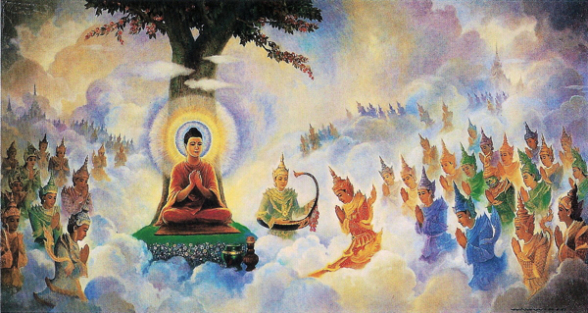
 
The Buddha teaching in Tavatimsa, "Space World of the Thirty-Three" (mettarefuge)
  
Researchers suggested this bonanza of planets in the so-called Goldilocks zone around a star, a habitable zone in which conditions are liquid water to exist on a planet’s surface and potentially supportlife, could mean there is a "traffic jam" of worlds where life could exist, project officials said.
  
"These are planet candidates that slipped through the net, being missed by professional astronomers and rescued by volunteers in front of their web browsers,” said the University of Oxford's Chris Lintott, who helms the Zooniverse, in a statement. “It's remarkable to think that absolutely anyone can discover a planet.”
  
Life on an "Avatar"-like moon
The planet PH2 b was found using data from NASA's prolific Kepler Space Telescope and confirmed with 99.9 percent confidence by observations at the W. M. Keck Observatory in Hawaii. More

The Buddha taught in Space?
Dhr. Seven, Amber Dorrian, monks of the Los Angeles Buddhist Vihara
  
Yes. The Buddha and many of his monastic disciples frequently visited space. There are many such worlds described. Two spheres of planes are material, one dense and sensual the other fine and ethereal, and those worlds can be reached from here.

Not only were their various forms of conveyance (vimanas) in space (akasha, limitless sky) at the time of the Buddha, but there had been overt extraterrestrial contact many times in the ancient prehistoric past of the planet. (There are long-lived beings who visit and reside on this planet as well as on nearby sectors in space who told the Buddha of the past; however, he was capable of discerning the past independent of their reports).

Mother Maya dreams of conceiving a baby
One spectacular case of the Buddha visiting space is when he went to go visit his biological mother, Maya Devi. She died seven days after his birth and was reborn in space. As Buddhism is divided into three sections (sutras, disciplinary code, and "higher teachings") a question arises as to who formulated the ultimate-teachings known as the Abhidharma.

In the commentaries of the oldest existing Buddhist school, the Theravada ("Teaching of the first generation Elder Disciples of the Buddha"), it is held that the Abhidharma was first taught by the Buddha himself.

Other traditions argue that it was a later addition by monastic commentators systematizing the Teachings. According to legend, shortly after his great enlightenment the Buddha spent a long time in meditation. 
  
During this time he formulated the Abhidharma, a very systematic way of presenting the highest truths or ultimate realities that lead to liberation from ignorance and suffering in this very life.

He later traveled into space -- by his own means (roughly speaking by, for lack of a better term, astral projection that produces a physical counterpart body appropriate to the realm being visited) -- to teach the "heavenly" space beings dwelling there the Abhidharma. This included his deceased mother Māyā, who had been reborn as a male by the name of Maya-deva-putta (which is more description than name, "Maya born among the devas") in a higher "celestial" or akashic (space) world known as Tusita

Buddhist depiction of space worlds
Tradition holds that the Buddha gave daily summaries of the teachings delivered in space to his chief male disciple "foremost in wisdom," Shariputra, who then passed them on to the other monastics (Red Pine, The Heart Sutra: The Womb of the Buddhas, 2004).

The Abhidharma is presented as a pure and undiluted form of the Dharma that was usually too difficult for most (earthling) practitioners of the Buddha's time to grasp. Instead, the Buddha taught by the method related in the various sutras, giving appropriate, immediately-applicable teachings as each situation arose, rather than attempting to set forth the complete Abhidharma in all its complexity.
 
There is a similarity between the Theravada tradition of the Adhidharma and that of the later and larger Mahayana school, which also claimed to be too difficult for the people living in the Buddha's time.

Saturday, November 10, 2012

Would the Buddha carry an iPad? (Yes, if...)


What is it with Thailand, the Apple Corporation, and Buddhist temples lately? First, abbot of the Dhammakaya temple said that former Apple CEO Steve Jobs is kickin’ it in the afterlife as a mid-level deva with his own celestial palace in space. Now a temple in Thailand’s Chom Phra district has decided that the Buddha carries around an iPad with him wherever he goes.
  
Ban Jabok-Ban Nong Leg temple in Thailand’s northeastern Surin province is now trying to send a message by making the Buddha hold an iPad in their next statue, says The Bangkok Post:
Traditionally, Phra Sivali, a pose of the Buddha, carries a walking stick, an umbrella, and a bowl, and is worshipped for those seeking love, luck, and prosperity.
But the one to be built by the temple will have one hand carrying the umbrella -- and the other one clutches one of the innovative bestsellers launched by the late Steve Jobs instead of the stick.
[WQ: This is quite incorrect. Venerable (Phra) Sivali is not "a pose"; he was a famous enlightened Buddhist monk, now a popular and powerful source of veneration because of his incredibly good karma and resultant good luck. He easily obtained all he wanted. Many Thai good luck charms and amulets are based on him as a well known arahant. Theravada Buddhism does not have many such prosperity figures, so Southeast Asia loves Great Sivali. Therefore, this entire Bangkok Post story is misleading: It will not be "the Buddha" holding a posh iPad, a modern symbol of abundance and cool, but Sivali.]

Thai Temple Says Buddha Should Carry An iPadThis might seem like an attention-grabbing gimmick, and maybe it kind of is. But the message the temple wants to send is good and forward-facing. They want to stress that monks need to embrace the technology of the modern world in getting their message across:
  
“Monks have to catch up with the changes and use those gadgets, such as the iPad, to lure the [younger] generation to the temple. Monks can use them to teach Dhamma to those who live their life with new communication technologies,” a temple spokesman said.

Apple CEO reborn in space?
Seven Dharmachari and Amber Dorrian, Wisdom Quarterly (COMMENTARY)
Bright golden complexion of the Buddha entering nirvana, Thailand (Luped/flickr.com)
  
Would a Buddha statue carry an iPad? Yes, if... it were in Thailand. The Buddha himself, not so much. In his day he delighted in letting go of those things which are powerful sources of grasping and clinging in the world.

In his day he instructed his disciples in pursuing the joy and liberation that comes from letting go of impermanent, unsatisfactory, impersonal things and, moreover, the personal phenomena we cling to as ourselves. That can only be let go of through wisdom, as insight uproots what is otherwise impossible to drop.

But Thailand's massive lay meditation movement, known as Dhammakaya ("body of the Dharma"), is kidding about Steve Jobs in "heaven," right?

Buddhism is atheistic? No There is no all-producing creator God; there are many gods (brahmas), many of whom are creative and powerful. Buddhism is scientific? Maybe. It is certainly the spiritual tradition most consistent and amenable to science. Buddhism is nihilistic? No.
  
Unlike modern nerds who think or hope or fear everything ends at death, that's not what happens. Conventionally speaking, life carries on like nothing happened. Ultimately speaking, "we" are dying from moment to moment and do not need to wait for bodily collapse/death to start crying about it or feeling relieved.

"Everything (all conditioned phenomena) is hurtling towards destruction; work out your liberation with diligence," the historical Buddha is reputed to have said (Mahaparinibbana Sutra, DN 16). These were his last words before passing into final nirvana. The fully enlightened do not die, because "death" entails being reborn (as well as currently existing in some ultimate sense). But we do die, conventionally speaking. And Steve Jobs has. With the coming together of the aggregates, there is renewed-becoming an instant later.
  
And there are many worlds in space to be reborn in. "Space" (akasha) to the ancients was called "sky." That "celestial" world above is the endless blue that goes to black nightly. There are many levels superior to the human plane. It is not too difficult to be reborn into these worlds of devas ("shining ones"), which are increasingly more subtle and refined, brilliant and long-lived. The first two "heavens" are far more advanced technologically and closely related to this world. The proof, the scientific evidence?

They can be seen now before dying. Because the knowledge is filtered and kept from us does not mean it is concealed form all scientists. And when they become whistleblowers telling us what they've seen and worked on, the knowledge-filterers tell us they're bonkers and not to be listened to. There are two ways to see, internally and externally. The first is harder but more convincing; the second is tough but will leave one feeling bonkers.
  
(What is it? Get a job in a scientific field in academia or the private sector then get recruited to work on black budget project, top secret stuff. Go to Washington through underground highspeed trains through tunnels beneath this country and scattered around the planet, or to Area 51, or Dreamland, or the Skunkworks, or any other secret site).

The first is developing insight (vipassana) and wisdom (prajna). This does not come from studying and thinking, but from intensive serenity-concentration and mindfulness-contemplation. Good luck. It takes effort. So for everyone who would rather study, the texts are there. Drink deep, for a little knowledge is a dangerous thing.

We won't like the answer we see; it's too much like the Christianity we laugh at as moronic and senseless. The truth is more mystic than systematic. But Buddhist practice is great for being systematic resulting in mysticism, rather than mysticism resulting in confusion.

(Dhammakaya International)

All religious traditions teach something worthwhile. It is not their fault if we do not understand what they are trying to say. The shamans were right, the mystics were onto something. But how do we get from here to there? There's an eightfold path that lays out the basics. And there is a very detailed 37 Requisites of Enlightenment that lays bare all the Buddha taught as necessary for seeing and experiencing enlightenment in this very life.

Steve Jobs in a heaven (akasha deva world)? It could be, but we doubt it. After selling millions of human beings out to the monsters on the planet who would spy on everyone, control us, damage our DNA, entrance us, lull us into sleep, enslave us, wipe us out? If he was a man caught up in his work, obsessed with innovation, okay. Great.

But if he was a man who sold the world for earthly success and fame, then... It doesn't look good for him. A "bad" person can go to a heaven. Christianity understands this, but Christians don't. It is not by being forgiven or absolved for our karma. It is by being fortunate at the moment of passing from this life to the next, by having a skillful, useful, lovely act (deed, karma, intention, will, fruition, impulsion) come up for us.

That will be a lot easier to do if we begin to calm our minds/hearts now and store up many more beneficial acts than detrimental ones. Why do harm when it only comes back around to us to harm us? What did Jobs do? What else did he do? He surely did terrible things (just ask the FBI and CIA and NSA). But all his hands toting iProducts love him, too. Look, there's a Buddha statue holding one!

So if he did acts motivated by nongreed, nonhatred/fear, nondelusion, then he is quite possibly in a better place. These heavens are not permanent, but they are much longer-lived than this human realm. There are other human and human-like realms, too. Here is a simplification that sounds an awful lot like Christianity and even Islam, like what shamans see and rabbis teach. Rather than laugh, ask: In what way is this true, too? More (with insert photos explained for those activating Google Translate)


Thursday, August 16, 2012

Who are the "Buddhists from space"?

Dharmacharis Seven and Amber Dorrian, Wisdom Quarterly
The Buddha under, on, above Mt. Sumeru, Axis Mundi, with humans at base (michielkauwatjoecom).
  
 Cave art: sky devas (Jasspierxia)
Who are the "space aliens" (akasha-loka devas) and how could they be Buddhist? As funny as it may sound, there are Buddhists in space. 
  
"Space" (Sanskrit, akasha) refers to the infinite sky. Beings coming from, patrolling, or living in the sky are referred to as akasha devas -- literally, "space shining ones."
  
Not all are devas proper, but it is a general term for superior and longer lived beings. (These are the gods, godlings, and demigods described in religious lore East and West, from pre-Hindu to pre-Christian, in ancient India, Rome, Greece, Egypt, Sumer, and throughout the Near East).
There are also asuras (titans), yakkhas (ogres of a furry bipedal nature), nagas (reptilians), and brahmas (powerful creative beings that have transcended sex). One class of beings who reside two levels up in the space worlds (lokas) above Earth are the subjects of Sakka, Ruler of the Devas. Which devas? Only the limited number in Tavatimsa, the world of the 33 "lords" or rulers of that space plane.
 
His "star command" is good and wishes to benefit humans and the perpetuation of the Buddha's Dharma (path to liberation).
   
He frequently visited the Buddha in his vimana (UFO, space chariot) with his driver and is said to have become a stream enterer, having entered upon the first stage of enlightenment by hearing the Buddha's teaching. There are inimical forces however. And Sakka is said to have asked lesser "angelic" (subordinate space rulers from the four quarters of the sky) messenger beings (devas and gandharvas) to keep an eye on human progress particularly in the arena of virtue.
   
It is said that these "Four Great Kings" (catu-maha-rajikas), who regard Sakka as their king making him "King of Kings," patrol our skies and monitor humanity in that respect apparently with devices that read the heart/mind of humans.
   
These devas or "space aliens," it should be noted, are not hideous reptoids, little green men, or monsters. They are Nordic aliens who mated with humans and thereby enhanced our physical symmetry, beauty, and intelligence as is recorded by countless cultures and spiritual traditions.
   
While all this may seem like utterly ridiculous "mythology," East and West, Wisdom Quarterly tries to keep abreast of actual UFO research, leaks, and discoveries to show how far from the mark we have strayed from what is real and what the modern mainstream media would have us believe.
  
It is only natural that one would doubt and dismiss any talk of angels, aliens, giants, and virtue. And that would be fine if we did not then fail to investigate. After all, the truth is much stranger than our fiction.

Buddhist depiction of deva/"angel (Swanksalot)

Saturday, June 16, 2012

The Buddha's return from Space

Tipitaka.net, Dhammapada 181, edited by Wisdom Quarterly
Higher Buddhist heavens (akasha deva lokas) 20th anniversary Hubble (NASA)
  
SANKASSANAGARA, ancient India - On returning from space, the Realm of the Thirty-Three, the Buddha uttered this verse (181) in reply to Sariputra's welcome. 
  
On one occasion, while at Savatthi, the Buddha performed the "miracle of the pairs" in answer to the challenge of the ascetics of various sects. After this, he went to Tavatimsa. His mother -- who had been reborn in another space realm, Tusita, as the deva Santusita -- also went to Tavatimsa. 
  
There the Buddha met her and expounded the Higher Teachings (Abhidharma) to the devas and the brahmas throughout the three-month Rains Retreat. As a result, Santusita attained the fruition of stream entry along with numerous devas and brahmas
  
Sariputra -- the Buddha's chief male disciple foremost in wisdom -- spent the Rains Retreat at Sankassanagara, 30 yojanas [estimated 210 miles] from Savatthi. While there, regularly instructed by the Buddha, he taught the Abhidharma to the large number of ascetics staying with him. He covered the entire course by the end of the retreat.
   
Towards the end Great Moggallana -- the Buddha's other chief male disciple foremost in psychic powers -- went to Tavatimsa to see the Buddha. He was told the Buddha would return to the human world at Sankassanagara on the full moon day at the end of the retreat. As promised, the Buddha came with his aura's six colored rays shining forth from his body to the city gate during the month of Assayuja as the Moon shone brightly.
   
Butterfly Nebula (NASA/Hubble)
He was accompanied by a large following of devas on one side and a large following of brahmas on the other. A large gathering led by Sariputra welcomed the Buddha as the whole town was lit up.
  
Sariputra was awed by the grandeur and glory of the scene. He reverently approached the Buddha and said, "Venerable sir! We have never seen or even heard of such magnificent and resplendent glory. Indeed, venerable sir, you are loved, respected, and revered by devas, brahmas, and humans alike!"
  
The Buddha replied, "Sariputra, buddhas endowed as they are with unique qualities are truly loved by humans and devas alike." Then the Buddha uttered this verse:

The wise who practice absorbed concentration
and insight meditation [jhana and vipassana]
take delight in the peace of liberation from
sensual pleasures and mental defilements. 
Such wise and mindful ones truly comprehend 
the Four Noble Truths
and are also held dear by the devas.
  
At the end of the discourse the large number of ascetics who were Sariputra's pupils attained full enlightenment (arhatship) and a great many from the congregation attained steam entry (the first stage of enlightenment).