Loading...

This is default featured post 1 title

Go to Blogger edit html and find these sentences.Now replace these sentences with your own descriptions.This theme is Bloggerized by Lasantha Bandara - Premiumbloggertemplates.com.

This is default featured post 2 title

Go to Blogger edit html and find these sentences.Now replace these sentences with your own descriptions.This theme is Bloggerized by Lasantha Bandara - Premiumbloggertemplates.com.

This is default featured post 3 title

Go to Blogger edit html and find these sentences.Now replace these sentences with your own descriptions.This theme is Bloggerized by Lasantha Bandara - Premiumbloggertemplates.com.

This is default featured post 4 title

Go to Blogger edit html and find these sentences.Now replace these sentences with your own descriptions.This theme is Bloggerized by Lasantha Bandara - Premiumbloggertemplates.com.

This is default featured post 5 title

Go to Blogger edit html and find these sentences.Now replace these sentences with your own descriptions.This theme is Bloggerized by Lasantha Bandara - Premiumbloggertemplates.com.

Monday, June 11, 2012

依據師尊近期傳授的密法上師們主持法會與灌頂的注意事項

繼宗委會公布了不可遙灌頂的密法名稱後,一些道場來函詢問,是否可邀請上師們舉辦相關的主尊法會?

師尊教示:

一、天上聖母、地母菩薩、韋陀天、伽藍天、迦樓羅天、除蓋障菩薩:上師們可主持這些主尊的法會,可為大眾做修法灌頂。

二、帝釋天、高王觀世音、普巴金剛、喇呼拉尊者、不空羂索觀音、金剛亥母、白度母、般若佛母、佛眼佛母、妙音佛母、無我佛母:上師們可主持這些主尊的法會,可為大眾做持咒灌頂。上師們不可授予這些主尊的修法灌頂,需由師尊親灌。

三、大梵天王、大輪金剛、大自在王佛:上師們不可主持這些主尊的法會,不可為大眾做其持咒灌頂、修法灌頂。

對於上述第一項的上師可主持法會內容,宗委會謹此註明,請上師們必須同時遵守上師守則第F項「上師的弘法規則」中,第三條與第五條的灌頂相關規定。條文中提及的「持咒達指定圓滿數」,師尊如未對該主尊密法的持咒數作特別教示,則以30萬遍為圓滿數。

"Yogis of Tibet" (film)

Dhr. Seven, Pat Macpherson, CC Liu, Wisdom Quarterly; Jeffrey Pill (video); Ayya Khema (book)
The fabled land of Tibet, with Lhasa its capital and Potala Palace its heart (nekorpa.org)
  
()For the first time, the reclusive and secretive Tibetan Buddhist monks (yogis and lamas) agree to discuss aspects of their philosophy and allow themselves to be filmed while performing their ancient practices. They do this to preserve an extraordinary culture being eradicated. Directed by Jeffrey M. Pill.
   
Himalayan Buddhist flags (Bhakti Omwoods)
Once upon a time in Tibet, when people followed the ancient Indian ascetic practices (of the Buddha and the Brahmins) prevalent on the subcontinent below, there were real-life mystics and magicians. Magic and Mystery in Tibet was an early western title by Alexandra David-Neel, embroidered and exaggerated to boost sales. But it hinted at the perplexity of what was possible in the Himalayan wilds, in the isolated home of seers (rishis), Bon wizards, partial shamans, and Buddhist wanderers. It is famously said, "Not all who wander are lost." While the austerities and mortifications once prevalent in Tibet may have reached extremes beyond the Buddha's "sane asceticism" (dhutanga), it produced and kept alive many of the feats that set Indian spirituality apart. This eventuality of taking secrets out into the world beyond the Himalayas did not come entirely as a surprise.
  
There was a prophecy that said, "When the Iron Bird Flies," the title of Western Theravada nun and meditation master Ayya Khema's book, "the Dharma [Buddhism] would reach the West." Like many Native American prophecies, we do not realize that they have come true until we look back on them. The "iron birds" were planes in the Age of Flight a time when we also re-entered the secret Space Age. The ages are cyclical. This is not the first time earthlings have flown in metal "birds." The long-lived devas remind us, and we can develop the capacity to look back to verify it. The bigger question is, What will we do with the liberating Dharma?

The Buddha's "Sane Asceticism"

Wisdom Quarterly; The Path of Purification; Palikanon.com
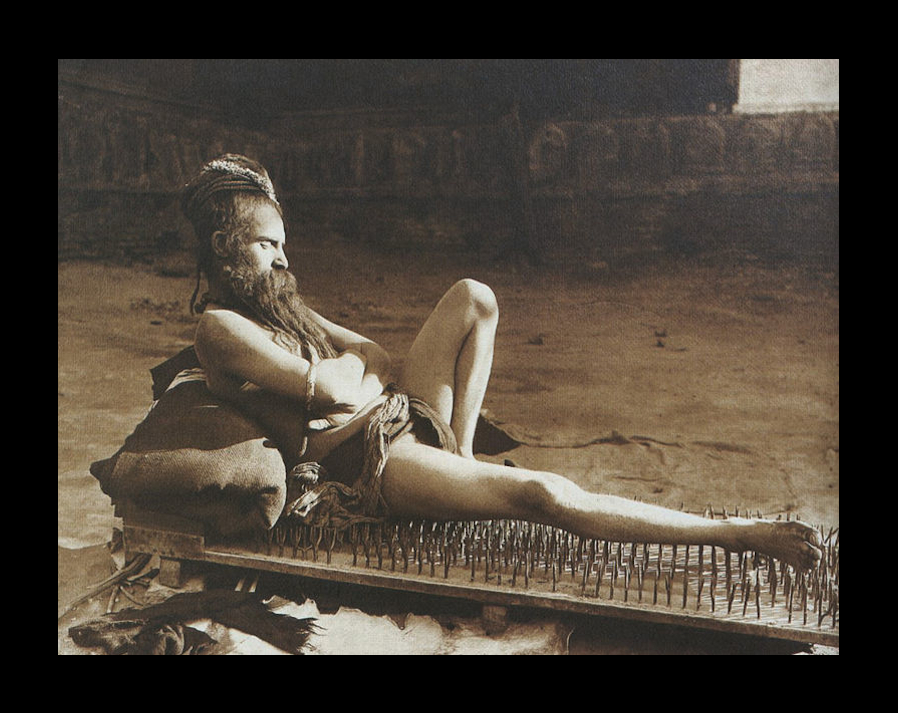
A wandering Hindu ascetic sleeping on a bed of nails in India (petermalakoff.com)
Siddhartha the ascetic realized that self-mortification was not the way to enlightenment or liberation from samsara.
 
But while the Buddha was not pro-asceticism, he did not condemn all ascetic practices. He suggested 13 difficult but practical austerities.
  
This "sane asceticism" can be helpful for individuals wishing to overcome negative tendencies in their character -- such as greediness, grasping, clinginess, attachment, discontentedness, laziness, and so on.
  
Wisely undertaking them  one is able to cultivate contentedness, renunciation (non-clinging to what one has), energy (inspiration for the goal), knowledge-and-vision, and so on.
  
No one need practice all of them, nor necessarily any of them. Moreover, they are contraindicated for "hate" (dosa) types who, not paradoxically, are most willing to undertake them. They will only increase aversion for such individuals rather than balancing and making greed (lobha) more manageable.
  
Under a wise teacher, particularly in a monastic setting, they can be helpful. Some are so useful that they have become set features of Theravada monastic life.

13 Ways of Shaking Off

1. "Using Discarded Cloth" is the sane ascetic practice of utilizing found cloth as material for making robes and sewing it in a patchwork. At the time of the Buddha, such cloth was readily accessible from charnal grounds which people avoided. (It has been suggested that the origin of the words bhikkhu and bhikkhuni, Buddhist "monk" and "nun," may be "rag gatherer").
  
2. "Three Robes" is the practice of using only three robes (upper, lower, and outer) as garments.

Merit is made by sharing and supporting the Sangha. Here parents and neighbors in Laos offer food to young novices (Franco Beccari/flickr.com).
   
3. "Gathering Alms" (pindapata) is the practice of eating only what one collects on alms round, which one shares with others or remains contented even if one gets nothing at all. Monastics are not allowed to beg or ask for food and requisites except under special circumstances. One observing this austerity declines meal invitations and instead offers the bowl to all without distinction who may want to share or give food.
  
4. "Unbiased Alms Gathering" is the practice of not omitting any house on alms round and avoiding returning again and again to the same house where one has received delicious food. In this way one is able to avoid becoming attached, expectant, full of preferences, or greedy for treats.
  
5. "One Eating" is the practice of partaking of one's alms food in one place at one time rather than eating a little in one spot then more in another.
   
6. "Limited Food" is the practice of eating only a certain measured amount of food from one's alms bowl rather than indulging one's appetite and using many dishes.
   
7. "No Food After Time" is the practice of not accepting any extra food after one has started to take one's meal.
   
8. "Dwelling in a Peaceful Place" or forest living is the practice of residing in a peaceful rather than noisy or busy place that distracts one from meditation and contemplative exercises. Peace and quiet and withdrawal (mental and sometimes physical) are needed to develop the stillness needed to potentiate one's insight practices. [See First Stop Then Insight.]
   
9. "Dwelling Under a Tree" is the practice of not dwelling under a roof.
   
10. "Dwelling in a Dewy Place" is the practice of residing neither under a roof nor a tree but in the open simply using one's robes as shelter.
   
11. "Charnal Ground Dwelling" is the practice of residing in a graveyard. Charnal grounds in India are desolate places where corpses are left in the open intact or only partially cremated. Wild animals, hungry ghosts, and frightening spirits may dwell in such places which are rarely frequented by humans. These are ideal places to contemplate foulness.
   
12. "Any Chanced Upon Place" is the practice of accepting any safe place as a bed wherever it happened to be. Buddhists monastics were, after all, wandering ascetics, recluses, hermits who did not tend to settle in one place (except during the Rains Retreat period) so as not to become attached or colloquial but free and open minded travelers.
   
Some monastics stand up (tibetanaltar).
13. "Not Lying Down" is the practice of not laying down to sleep but remaining seated, usually propped against a wall or even in a firm meditation posture. This discourages excess sleepiness as the body and mind (through behavior) becomes accustomed to remaining wakeful.

These are "13 Sane Ascetic Practices" (dhutangas) suggested by the Buddha in special cases.

PPL (Paid Per Lead)


Akhir akhir ini kita sering kali mengejar program program PPL (Paid Per Lead) dari luar, langsung main hajar (promosi) program setiap kali ada program baru yg di buka oleh orang asing… meski tidak jarang programnya berakhir dengan tidak membayar kita, seperti yang sempat beberapa kali saya alami dulu… :(
Namun kali ini sedikit berbeda, saya akan coba merekomendasikan salah satu program PPL LOKAL!buatan salah satu Guru saya (Mas Lutvi Avandi), saya panggil guru karena dulu ketika saya baru mulai belajar internet saya banyak membaca dan belajar dari tulisan tulisan beliau :)
Program yang ingin saya rekomendasikan saat ini adalah CafeBisnis, yang sejujurnya merupakan

Saturday, June 9, 2012

Beauty: Sun protection without toxic Sunscreen

Amber Dorrian, Yogi Seven, Ashley Wells, Wisdom Quarterly
Diet, water, yoga, mood, and melanin all protect the skin (Yoga Coop/Wisdom Quarterly).

   
Lauren Gott writes in response to Sunscreen is toxic! Protect skin with food: What do you recommend for redheads? I am practically a raw foodist (uber healthy), and I just cannot get away without using sunscreen, as well as, covering up with clothing, hats, etc. I use Devita sunscreen from Whole Foods.
   
The reason the skin burns is not because of the Sun. It burns as a result of an interaction between the Sun and bodily acidity. This used to be true, but the Sun we have today is not the Sun we once knew.
   
It used to be enough to alkalize the body; that would keep us from burning. NOTE: alkalizing the stomach is not the same as alkalizing the body.
  
Use PH test strips in the morning on saliva and urine to check how alkaline the body is. The stomach needs to be acidic when eating. It is a lack of stomach acidity that leads to poor digestion. Poor digestion is very acidifying.
  
Sun worshiping ages skin (shareitfitness)
What is mistakenly called "acid stomach" is remedied by proper food combining (the opposite of Food Complementing), taking digestive enzymes not alkalizing agents (mineral tablets like Alka-Seltzer or Tums).
  
The protective ozone layer we once enjoyed between us and the Sun has been attenuated and in some spots completely destroyed. Many more harmful rays are coming through. So it takes more to protect ourselves from the harmful rays of the skin.
(helpfulhealthtips.com)
Everything the sunscreen industry warns about why we need protection is true. But sunscreen does NOT offer the protection we are led to assume. It harms via endocrine disruption, xenoestrogen exposure, and toxic load. Used as directed, one cannot go stand in the Sun. That is not even the claim it makes; yet, that is how we treat it. The ingredients are extremely toxic, carcinogenic, free radical producing, prematurely aging, misleading, and best avoided.
   
For example, nano particle size minerals seep through the skin and do unknown harm. Other ingredients react to sunlight and age us prematurely. Titanium dioxide, a major ingredient in "screens" and "blocks," reacts to sunlight creating destructive free radicals. These astonishing facts are no longer secret. The SPF number is not regulated or overseen by any agency. It is more of a ballpark figure.

What to do instead?
Want flawless beauty? Learn photo retouching.
1. FEED THE SKIN. Make your own sunscreen creams. Use fresh aloe, organic cucumber, hemp oil, genuine Vitamin E, chia seeds. Blend. Keep in glass. Refrigerate. It is super cooling and healthy for the skin. Add color with beta carotene (e.g., carrot juice). Or try prickly pear and raw nopal gel. Real cocoa butter (preferably raw and available at health food stores), shea butter, or unrefined avocado oil are also good to keep moisture in and the skin smooth. Melt cocoa and shea before blending by holding them close to the body. Avoid chlorine, which is aging and drying; use a shower filter.

2. COVER UP. Stay out of direct sunlight, particularly at midday when rays are striking directly. This means wearing simple protection: wide brimmed hats, light colors which are more reflective (and even when sheer tend to provide more "SPF" than toxic ointments).

3. CHILL. Stay relaxed. Even a great diet will have a tough time countering the effects of anger, envy, resentment, distress, worry, and other acidifying conditions. Drink cooling drinks, which means NO added sugar. Sweeten with green stevia or real fruit. There is as much sugar in a glass of processed orange juice as a soda. Eat oranges instead. Eat whole berries of all kinds, fresh or frozen. Drink a gallon of water a day, preferably distilled, to stay hydrated and cleanse toxins. Dr. Leonard Coldwell recommends adding a teaspoon of pink Himalayan salt to remineralize it. Avoid plastic and aluminum containers. Glass and metal are safe.

4. UNTAN. Do not tan. There is generally enough Sun damage occurring to ever go seek it out  in a machine or on the beach. This has become true even in northern climes. The East Coast of the United States gets plenty of Sun earlier in spring and throughout the summer. Due to climate chaos warming is moving up, and plants and animals are slowly migrating north.

Ethnic beauty Barbie (kattisdolls.net)
5. GO GREEN. Eat as many greens as possible. Eat sea vegetables. Every meal should have something green. Food Combining is eating the right foods together. What makes them "right" is that they are able to be digested in the presence of each other. (Food Complementing is completely different and should NOT be practiced. It is the mistaken notion that to make a complete protein one has to eat beans and rice, or nuts and grains, together. These foods cannot be digested together, and one ends up with poor digestion. Eat these foods separately or with greens. Eat fruits alone. Allow at least an hour between foods. Do not drink water or anything alkalizing when eating food. The stomach needs to be strongly acidic. Take digestive enzymes. Make sure the digestive tract has healthy flora (probiotics). Get tested for heavy metal toxins, and chelate them out. Green leafy vegetables can be eaten with everything without disrupting digestion. Avoid acidifying foods, which as a rule of thumb refers to anything white or processed. Real food in its unprocessed state has colors. Although hard and inconvenient for Americans, avoid all animal products (dairy, chemically treated innards such as hot dogs and baloney, eggs, and bloodied carcasses). Take Vitamin D supplements, a hormone we need that could become deficient.

Lauren,
Wisdom Quarterly reader Lauren Gott
You're on the right track. Make sure you make the most of your raw food diet. (Avoid flax seed!) We start craving acidic and fermented foods and overdo protein, which becomes ammonia in the body and leaches out minerals like calcium and potassium and magnesium. Most raw foodists eat too many "processed" foods. Eat close to the Earth, actual raw food not just conveniently packaged chips and what not. There are three things that destroy enzymes, which are the main benefit of raw foods: heat, air, and light. Most raw foodists only concern themselves with heat. And the biggest piece of advice? Use sunscreen that you make yourself. The unbelievable truth is, you shouldn't put anything on your skin that you wouldn't put in your mouth. The skin absorbs straight into the bloodstream better than the digestive tract. Devita is a great company, but would you eat it? Alcohols, nano particles, stearates, stearic acids, PABA, propyl parabens, and other preservatives do greater harm than we are aware. It's radical advice. But redheads are usually radical, fashion forward types who need to do more to retain that delicate and dazzling beauty.

() Sunscreen's toxins cause skin cancer.